Theopolis Logo

Writing

Explore our collection of theological essays, biblical studies, and reflections on faith and culture.

See all
actionvance-t7el2ig3jmc-unsplash
Esther

Genesis 1 and Genesis 8

I mentioned last month ( BH 82) in my essay "Like a Dove" that Genesis 8 is a recapitulation of Genesis 1. Let me explicate that assertion here. Of course, the world after the Flood is a new creation, so we may expect a recapitulation of the first creation. It…

by James B. JordanMarch 28, 1996

ben-white-w8qqn1pmqh0-unsplash
Daniel

Esther: Historical & Chronological Comments (I)

The book of Esther is one of the most neglected of the books of the Bible. To be sure, sermons are preached on it, and commentaries have occasionally been written on it, but almost without exception Esther has been interpreted in isolation from the rest of Biblical history, chronology, and…

by James B. JordanMarch 28, 1996

actionvance-t7el2ig3jmc-unsplash
Biblical Horizons

A Letter on Geocentricity

Dear Mr. ______, . . . Here is how I look at the geocentricity question. Since I don’t recall what I wrote you before, I may be repeating some things. 1. The Bible does not teach it. Biblical passages used to support the idea are being misinterpreted. My original paper…

by James B. JordanMarch 28, 1996

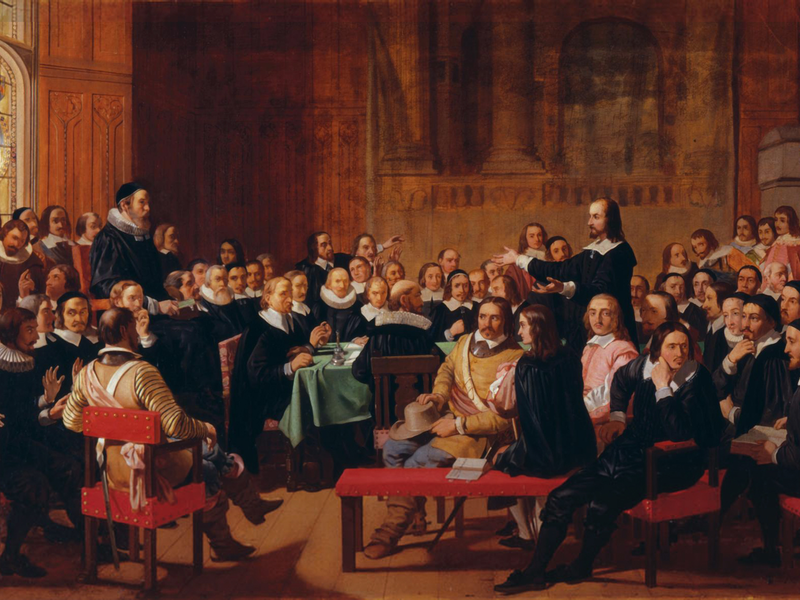
assertion_of_liberty_of_conscience_by_the_independents_of_the_westminster_assembly_of_divines_1644
Biblical Horizons

What is God?

Answer 4 of the Westminster Shorter Catechism is often taken as a magnificent answer to the question, "What is God?" It reads: "God is a Spirit, infinite, eternal, and unchangeable in his being, wisdom, power, holiness, justice, goodness, and truth." Presbyterians are fond of praising this statement, preaching on it,…

by James B. JordanFebruary 28, 1996
screenshot-2023-08-28-at-4-42-36-pm
Baptism

Like a Dove

The gospels tell us that at Jesus’ baptism, the Holy Spirit descended upon Him "in bodily form like a dove" (Luke 3:22 & parallels). Biblically sensitive commentators have associated this event with three Old Testament parallels: (1) the hovering of the Spirit over the creation in Genesis 1:2; (2) the…

by James B. JordanFebruary 28, 1996
tim-wildsmith-gzggi42wggm-unsplash
John

Jesus at Belshazzar’s Feast: Being an Explanatory Disquisition on an Aspect of the Story of the Woman Taken in Adultery

This they said to test him, that they might have some charge to bring against him. Jesus bent down and wrote with his finger on the ground. (John 8:6) The story of the woman taken in adultery (John 7:53-8:11) has been part of the canonical Christian Bible from its earliest…

by James B. JordanFebruary 28, 1996

Showing page 267 of 309

See all
See all
History

What is “Christianization”?

Peter Brown asks this question in the first essay in Authority and the Sacred: Aspects of the Christianisation of the Roman World (Canto original series) and sensibly, following the lead of RA Markus, tries to let early Christians themselves answer. There isn’t a single answer. Early in the fourth century,…

June 12, 2009
History

Polis and Oikos

Milbank often makes this point, but it’s huge: “Likewise the household, the site of productive provision, was not an arena of ‘politics’ and dialectical disputation, but of unquestioned paternal control. The Christian gothic ‘merging’ of oikos and polis , which as Ruskin in particular grasped, opened the question of virtue…

June 11, 2009
History

Against Mediating Institutions

Mediating institutions - those formations and associations that stand between the individual and the state - are essential for freedom, we’re often told. I agree with the aim, but have questions about whether the notion of mediating institutions gets at it. The main objection is that the theory appears to…

June 11, 2009

Benediction

The Aaronic blessing promises the “face” and “countenance” of Yahweh, and places the name of God on the people of God (Numbers 6:27). Psalm 44 explains these words of blessing. Yahweh’s hand drove out nations and planted Israel in the land (v. 2) because He shone the “light of [His]…

June 9, 2009

Libido dominandi

David Potter confirms Augustine’s claim that the foreign wars of Rome were an extension of a lust for domination and honor: Roman “thinking [about the outside world] involved terms such as gloria , the glory that was won in battle, the ability to compel a foreign people to do something.…

June 9, 2009

Early Archaeology

David Stone Potter again: “Homeric archaeology did not begin with Calvert or Schliemann. It was a feature of life in the second and third centuries AD, when ancient monuments were recognized as such and attached to the world of the poems. There is no reason to doubt that the scepter…

June 9, 2009

Showing page 1371 of 2212

Browse by Category

In Medias Res

Your weekly digest for all things Theopolis.

Donate

Theopolis is nearly 100% donor-supported. Consider joining us on our mission.