Theopolis Logo

Writing

Explore our collection of theological essays, biblical studies, and reflections on faith and culture.

See all
actionvance-t7el2ig3jmc-unsplash
Esther

Genesis 1 and Genesis 8

I mentioned last month ( BH 82) in my essay "Like a Dove" that Genesis 8 is a recapitulation of Genesis 1. Let me explicate that assertion here. Of course, the world after the Flood is a new creation, so we may expect a recapitulation of the first creation. It…

by James B. JordanMarch 28, 1996

ben-white-w8qqn1pmqh0-unsplash
Daniel

Esther: Historical & Chronological Comments (I)

The book of Esther is one of the most neglected of the books of the Bible. To be sure, sermons are preached on it, and commentaries have occasionally been written on it, but almost without exception Esther has been interpreted in isolation from the rest of Biblical history, chronology, and…

by James B. JordanMarch 28, 1996

actionvance-t7el2ig3jmc-unsplash
Biblical Horizons

A Letter on Geocentricity

Dear Mr. ______, . . . Here is how I look at the geocentricity question. Since I don’t recall what I wrote you before, I may be repeating some things. 1. The Bible does not teach it. Biblical passages used to support the idea are being misinterpreted. My original paper…

by James B. JordanMarch 28, 1996

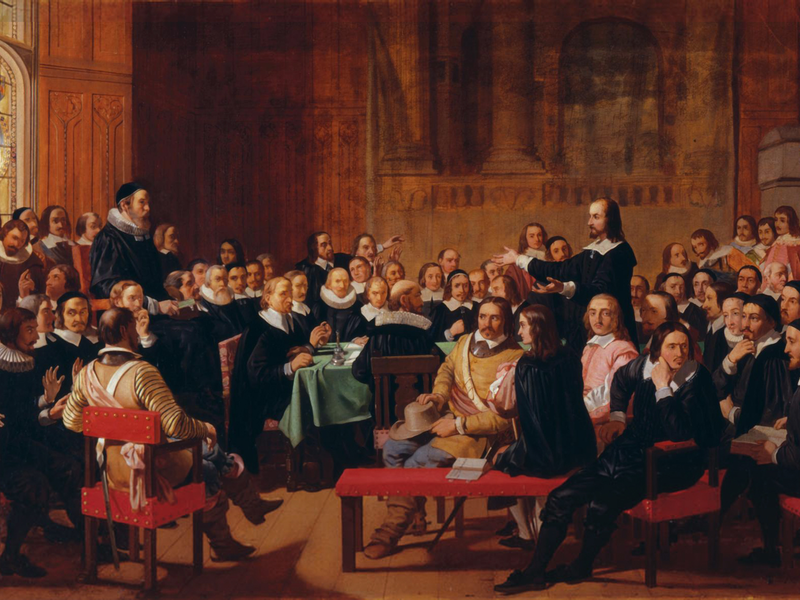
assertion_of_liberty_of_conscience_by_the_independents_of_the_westminster_assembly_of_divines_1644
Biblical Horizons

What is God?

Answer 4 of the Westminster Shorter Catechism is often taken as a magnificent answer to the question, "What is God?" It reads: "God is a Spirit, infinite, eternal, and unchangeable in his being, wisdom, power, holiness, justice, goodness, and truth." Presbyterians are fond of praising this statement, preaching on it,…

by James B. JordanFebruary 28, 1996
screenshot-2023-08-28-at-4-42-36-pm
Baptism

Like a Dove

The gospels tell us that at Jesus’ baptism, the Holy Spirit descended upon Him "in bodily form like a dove" (Luke 3:22 & parallels). Biblically sensitive commentators have associated this event with three Old Testament parallels: (1) the hovering of the Spirit over the creation in Genesis 1:2; (2) the…

by James B. JordanFebruary 28, 1996
tim-wildsmith-gzggi42wggm-unsplash
John

Jesus at Belshazzar’s Feast: Being an Explanatory Disquisition on an Aspect of the Story of the Woman Taken in Adultery

This they said to test him, that they might have some charge to bring against him. Jesus bent down and wrote with his finger on the ground. (John 8:6) The story of the woman taken in adultery (John 7:53-8:11) has been part of the canonical Christian Bible from its earliest…

by James B. JordanFebruary 28, 1996

Showing page 267 of 309

See all
See all
History

Purity and objectivity

Proctor again, summarizing a 1938 article on “Science and the Social Order” from Robert Merton: “the ideal of ‘pure science’ serves a dual function in modern society. On the one hand, the exaltation of pure science represents ‘a defense against the invasion of norms that limit directions of potential advance…

October 28, 2008
History

Revival of purity

Proctor yet again, describing the division of political economy into separate disciplines of sociology and economics in the nineteenth century: “Social theory in the eyes of the young sociologists might strive to become scientific, but to do so it must abandon its craft or practical-political origins and restrict itself to…

October 28, 2008
Philosophy

Artifice and nature

Proctor again, speaking of Renaissance science: “In the science of the moderns, there arises a curious reversal of the order of art and nature. Art becomes the standard against which nature is judged. Francis Bacon’s ‘nature in distress’ - nature distraught by experiment - is as genuine as nature left…

October 28, 2008
Philosophy

Pure knowledge

The drive for purity in knowledge is an ancient one. Robert Proctor ( Value-Free Science? ) sees this impulse in Plato and Aristotle. For the former, knowledge is pure “in the degree to which it makes no appeal to practical arts. Thus Plato criticized Eudoxus, Archytas, and Menaechmus for trying…

October 28, 2008

Anarthrous God

CK Barrett argues in his John commentary that the anarthrous theos of John 1:1 (emphasized by Arians everywhere and at all times) shows that “the Word is God, but is not the only being of whom this is true; if ho theos had been written it would have been implied…

October 28, 2008
Uncategorized

Word came, saying

After Genesis 15, the next time the “word of God came . . . saying” is in Samuel. The word of God comes to Samuel, saying that Saul is rejected (1 Samuel 15:10), and again comes to Nathan to deliver the promise to David (2 Samuel 7:4). The connection of…

October 27, 2008

Showing page 1456 of 2212

Browse by Category

In Medias Res

Your weekly digest for all things Theopolis.

Donate

Theopolis is nearly 100% donor-supported. Consider joining us on our mission.