Theopolis Logo

Writing

Explore our collection of theological essays, biblical studies, and reflections on faith and culture.

See all
actionvance-t7el2ig3jmc-unsplash
Esther

Genesis 1 and Genesis 8

I mentioned last month ( BH 82) in my essay "Like a Dove" that Genesis 8 is a recapitulation of Genesis 1. Let me explicate that assertion here. Of course, the world after the Flood is a new creation, so we may expect a recapitulation of the first creation. It…

by James B. JordanMarch 28, 1996

ben-white-w8qqn1pmqh0-unsplash
Daniel

Esther: Historical & Chronological Comments (I)

The book of Esther is one of the most neglected of the books of the Bible. To be sure, sermons are preached on it, and commentaries have occasionally been written on it, but almost without exception Esther has been interpreted in isolation from the rest of Biblical history, chronology, and…

by James B. JordanMarch 28, 1996

actionvance-t7el2ig3jmc-unsplash
Biblical Horizons

A Letter on Geocentricity

Dear Mr. ______, . . . Here is how I look at the geocentricity question. Since I don’t recall what I wrote you before, I may be repeating some things. 1. The Bible does not teach it. Biblical passages used to support the idea are being misinterpreted. My original paper…

by James B. JordanMarch 28, 1996

assertion_of_liberty_of_conscience_by_the_independents_of_the_westminster_assembly_of_divines_1644
Biblical Horizons

What is God?

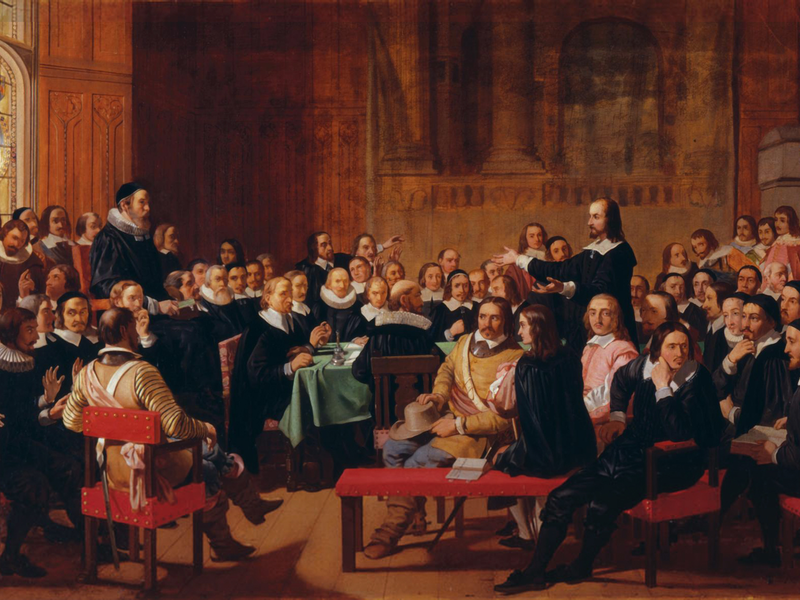
Answer 4 of the Westminster Shorter Catechism is often taken as a magnificent answer to the question, "What is God?" It reads: "God is a Spirit, infinite, eternal, and unchangeable in his being, wisdom, power, holiness, justice, goodness, and truth." Presbyterians are fond of praising this statement, preaching on it,…

by James B. JordanFebruary 28, 1996
screenshot-2023-08-28-at-4-42-36-pm
Baptism

Like a Dove

The gospels tell us that at Jesus’ baptism, the Holy Spirit descended upon Him "in bodily form like a dove" (Luke 3:22 & parallels). Biblically sensitive commentators have associated this event with three Old Testament parallels: (1) the hovering of the Spirit over the creation in Genesis 1:2; (2) the…

by James B. JordanFebruary 28, 1996
tim-wildsmith-gzggi42wggm-unsplash
John

Jesus at Belshazzar’s Feast: Being an Explanatory Disquisition on an Aspect of the Story of the Woman Taken in Adultery

This they said to test him, that they might have some charge to bring against him. Jesus bent down and wrote with his finger on the ground. (John 8:6) The story of the woman taken in adultery (John 7:53-8:11) has been part of the canonical Christian Bible from its earliest…

by James B. JordanFebruary 28, 1996

Showing page 267 of 309

See all
See all

Epicurean indifference revisited

Wes Callihan writes, in response to my brief quotation from Lucretius: “Possibly, however, Lucretius wouldn’t consider the indifferent watcher from the porch outside Pompeii a true Epicurean. Doesn’t the very next line go on to say something about how the pleasure is *not* in the other person’s suffering but in…

October 15, 2008
Philosophy

Direction revelation

Isaiah Berlin’s book on Hamann is lively engaging, but Berlin doesn’t get Hamann. For instance: “Hamann’s constantly repeated point is that revelation is direct contact between one spirit and another, God and ourselves.” Not. The opposite is the case: His constantly repeated point is that God speaks to the creature…

October 15, 2008

Lucretian wisdom

Book 2 of De rerum natura begins with “It is sweet on the great sea to watch from the shore other people drowning.” The words were found on a wall on a house in Pompeii. Perhaps someone sweetly watched from a perch opposite Vesuvius as the lava flow swallowed up…

October 14, 2008

Arian incoherence

Athanasius ties the Arians up in knots with an order-of-decrees argument. If the Son is created for the sake of creating us, then the Son exists for our need rather than we for His sake. That suggests a particular ordering of God’s will: “It is not that God, having the…

October 14, 2008

Speech-act Christology?

Athanasius says that “the words of human beings do not act.” Instead, “it is not by words but by hands that a human being works, for human hands have subsistence while words do not.” Hence, he is willing to adopt Irenaeus’s notion that the Son and Spirit are the two…

October 14, 2008

Creator-creature

Athanasius ( Orations Against the Arians ) writes that “God is not like us.” This is in the context of explaining how the eternal Word differs from the ephemeral words of human beings, and how the divine Word actually does what it says: “the Word of God is not, as…

October 14, 2008

Showing page 1460 of 2212

Browse by Category

In Medias Res

Your weekly digest for all things Theopolis.

Donate

Theopolis is nearly 100% donor-supported. Consider joining us on our mission.