Theopolis Logo

Writing

Explore our collection of theological essays, biblical studies, and reflections on faith and culture.

See all
timothy-eberly-djj49s6ud2o-unsplash
Leviticus

Yahweh's War Against Death

Stories, frankly all human stories are practically always about one thing aren’t they? Death. The inevitability of death. . . . “There is no such thing as a natural death. Nothing that happens to man is ever natural, since his presence calls the whole world into question. All men must…

by Brian MarrApril 14, 2014

screenshot-2023-09-21-at-4-52-42-pm
Matthew

Inescapable Blood

Matthew is organized around 5 discourses, which trace out the history of Jesus as a recapitulation of the history of God and Israel in the Old Testament. Jesus first speaks as a new Moses, instructing His disciples on a mountain about a righteousness that surpasses the righteousness of the scribes…

by Peter LeithartApril 10, 2014
screen-shot-2022-05-12-at-12-07-23-pm
Angels

Did Angels Marry People? The Sin of Cultural Intermarriage

The fall of the Sethites in Genesis 6 is the third fall of mankind, or the third degree of Adam’s original fall. Adam sinned in a Garden against his Father by stealing something he was supposed to wait to obtain. (“Every tree shall be food for you” Genesis 1:29.) Cain…

by James B. JordanApril 7, 2014
sixteen-miles-out-al48tflf4e8-unsplash
Angels

Did Angels Marry People? The Sons of God in Genesis 6

The recent fantasy film Noah and a slightly related blog comment by my friend Douglas Wilson have stirred up again the question of whether the “sons of God” in Genesis 6 who married the “daughters of men” were fallen angels or the priestly line of Seth. Doug argues for angels,…

by James B. JordanApril 4, 2014
kiwihug-l4gw27xzn1i-unsplash
Angels

The Angels of Jude

The prophecy of Jude concerns apostasy. An illustration of apostasy and its consequences is found in verse 6, which the New American Standard Bible translates this way: "And angels who did not keep their own domain, but abandoned their proper abode, He has kept in eternal bonds under darkness for…

by James B. JordanApril 3, 2014
screenshot-2023-09-21-at-4-22-42-pm
Matthew

Women at the Cross

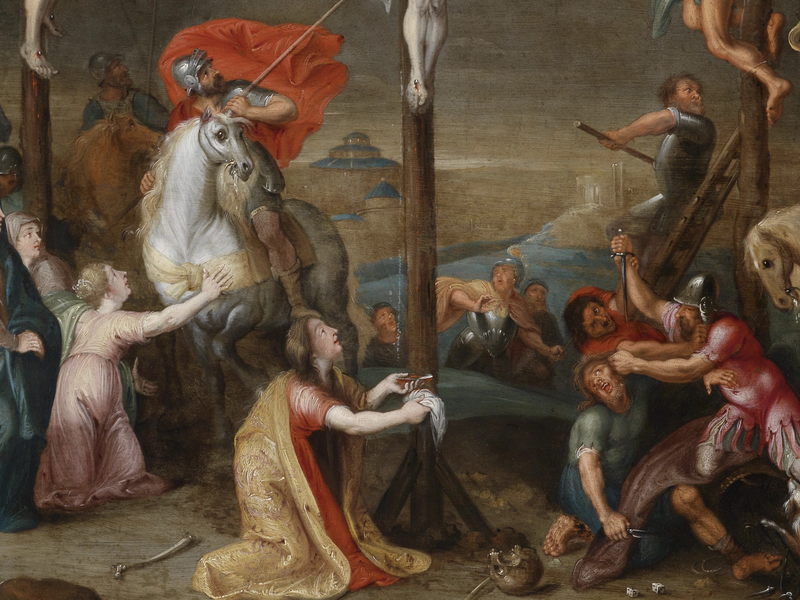
At His death, Jesus is surrounded by a Roman centurion and his cohort of Gentile solders. Matthew doesn't say that any disciples are there. But women are, and so is Joseph of Arimathea, identified as a “disciple” but, as John tells us, a “secret disciple for fear of the Jews,”…

by Peter LeithartMarch 31, 2014

Showing page 176 of 309

See all
See all
Politics

Liberalism, again

Jim Rogers of Texas A&M responds to my posts about liberalism, where I quoted a couple of passages from a recent essay by John Milbank. Rogers writes: “I do think that there is probably a liberal anthropology that can be criticized in a way similar to Milbank. But sometimes I…

October 13, 2008

Ville des expiations

When Jesus tells Peter to forgive “seventy times seven” times, He is only alluding to the climax of God’s dealings with Israel that Daniel prophesied; he is He is also is alluding to Lamech, who threatened to avenge himself “seventy-sevenfold” (Genesis 4:22-23). Lamech was the descendant of Cain. Cain was…

October 12, 2008

Seventy times seven

In the first year of Darius, Daniel was studying the book of Jeremiah’s prophecies when he came upon the prophecy that Israel would be released from captivity after 70 years. The 70th year of exile was coming, and so Daniel began fasting in sackcloth and ashes, and be began confessing…

October 12, 2008
Philosophy

Getting Hamann Wrong

Frederick Beiser’s ( Fate of Reason ) account of Hamann is a mess. He gets the history right (so far as I know it), but his summary of Hamann’s thought is not only mistaken; it’s incoherent. For Hamann, Beiser says, “faith is an immediate experience,” like sense experience, but on…

October 10, 2008
Uncategorized

Outsidelessness

Hamann does believe, as many postmoderns do, that we have no access to reality without language. But for Hamann this does not mean that we suffer “linguistic claustropobia,” or “outsidelessness.” Dickson again: “the fact that perceiving and understanding are inseparable from speaking is commonsensical; one no more need despair over…

October 10, 2008

Honoring the author

Hamann says that the historical-critical method of biblical interpretation does not, despite its apparent attention to the human author, really honor the author. This is because historical-critical interpretation is “castrated,” removing all passion and kerygmatic intention. Dickson writes, “The desires and kerygmatic intentions of the biblical authors are appreciated, and…

October 10, 2008

Showing page 1461 of 2212

Browse by Category

In Medias Res

Your weekly digest for all things Theopolis.

Donate

Theopolis is nearly 100% donor-supported. Consider joining us on our mission.