Theopolis Logo

Writing

Explore our collection of theological essays, biblical studies, and reflections on faith and culture.

See all
actionvance-t7el2ig3jmc-unsplash
Esther

Genesis 1 and Genesis 8

I mentioned last month ( BH 82) in my essay "Like a Dove" that Genesis 8 is a recapitulation of Genesis 1. Let me explicate that assertion here. Of course, the world after the Flood is a new creation, so we may expect a recapitulation of the first creation. It…

by James B. JordanMarch 28, 1996

ben-white-w8qqn1pmqh0-unsplash
Daniel

Esther: Historical & Chronological Comments (I)

The book of Esther is one of the most neglected of the books of the Bible. To be sure, sermons are preached on it, and commentaries have occasionally been written on it, but almost without exception Esther has been interpreted in isolation from the rest of Biblical history, chronology, and…

by James B. JordanMarch 28, 1996

actionvance-t7el2ig3jmc-unsplash
Biblical Horizons

A Letter on Geocentricity

Dear Mr. ______, . . . Here is how I look at the geocentricity question. Since I don’t recall what I wrote you before, I may be repeating some things. 1. The Bible does not teach it. Biblical passages used to support the idea are being misinterpreted. My original paper…

by James B. JordanMarch 28, 1996

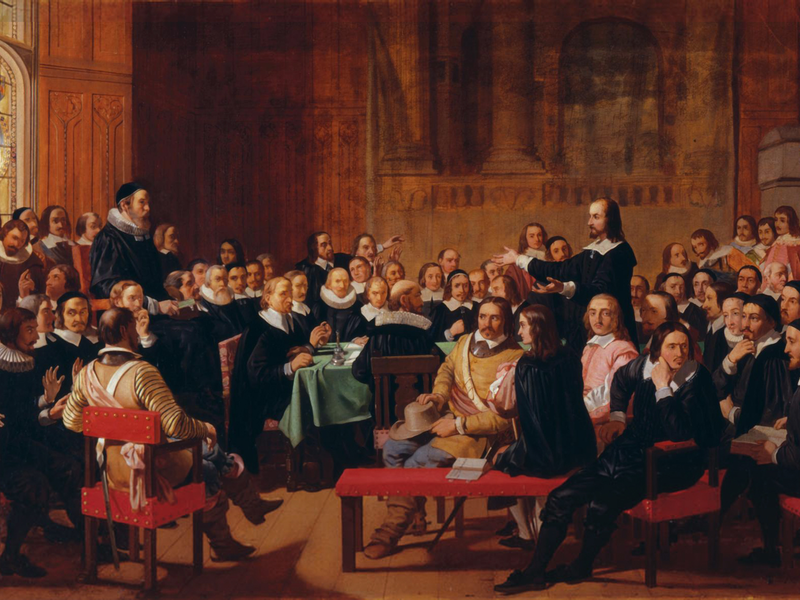
assertion_of_liberty_of_conscience_by_the_independents_of_the_westminster_assembly_of_divines_1644
Biblical Horizons

What is God?

Answer 4 of the Westminster Shorter Catechism is often taken as a magnificent answer to the question, "What is God?" It reads: "God is a Spirit, infinite, eternal, and unchangeable in his being, wisdom, power, holiness, justice, goodness, and truth." Presbyterians are fond of praising this statement, preaching on it,…

by James B. JordanFebruary 28, 1996
screenshot-2023-08-28-at-4-42-36-pm
Baptism

Like a Dove

The gospels tell us that at Jesus’ baptism, the Holy Spirit descended upon Him "in bodily form like a dove" (Luke 3:22 & parallels). Biblically sensitive commentators have associated this event with three Old Testament parallels: (1) the hovering of the Spirit over the creation in Genesis 1:2; (2) the…

by James B. JordanFebruary 28, 1996
tim-wildsmith-gzggi42wggm-unsplash
John

Jesus at Belshazzar’s Feast: Being an Explanatory Disquisition on an Aspect of the Story of the Woman Taken in Adultery

This they said to test him, that they might have some charge to bring against him. Jesus bent down and wrote with his finger on the ground. (John 8:6) The story of the woman taken in adultery (John 7:53-8:11) has been part of the canonical Christian Bible from its earliest…

by James B. JordanFebruary 28, 1996

Showing page 267 of 309

See all
See all
Literature

Conrad and empire

William Deresiewicz has an excellent review of a new biography of Joseph Conrad in the June 11 issue of TNR . One thread of the review has to do with Conrad’s phantasmagorical vision of European imperialism and his related concern for the moral dangers of isolation from well-known social habits…

June 5, 2008

Meaning and Significance

In an effort to maintain his distinction of meaning and significance, interpretation and critical assessment, E. D. Hirsch examines Welleck’s treatment of Marvell’s phrase “vegetable love.” He notes that “Welleck could not even make his point unless he could distinguish between what ‘vegetable’ probably means as used in the text…

June 4, 2008

Saussure and semantics

Tallis yet again: He argues that confusion of langue and parole : leads to “conflation of the idea of a world as a value or set of values within the system with the meaning of a word used on a particular occasion, that by virtue of which verbal meaning is…

June 4, 2008

Differance and words

Tallis thinks that one of the basic confusions of post-Saussurean criticism is a confusion of the levels of parole and langue . Signifiers and signifieds are, for Saussure, purely differential; but words are not signifiers or signifieds, but types of signs, which are combinations of the two. Signifier and signified…

June 4, 2008

Language and reality

Does language take cues from reality? Tallis says Yes; at least, that’s one kind of relation language has to reality. His charming evidence: He notes that it’s more common to add “barking” to “dog” than to add other verbs. If language doesn’t take its cues from reality, “we must surely…

June 4, 2008

Spatial and Linguistic “Edges”

Tallis contests the post-structuralist notion that all distinctions are linguistic, imported to reality by what we say about them. This, he thinks, oversimplifies a more complex situation. For some realities, the “edges” are determined by language, because those realities depend on classifications that we have brought to the real world.…

June 4, 2008

Showing page 1508 of 2212

Browse by Category

In Medias Res

Your weekly digest for all things Theopolis.

Donate

Theopolis is nearly 100% donor-supported. Consider joining us on our mission.