Theopolis Logo

Writing

Explore our collection of theological essays, biblical studies, and reflections on faith and culture.

See all
screen-shot-2022-08-04-at-9-36-57-am
John

How Jesus Saved the World, Part 1

We are too used to reading the Gospels’ stories of Jesus’ arrest, trial, condemnation, and death from a devotional perspective and so we miss a lot of what’s going on. We actually have a difficult time trying to figure out the meaning of the details of the story. Of course,…

by Jeff MeyersFebruary 21, 2013
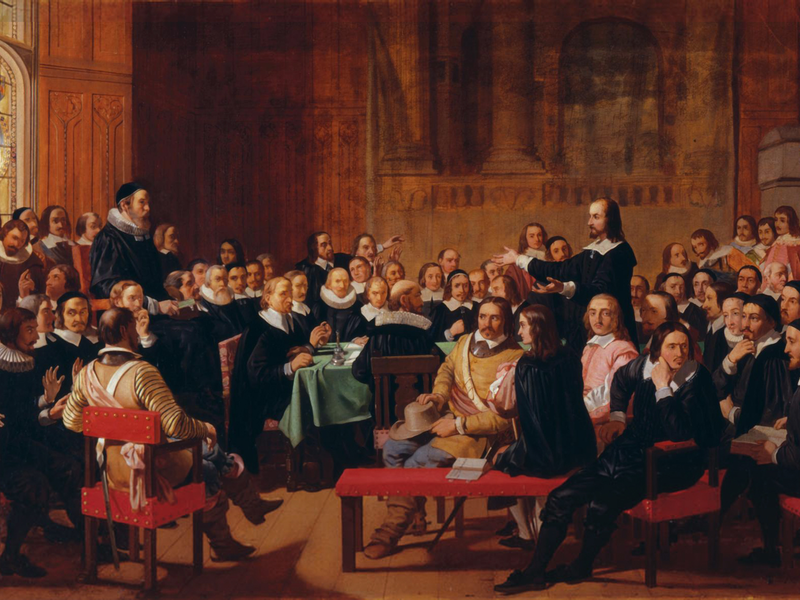
assertion_of_liberty_of_conscience_by_the_independents_of_the_westminster_assembly_of_divines_1644
Protestantism

The Forgotten Reformation?

This is the first in a series of essays on "Continuing the Reformation." Many different churches descend from the original Protestant Reformation, and those that are the most conservative are often insistent that they are largely if not completely true to the Reformation, or to the branch from which they…

by James B. JordanFebruary 19, 2013
markus-winkler-aid-xyrtlec-unsplash
Theopolis News

Reading the Bible

Trinity House fellow James B. Jordan will be teaching a one-day seminar on "How to Read the Bible for the First Time . . . Again" next Friday, February 22, in North London. The event is sponsored by Emmanuel Evangelical Church, Southgate, costs 20 pounds (10 for theology students) and…

by Peter LeithartFebruary 16, 2013
chris-leboutillier-be8mnfxzbgo-unsplash
Church Calendar

A Primer on Ash Wednesday

Audio Reading of this Post https://theopolis-blogcast.simplecast.com/episodes/a-primer-on-ash-wednesday What is Ash Wednesday? Ash Wednesday is the first day of Lent, a season focused on the sufferings and cross of Jesus. But Jesus’ death on the cross cannot be separated from the cross we are called to bear in union with him, so…

by Rich LuskFebruary 13, 2013
aaron-burden-qjdzyt_k8xg-unsplash
Theopolis News

Welcome

Welcome to the Trinity House web site. It’s unfinished, as you’ll soon discover, but it’s more finished than it was, and for that we are very grateful. Thanks to David Dalbey for the design, and to my son Sheffield for the execution. Trinity House exists to advance the reformation of…

by Peter LeithartFebruary 13, 2013
screen-shot-2022-05-12-at-12-07-23-pm
Biblical Horizons

More on the “Regeneration” Business

In our I hope brief blog-versation, Doug Wilson has posted a couple more things to think about. In one he asks who our father/Father is. We either have God or the devil as our father. Well, yes and no. I’m with Doug in what he’s getting at, I think, but…

by James B. JordanJune 23, 2012

Showing page 199 of 309

See all
See all
Uncategorized

1 & 2 Kings

Uriah Y Kim reviews my Kings commentary in a recent issue of Reviews in Religion and Theology . He’s got some criticisms, but overall it’s a fair review. A couple of responses on specific points: 1) He thinks my contention that there is a “seventh-king” pattern is suspect; my counting…

October 22, 2007
History

Patronage

Richard Saller defines patronage by three features (summarized by Griffin): “(1) it involves the reciprocal exchange of goods and services; (2) that it is a personal relationship of some duration; (3) that it is asymmetrical, in the sense that the two parties are of unequal status and offer different kinds…

October 22, 2007

Gratitude in ancient thought

Griffin begins her essay: “The exchange of beneficia - gifts and services - was an important feature of Greek and Roman society at all periods. Its prominence was reflected in the number of philosophical works that analyzed the phenomenon. From the fourth century B.C. onwards, euergesia and charis became subjects…

October 22, 2007
History

Seneca and Roman Society

Miriam Griffin has a richly detailed discussion of Seneca’s de Beneficiis in a 2003 issue of The Journal of Roman Studies . The article discusses the appropriateness of “patronage system” as a description of Roman social relations, Seneca’s use of exaggeration for moral effect, the and similarities between Seneca and…

October 22, 2007
History

Pointy Greeks

Seneca found Chrysippus’s treatment of the Three Graces too subtle: He was a great man but “a Greek, whose intellect, too sharply pointed, is often bent and turned back upon itself; even when it seems to be in earnest it only pricks, but does not pierce.” Seneca himself found in…

October 22, 2007
Philosophy

Kant on Ingratitude

In his Lectures on Ethics, Kant says that ingratitude is among the vices that “are the essence of vileness and wickedness.” He adds, “It is inhuman to hate and persecute one from whom we have reaped a benefit, and if such conduct were the rule it would cause untold harm.…

October 22, 2007

Showing page 1617 of 2212

Browse by Category

In Medias Res

Your weekly digest for all things Theopolis.

Donate

Theopolis is nearly 100% donor-supported. Consider joining us on our mission.