Theopolis Logo

Writing

Explore our collection of theological essays, biblical studies, and reflections on faith and culture.

See all
actionvance-t7el2ig3jmc-unsplash
Esther

Genesis 1 and Genesis 8

I mentioned last month ( BH 82) in my essay "Like a Dove" that Genesis 8 is a recapitulation of Genesis 1. Let me explicate that assertion here. Of course, the world after the Flood is a new creation, so we may expect a recapitulation of the first creation. It…

by James B. JordanMarch 28, 1996

ben-white-w8qqn1pmqh0-unsplash
Daniel

Esther: Historical & Chronological Comments (I)

The book of Esther is one of the most neglected of the books of the Bible. To be sure, sermons are preached on it, and commentaries have occasionally been written on it, but almost without exception Esther has been interpreted in isolation from the rest of Biblical history, chronology, and…

by James B. JordanMarch 28, 1996

actionvance-t7el2ig3jmc-unsplash
Biblical Horizons

A Letter on Geocentricity

Dear Mr. ______, . . . Here is how I look at the geocentricity question. Since I don’t recall what I wrote you before, I may be repeating some things. 1. The Bible does not teach it. Biblical passages used to support the idea are being misinterpreted. My original paper…

by James B. JordanMarch 28, 1996

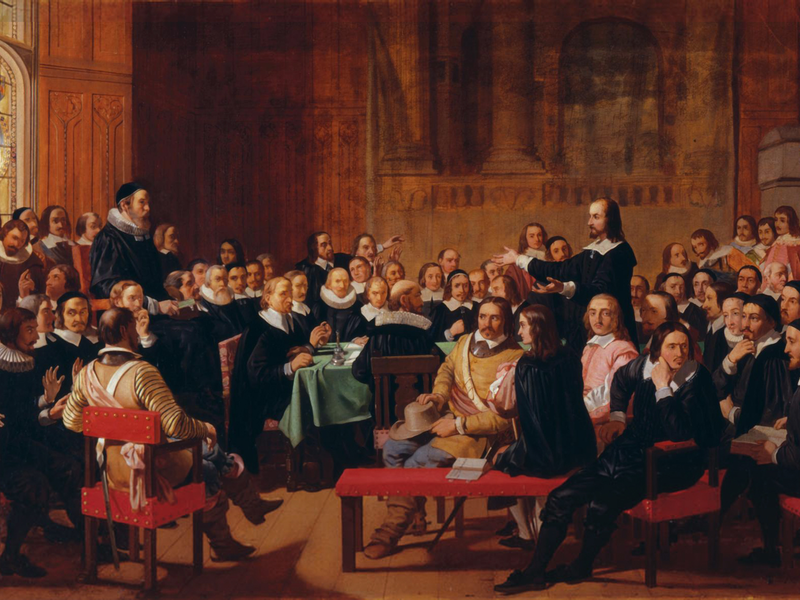
assertion_of_liberty_of_conscience_by_the_independents_of_the_westminster_assembly_of_divines_1644
Biblical Horizons

What is God?

Answer 4 of the Westminster Shorter Catechism is often taken as a magnificent answer to the question, "What is God?" It reads: "God is a Spirit, infinite, eternal, and unchangeable in his being, wisdom, power, holiness, justice, goodness, and truth." Presbyterians are fond of praising this statement, preaching on it,…

by James B. JordanFebruary 28, 1996
screenshot-2023-08-28-at-4-42-36-pm
Baptism

Like a Dove

The gospels tell us that at Jesus’ baptism, the Holy Spirit descended upon Him "in bodily form like a dove" (Luke 3:22 & parallels). Biblically sensitive commentators have associated this event with three Old Testament parallels: (1) the hovering of the Spirit over the creation in Genesis 1:2; (2) the…

by James B. JordanFebruary 28, 1996
tim-wildsmith-gzggi42wggm-unsplash
John

Jesus at Belshazzar’s Feast: Being an Explanatory Disquisition on an Aspect of the Story of the Woman Taken in Adultery

This they said to test him, that they might have some charge to bring against him. Jesus bent down and wrote with his finger on the ground. (John 8:6) The story of the woman taken in adultery (John 7:53-8:11) has been part of the canonical Christian Bible from its earliest…

by James B. JordanFebruary 28, 1996

Showing page 267 of 309

See all
See all

Exhortation

Most of the Beatitudes in Matthew are stated in third person. “Blessed are the poor in spirit, for theirs is the kingdom of heaven.” ” They shall be comforted,” ” they shall inherit the earth,” ” they shall be called the sons of God.” At the end, Jesus changes the…

September 2, 2007
Theology

Music, Time, and Augustine

One of the best discussions of Augustine’s views on time comes from Jeremy Begbie’s Theology, Music, and Time (ch. 3). Following Ricoeur’s discussion, Begbie claims that Augustine’s distentio “is conceived as the three-fold present, and the threefold present as distentio . The distentio consists in the non-coincidence of the mind’s…

August 30, 2007
Theology

Escaping time

John Rist offers some important insights into Augustine’s view of time. He notes, as many commentators do, that Augustine is not aiming to provide a definition of time but to answer the question of how time can be measured. The dilemma is: If the past no longer is, and the…

August 30, 2007

Distention and eschatology

In a 1957 essay in Man and Time , Gilles Quispel claims that Augustine’s views of time have been extracted from the “great struggle between a cyclical and a historical view of the world, between archaism and Christianity,” and therefore have been misunderstood. Augustine “comes to grips with the Neoplatonists…

August 30, 2007
Philosophy

Augustine’s non-Aristotelian Universe

Augustine argues in Confessions that time is not reducible to the movement of the celestial bodies. Aristotle agreed; but, as Ricoeur points out, the arguments that Augustine used departed radically from Aristotle. First, if the sun and stars stopped moving, and yet a potter’s wheel continued to move, time would…

August 30, 2007

Showing page 1638 of 2212

Browse by Category

In Medias Res

Your weekly digest for all things Theopolis.

Donate

Theopolis is nearly 100% donor-supported. Consider joining us on our mission.