Theopolis Logo

Writing

Explore our collection of theological essays, biblical studies, and reflections on faith and culture.

See all
ascension-rembrandt
Ascension

Ascension and Eucharist

It’s a simple point, obviously biblical and creedal: Jesus of Nazareth ascended into heaven as the God-man, and He remains the God-man in all his specific particularity from now to the end. He is Jesus the Christ, the same yesterday, today, and forever. Duh! But Douglas Farrow shows in his…

by Peter LeithartMay 27, 2013

markus-winkler-aid-xyrtlec-unsplash
Theopolis News

Register for Trinity Term Class

You can now register for the very first Trinity House intensive class, "How to Read the Bible," taught by James Jordan and Peter Leithart. There will be a kick-off welcome for students on the evening of Sunday, August 25, and the class will be held at Trinity Presbyterian Church ,…

by Peter LeithartMay 22, 2013
chris-bair-ndczc5739ck-unsplash
Deuteronomy

Deuteronomy as Narrative-Law

This series of essays will address the food laws in Deuteronomy 14:1-21. To some, this may seem like a work of supererogation. After all, why should a Christian be interested in outdated “laws” from the book of Deuteronomy? I hope to show that meditation on this portion of Scripture is…

by Ralph Allan SmithMay 20, 2013
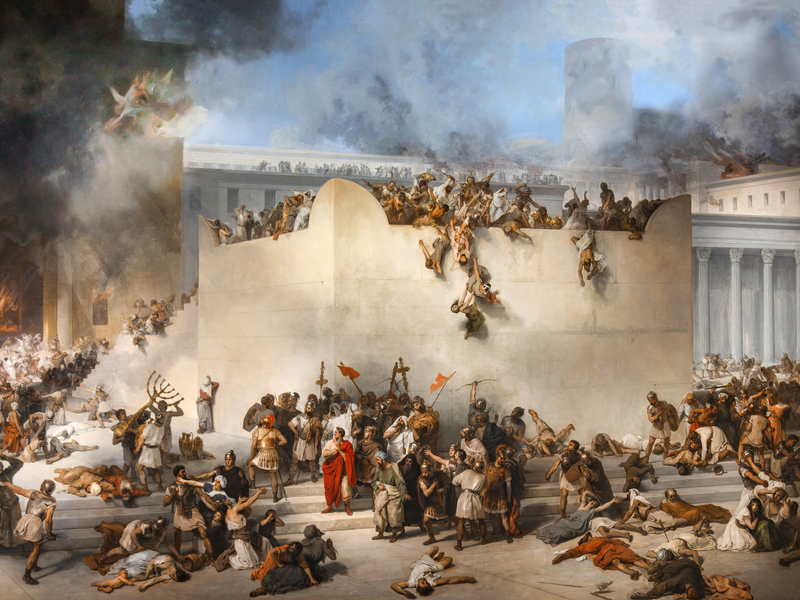
venice-la-distruzione-del-tempio-di-gerusalemme-francesco-hayez-gallerie-accademia-venice
Isaiah

Apocalyptic Patience

This essay was first published in 2011 in Credenda/Agenda . Isaiah 24 begins the section of Isaiah known as the “little apocalypse.” It’s a good name for this chapter. It’s a text of terror. The world is coming apart at the seams. The earth is emptied; and not only that,…

by Peter LeithartMay 15, 2013
sixteen-miles-out-al48tflf4e8-unsplash
Biblical Studies

Anti Anti-Supercessionism

This article was first published in 2010 in Credenda/Agenda . In recent years, mainstream theology has begun to recognize the disaster that followed from the Marcionism of classical liberalism. R. Kendall Soulen is a leading figure in efforts to restore the importance of the Old Testament to Christian theology. In…

by Peter LeithartMay 13, 2013
skyler-gerald-akljfvj5ym4-unsplash
Deuteronomy

Law and History: How to Read the Law of Moses

This is the last in a series of studies on Deuteronomy 22:30-23:8. In this series, I have offered an interpretation of Deuteronomy 22:30-23:8 which suggests that a simple surface reading of the text does not do justice to Moses’ or God’s intention, that the larger historical and legal context in…

by Ralph Allan SmithMay 8, 2013

Showing page 194 of 309

See all
See all
History

Revolutionary timing

Are we living in a time of world-revolutionary change? Impossible to say, of course, but there might be some hints contained in the developments of the last millennium. Rosenstock-Huessy notes that Western man has been formed by periodic world-historical revolutions since the 11th century: Gregorian (11th), the Reformation (16th), Puritan…

December 29, 2006
History

One world

William Cavanaugh suggests that globalization represents a false catholicity, a unification of the human race organized around consumption and Hollywood blockbusters. That’s certainly one legitimate angle. On the other hand: The wealth of the wicked is stored up for the righteous, and Cain and Nimrod built cities long before David…

December 29, 2006
History

Fallen Soldiers

George L. Mosse’s Fallen Soldiers (Oxford 1990) is a fascinating study of the “Myth of War Experience” that developed between the French Revolution and came to a climax in World War I and its aftermath. Mosse develops a number of intertwined themes: the rise of volunteer armies after the French…

December 29, 2006

Childbirth

Rosenstock-Huessy notes the difference between animal birth and human childbirth, the main difference being that human parents remain with children after the birth: “marriage means to go from the blind act of the moment, through the whole life cycle to its most opposite point the childbirth,” and this shows “that…

December 29, 2006
History

Naming and nationalism

With nationalism at its height in the nineteenth century, the common practice of giving children biblical names was a check on nationalist idolatry, a reminder that the child was part of Christendom, not merely of France, Germany, England, etc. Rosenstock-Huessy puts the point dramatically: “When biblical names disappeared in Europe…

December 29, 2006
Science

Scientific law

In their Science & Grace (Crossway 2006), Tim Morris and Don Petcher helpfully define a law of nature as “God’s sustaining of, or man’s description of, that pattern of regularity that we observe in nature as God works out His purposes towards His own ends in HIs covenant faithfulness, through…

December 28, 2006

Showing page 1746 of 2212

Browse by Category

In Medias Res

Your weekly digest for all things Theopolis.

Donate

Theopolis is nearly 100% donor-supported. Consider joining us on our mission.