Theopolis Logo

Writing

Explore our collection of theological essays, biblical studies, and reflections on faith and culture.

See all
johann-siemens-epy0gbjzzzu-unsplash
Apologetics

A Sabbath Conversation: How Old is the Earth?

As Adam and Eve walked to the center of the Garden of Eden to meet with the LORD on their first Sabbath they conversed about the origin and age of the earth. Adam: You know, honey, we spent a lot of time yesterday making preparations for our house, and we…

by Jeff MeyersOctober 3, 1997

img_1043
Biblical Horizons

Psalms for Exile: The Narrative Progression in the Fifth Book of the Psalter

Some of our forefathers believed in reading/singing the psalms in order. Today, when the psalms are even used at all, they tend to be used randomly, though sometimes tied to a church calendar or to the pastor’s sermon. The Bible does not bind us to any particular practice, but there…

by James B. JordanSeptember 4, 1997
jordan-wozniak-xp_agmeea6s-unsplash-2
Biblical Chronology

The Anthropomorphic Days of C. John Collins, Part 2

Dr. Collins begins his essay with a brief statement of the Day Age view and then a brief statement of the Six Day view, focussing on the challenge to that view posed by modern "science." He ends this discussion by writing: "Two crucial points are at stake here: first, the…

by James B. JordanSeptember 4, 1997
john-salzarulo-wtjrpjzabcq-unsplash
Biblical Horizons

Paperweights and the Puzzles of Secularism

In his The Construction of Social Reality , Berkeley philosopher John Searle puzzles over the ontology of the products of human construction. Certain things – granite, platypi, weeping willows – occur naturally; while other realities – stone walls, zoos and parks, Chase Manhattan Bank – exist only as products of…

by Peter LeithartAugust 27, 1997
ales-krivec-4mibe6zg5r0-unsplash
Biblical Chronology

The Anthropomorphic Days of C. John Collins, Part 1

In the journal Presbyterion 20 (1994):109-130, published by Covenant Theological Seminary, Dr. C. John Collins sets forth a revision of the Day Age approach in his essay, "How Old Is the Earth? Anthropomorphic Days in Genesis 1:1–2:3." Dr. Collins’s essay has been widely accepted in evangelical Presbyterian circles as an…

by James B. JordanAugust 4, 1997
screenshot-2023-09-04-at-10-37-01-am
Biblical Horizons

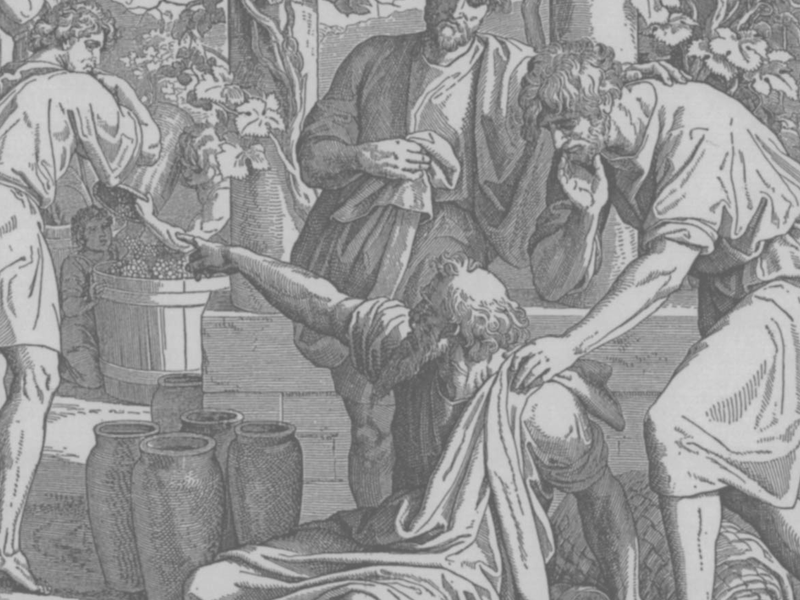
The Sin of Ham and the Curse of Canaan, Part 3 (An Exposition of Genesis 9:20-27)

The Righteousness of Shem and Japheth As noted above, the action of Shem and Japheth was purely symbolic. They did not need to cover Noah with a garment, for he was already covered by the tent. Their action was a symbolic affirmation of Noah’s authority, a symbolic rejection of Ham’s…

by James B. JordanAugust 4, 1997

Showing page 254 of 309

See all
See all

Mediated fellowship

1 John 1:1-3 describes how those who never saw, heard, or handled the incarnate word of life can come to have fellowship with the Father through Jesus. First, the apostles (“we”) witnessed the Word in flesh directly. Second, they proclaim that testimony. Third, through believing their testimony, we come to…

December 3, 2005

Feast of Booths

John Kleinig suggests that Luke’s account of the Transfiguration alludes to the feast of booths: Luke “alone of the Gospel writers relates that the transfiguration occurred on the eighth day after Peter’s confession of faith (Lk 9:28). The transfiguration was the epiphany of Jesus as God’s Son. It showed Peter,…

December 1, 2005
History

Modern heroism

Zygmunt Bauman, in the book mentioned above, traces the shifts in Western cultural imagination from the ancient hero through the Christian martyr, to the revival of the ancient heroic ideal in the early modern period, to our current cult of celebrity. According to Bauman, the modern hero was born “or…

November 29, 2005
History

Conservator

An etymology of “conservative” from the online Dictionary of the History of Ideas (http://etext.lib.virginia.edu/DicHist/dict.html): In Latin conservare means to protect, preserve, save; the noun of agency, conservator, appears as a synonym for the substantives custos, servator. Just as the Greek S?ter (“Savior”) was adopted from the religious realm by the…

November 29, 2005
History

Modern sacralization

Still on Bauman: “In most of its descriptions, modernity is presented as a time of secularization (‘everything sacred was profaned,’ as young Marx and Engels memorably put it) and disenchantment. What is less often mentioned, however, though it should be, is that modernity also deified and enchanted the ‘nation,’ the…

November 29, 2005
History

Desire and resistance

More on Bauman, since that last post was getting too long: Consumerism, we (especially Christians) tend to think, is driven by desire; if so, perhaps the solution is to limit or suppress desire. Bauman points out that the goal of consumer economies is to render desires irrelevant to consumption. Desires…

November 29, 2005

Showing page 1918 of 2212

Browse by Category

In Medias Res

Your weekly digest for all things Theopolis.

Donate

Theopolis is nearly 100% donor-supported. Consider joining us on our mission.