
Theopolis Logo

Writing

Explore our collection of theological essays, biblical studies, and reflections on faith and culture.

See all
jonathan-borba-lgj3qbhoqui-unsplash
Art

Toward a Biblical Definition of Obscenity

My copy of Webster’s New Collegiate Dictionary (1976: not so new, really) defines obscene as (1) "disgusting to the senses; repulsive" and (2) "abhorrent to morality or virtue; specif: designed to incite lust or depravity." Definitions such as this serve a useful purpose only when there is agreement on what…

by Peter LeithartMay 30, 1991
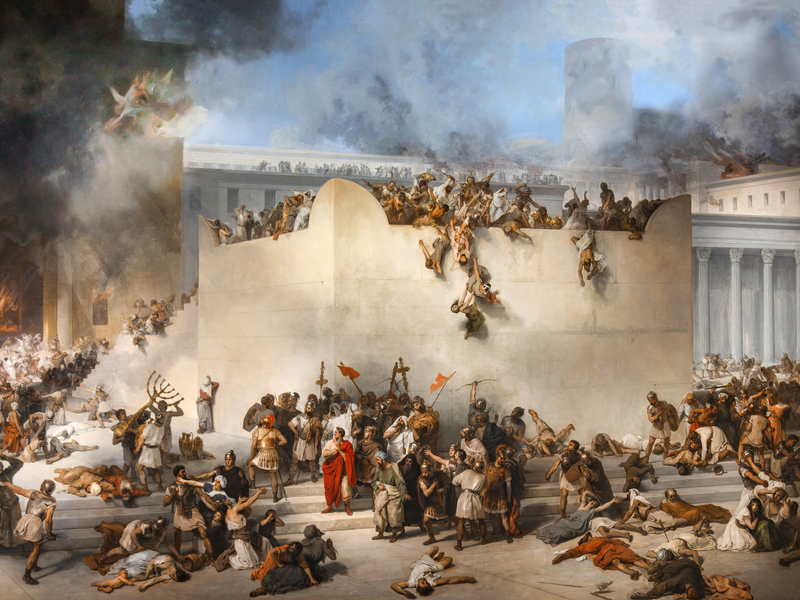
venice-la-distruzione-del-tempio-di-gerusalemme-francesco-hayez-gallerie-accademia-venice
Biblical Studies

The Abomination of Desolation, Part 1

An Overview Here begins a series of studies in the Abomination of Desolation, or Desolating Sacrilege. This month and next I shall set out an overview of what I regard as the best interpretation of the phenomenon. Later essays will look at it in more detail. (The original form of…

by James B. JordanMay 22, 1991
49980-nicolas_poussin_-_the_judgment_of_solomon_-_wga18330-800w-tn
Biblical Studies

Advice From a Sojourner, Part 12

29. There are three things that are stately in their march, Even four that are stately when they walk: 30. The lion is mighty among beasts And does not turn back before any, 31. The strutting cock, The male goat, And a king with his army around him. 32. If…

by James B. JordanMay 22, 1991
tanner-mardis-xuxghzhibn4-unsplash-1-2
Biblical Studies

The Chronology of Ezra & Nehemiah, Part 4

We have seen that it is likely that the Artaxerxes of Ezra-Nehemiah is the same as Darius the Great. If this solution be correct, and I think it is, possibly there is another problem in Ezra that can be resolved by it. In Ezra 4:6 we are told that "in…

by James B. JordanMay 22, 1991
giammarco-zeh-ljawhtg-unsplash
Biblical Horizons

The Weight of Being

Czech novelist Milan Kundera, though hardly a household name in the English-speaking world, has achieved a certain notoriety in America in recent years, largely on the strength of the English translation and film version of his novel, The Unbearable Lightness of Being. 1 The Unbearable Lightness of Being — the…

by Peter LeithartMay 6, 1991
49980-nicolas_poussin_-_the_judgment_of_solomon_-_wga18330-800w-tn
Proverbs

Advice From a Sojourner, Part 11

24. Four things are small on the earth, But they are exceedingly wise; 25. The ants are not a strong folk, But they prepare their food in the summer; 26. The coneys are not a mighty folk, Yet they make their houses in the rocks; 27. The locusts have no…

by James B. JordanApril 22, 1991

Showing page 297 of 309

See all
See all
Literature

Ibsen

Ibsen, Steiner argues, did not write tragedies. Ibsen wrote “dramatic rhetoric” calling society to reform. For real tragedy, there is no such “solution” to be found, there is no remedy, except destructive sacrifice and perhaps a deus ex machina. From this angle, tragedy is perhaps among the STOICHEIA that prepared…

January 7, 2004
Literature

More Quotations from Steiner

Some more quotations from Steiner’s Death of Tragedy : “We cannot understand the romantic movement if we do not perceive at the heart of it the impulse toward drama . . . . The romantic mode is neither an ordering nor a criticism of life; it is a dramatization. And…

January 7, 2004
Theology

NT Wright’s Rutherford House Lecture

Some thoughts on NT Wright’s Rutherford House Lecture, August 2003. I have little disagreement with much of the lecture, and it clarified a number of things for me. Wright’s views on justification, however, continue to puzzle me at a number of points. Here’s an attempt to clarify my (or NTW’s)…

January 7, 2004
Theology

NT Wright’s Rutherford House Lecture

Some thoughts on NT Wright’s Rutherford House Lecture, August 2003. I have little disagreement with much of the lecture, and it clarified a number of things for me. Wright’s views on justification, however, continue to puzzle me at a number of points. Here’s an attempt to clarify my (or NTW’s)…

January 7, 2004
Literature

European Drama

Steiner notes that, following the Renaissance, European drama operated under the shadows of neo-classical and Elizabethan dramatic practice, the former “closed” and rigidly adhering to Aristotelian criteria, the other open and experimental. He discusses the theory of Thomas Rymer (a neo-classicist) at some length, concluding that the controversies that Rymer…

January 6, 2004
Literature

Shakespearean Difference

George Steiner in his Death of Tragedy describes the “Shakespearean difference” as mainly due to Shakespeare’s avoidance of fascination with Hellenic models: “The neo-classic view [which rigidified Aristotelian conceptions of tragedy] expresses a growing perception of the miracle of Greek drama. This perception was fragmentary. There were few translations of…

January 6, 2004

Showing page 2141 of 2212

Browse by Category

In Medias Res

Your weekly digest for all things Theopolis.

Donate

Theopolis is nearly 100% donor-supported. Consider joining us on our mission.