Theopolis Logo

Writing

Explore our collection of theological essays, biblical studies, and reflections on faith and culture.

See all
kristina-flour-bcjdbykwquw-unsplash
Culture

On Foul Language

The Stranger: Do you have to use so many cuss words? The Dude: What the f*ck you talking about? - The Big Lebowski There was a man I knew, an elder at his church, who, whenever he was called upon to announce a pregnancy, preferred the euphemism “with child” because…

by Remy WilkinsJanuary 12, 2016

organ-pipes
How to Worship

Pipes Worth Playing

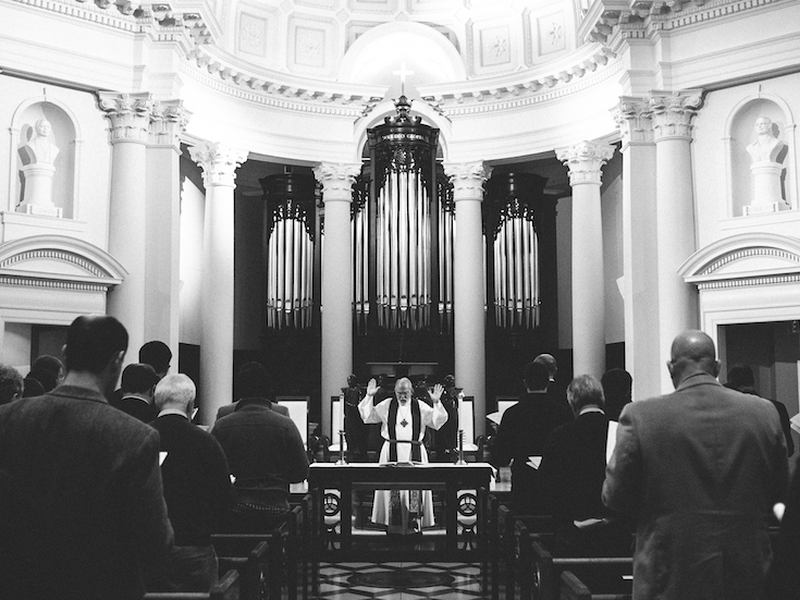
I know what you’re thinking. Organ: funeral, ball game, grand dusty cathedral. Why should modern Christians of such a technological age revisit a thousand year-old instrument? Don’t worry, I will not be trying to punch another hole in my Weird Music Preferences and Opinions card here. The truth is, our…

by Jarrod RicheyJanuary 7, 2016
tree-2
James

Do Things Have Natures?

Do things have natures? As I am posing the question, it is not simply a question of whether there are particular kinds of things in the world that have characteristic features, patterns of behavior, trajectories of growth and development. If that is what the word means, then the answer is…

by Peter LeithartJanuary 5, 2016
jim-leading-worship
Theopolis News

2016 Nevin Lectures with Father John Behr

We are excited to announce our 2016 Nevin Lectures featuring Father John Behr. Fr. John is the Dean of St. Vladimir's Seminary and Professor of Patristics, as well as the author of multiple works. He will be delivering three lectures over the course of two days dealing with "What Protestants…

by Brian MoatsJanuary 4, 2016
times-square
Creation

Time, Curse or Gift?

New Year's Day makes one reflective, at least about the past year, perhaps about life, perhaps, more broadly, about time itself. Many view time as a curse. Some see it as a curse because of missed chances. As one day or year moves on to the next, all we can…

by Peter LeithartDecember 31, 2015
nativity-2
Advent

The Manger

It seems a truism to say that we live in the world: that the world is outside of us. In reality the world is very much inside of us too. In fact the world passes through us as much as we pass through it. We breathe in its air, using…

by Arthur KayDecember 29, 2015

Showing page 138 of 309

See all
See all
Uncategorized

Civilizing Process

In a 1983 article in Past & Present , Lawrence Stone presented evidence that showed a precipitous drop in the homicide rate in England from the 14th to the 20th century. Why? Stone thinks that Elias’s Civilizing Process had something to do with it: “Yves Castan has shown with great…

March 30, 2013
Uncategorized

Critique of Violence

Critchley ( Philosophy and the Return of Violence: Studies from this Widening Gyre , 64- 8) gives a lucid analysis of Walter Benjamin’s “Critique of Violence” (in Reflections: Essays, Aphorisms, Autobiographical Writings ), organized around Benjamin’s distinctions between law-making and law-preserving violence, between political and the general strike, and between…

March 30, 2013
Uncategorized

Zizek’s dreams

In his essay in Philosophy and the Return of Violence: Studies from this Widening Gyre , Simon Critchley describes Zizek’s Barlebyan politics in Shakespearean terms: “Zizek is, I think, a Slovenian Hamlet.” He “dreams of a divine violence, a cataclysmic, purifying violence of the sovereign ethical deed,” but is left…

March 30, 2013
Politics

Shades of Grey

At the end of his massively documented The Shadow World: Inside the Global Arms Trade , Andrew Feinstein notes the blurring of lines between formal and informal arms markets, the black and the white markets that merge into gray: “While the large defence contractors like BAE and Lockheed Martin -…

March 29, 2013
Uncategorized

Permanent War Economy

Back in 1944, Walter Oakes predicted Marxianly that late capitalism would naturally develop a “permanent war economy.” Defining a war economy as one where “the government’s expenditures for war . . . become a legitimate and significant end-purpose of economic activity.” Capitalism, Oakes claimed, seeks equilibrium that reduces unemployment and…

March 29, 2013
Politics

Not Bees

Some political theorists have thought that we can live like bees - sociable without command, law, speech, punishments. Hobbes demurs ( Hobbes: Leviathan , II.17). And not because we are superior to bees. We can’t live like bees because we are “continually in competition for honour and Dignity” and thus…

March 29, 2013

Showing page 763 of 2212

Browse by Category

In Medias Res

Your weekly digest for all things Theopolis.

Donate

Theopolis is nearly 100% donor-supported. Consider joining us on our mission.