Theopolis Logo

Writing

Explore our collection of theological essays, biblical studies, and reflections on faith and culture.

See all
aaron-burden-h8s0pf2rcqs-unsplash
Galatians

The Restoration of the Galatians

While controversies over the writings of Paul continue in various corners of the intellectual globe, the word of God given through Paul and his scribe and all of the church’s interpreters and translators over the last two millennia is still readily available to the lofty and the lowly. Paul, as…

by Grace LangnessMarch 25, 2013

kiwihug-l4gw27xzn1i-unsplash
Deuteronomy

Law and History: How to Read the Law of Moses (Part 2)

The second in a series of studies in Deuteronomy. Deuteronomy 22:30: A man shall not take his father’s wife, and shall not uncover his father’s wing (Hebrew: kanaf ). There are a number of unusual features in this law that mark it out from the previous context, indicating that it…

by Ralph Allan SmithMarch 20, 2013
200403-moss-pilate-tease_pncfq5
History

Victimhood and the Gospel

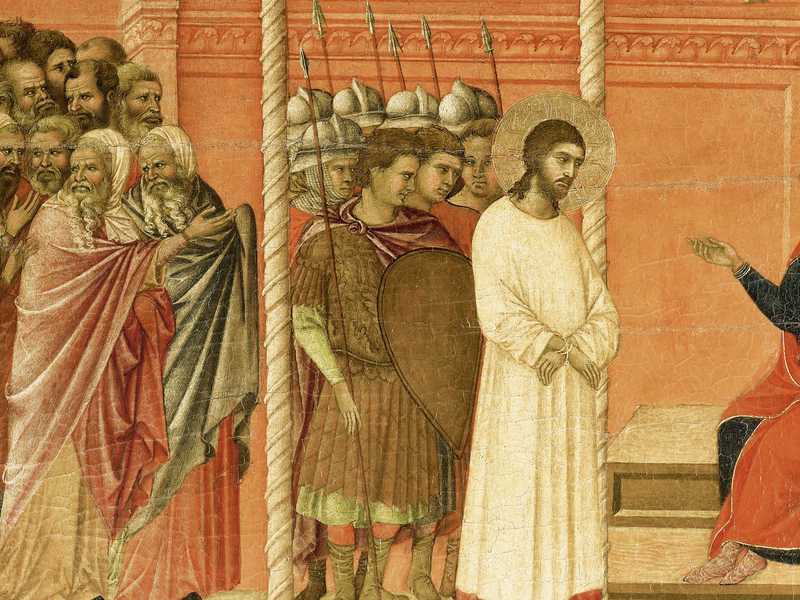
The texts of Christianity have been slowly at work, under the power of the Holy Spirit for 2000 years now. If we could be magically transported back into the world of two millennia ago, modern Americans would be shocked at the cruelty of that world. There was no concern for…

by Richard BledsoeMarch 18, 2013
aaron-burden-1ebsmyrau-s-unsplash
Luke

The Dysfunctional Family of the Gadarene Madman

The Story of the Gadarene Madman is told in all three synoptic Gospels (Matthew 8:28-34, Mark 5:1-20, Luke 8:26-37). Jesus ventures into a Gentile area when He passes over the Sea of Galilee. Upon disembarking from his boat, he is immediately met by a demon-possessed madman. Upon meeting Jesus, he…

by Richard BledsoeMarch 13, 2013
aaron-burden-1ebsmyrau-s-unsplash
Deuteronomy

Law and History: How to Read the Law of Moses

Part 1 of a multi-part series of studies on Deuteronomy 22:30-23:8. Eric Auerbach, in his classic work on Western literature, devotes his first chapter to contrasting Homer with the Bible. Of Homer, he writes of the “need of Homeric style to leave nothing which it mentions half in darkness and…

by Ralph Allan SmithMarch 12, 2013
markus-winkler-aid-xyrtlec-unsplash
Theopolis News

James Jordan in Korea, Japan

Trinity House Fellow James B. Jordan will be a speaker at an International Conference on Biblical Symbolism that will be held in Seoul on Monday, May 27 in 2013. He will address "The Importance of Biblical Symbolism and Symbolic Interpretation of the Bible." The conference will have three other speakers…

by Peter LeithartMarch 9, 2013

Showing page 197 of 309

See all
See all
Science

Science, Hope, Censorship

John Gray ( Straw Dogs: Thoughts on Humans and Other Animals , 19) argues that “Among us, science serves two needs: for hope and censorship.” It feeds hope because science is the only institution where progress is evident: “The political projects of the twentieth century have failed, or achieved much…

January 22, 2013

Superstitious liberalism

The bracing premise of John Gray’s Straw Dogs: Thoughts on Humans and Other Animals (xi-xii) is that liberal humanism is grounded in a “superstition” that is “further from the truth about the human animal than any of the world’s religions.” That superstition is a belief in progress, which outside of…

January 22, 2013
History

Puritans and Anglicans

In his 1976 study of Godly Man in Stuart England: Anglicans, Puritans and the Two Tables, 1620-70 (Historical Publications) , J. Sears McGee uses the law’s “two tables” to distinguish Anglicans from Puritans. Puritans were men of the “first table,” Anglicans of the second. Both worked with the same “palette…

January 22, 2013

The Gift of Guilt

Visser ( Beyond Fate (Massey Lectures) (CBC Massey Lecture) , 43-4) makes the commonplace observation that Christianity dislodged the honor-shame patterns of the ancient world and replaced it with a sin-guilt nexus. Unlike many, Visser views this as a tremendous gain, even a liberation: “In recognizing wrongdoing as sin, we…

January 22, 2013
History

A place at the table

In her Beyond Fate (Massey Lectures) (CBC Massey Lecture ) (15-16) , the always-stimulating Margaret Visser describes the cultural achievement of making a “place” at table. For us Westerners, “Each diner sits on an upright, separate chair drawn up to a table on which is laid his or her ‘place.’…

January 22, 2013
History

Greeks and others

In the twelfth book his Christian Topography , the sixth-century Italian known as Cosmas the Indian Navigator tries to show that biblical history is consistent with the best records of ancient pagans. “Best” means not -Greek. It’s a highly inaccurate, charming, amusing passage: “But the Chaldaeans and the Medes and…

January 21, 2013

Showing page 811 of 2212

Browse by Category

In Medias Res

Your weekly digest for all things Theopolis.

Donate

Theopolis is nearly 100% donor-supported. Consider joining us on our mission.