Theopolis Logo

Writing

Explore our collection of theological essays, biblical studies, and reflections on faith and culture.

See all
screen-shot-2022-08-04-at-9-36-57-am
John

How Jesus Saved the World, Part 1

We are too used to reading the Gospels’ stories of Jesus’ arrest, trial, condemnation, and death from a devotional perspective and so we miss a lot of what’s going on. We actually have a difficult time trying to figure out the meaning of the details of the story. Of course,…

by Jeff MeyersFebruary 21, 2013
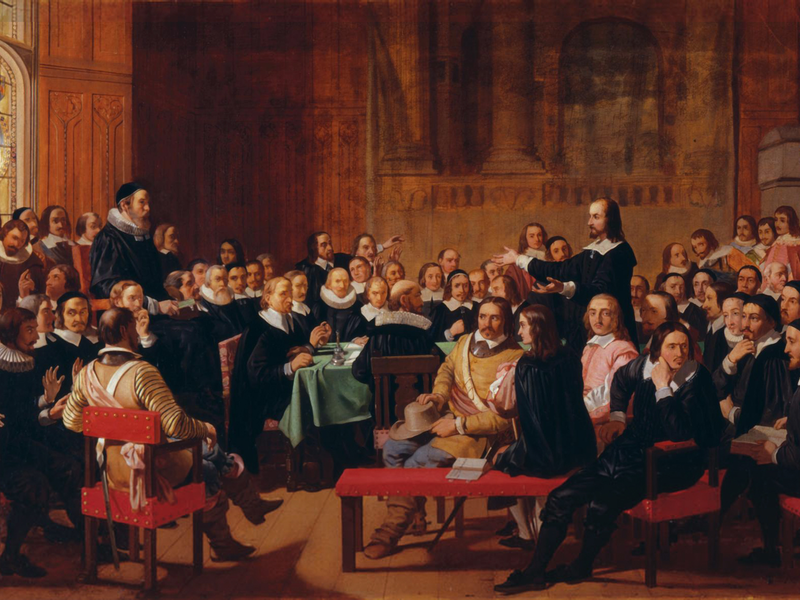
assertion_of_liberty_of_conscience_by_the_independents_of_the_westminster_assembly_of_divines_1644
Protestantism

The Forgotten Reformation?

This is the first in a series of essays on "Continuing the Reformation." Many different churches descend from the original Protestant Reformation, and those that are the most conservative are often insistent that they are largely if not completely true to the Reformation, or to the branch from which they…

by James B. JordanFebruary 19, 2013
markus-winkler-aid-xyrtlec-unsplash
Theopolis News

Reading the Bible

Trinity House fellow James B. Jordan will be teaching a one-day seminar on "How to Read the Bible for the First Time . . . Again" next Friday, February 22, in North London. The event is sponsored by Emmanuel Evangelical Church, Southgate, costs 20 pounds (10 for theology students) and…

by Peter LeithartFebruary 16, 2013
chris-leboutillier-be8mnfxzbgo-unsplash
Church Calendar

A Primer on Ash Wednesday

Audio Reading of this Post https://theopolis-blogcast.simplecast.com/episodes/a-primer-on-ash-wednesday What is Ash Wednesday? Ash Wednesday is the first day of Lent, a season focused on the sufferings and cross of Jesus. But Jesus’ death on the cross cannot be separated from the cross we are called to bear in union with him, so…

by Rich LuskFebruary 13, 2013
aaron-burden-qjdzyt_k8xg-unsplash
Theopolis News

Welcome

Welcome to the Trinity House web site. It’s unfinished, as you’ll soon discover, but it’s more finished than it was, and for that we are very grateful. Thanks to David Dalbey for the design, and to my son Sheffield for the execution. Trinity House exists to advance the reformation of…

by Peter LeithartFebruary 13, 2013
screen-shot-2022-05-12-at-12-07-23-pm
Biblical Horizons

More on the “Regeneration” Business

In our I hope brief blog-versation, Doug Wilson has posted a couple more things to think about. In one he asks who our father/Father is. We either have God or the devil as our father. Well, yes and no. I’m with Doug in what he’s getting at, I think, but…

by James B. JordanJune 23, 2012

Showing page 199 of 309

See all

Showing page 22 of 43

See all
History

Modernity and antiquity

Kumar suggests that “some of the principal hall-marks of modernity” are already evident in the Christian notions of time and history. Both Christianity and modernity separate time from nature, and humanize time; time is seen by both as “linear and irreversible”; both see history as an Aristotelian drama with beginning,…

February 24, 2006
History

First Modernity

The Latin modernus was coined in the late fifth century, as an antonym to antiquus , and variations of modernus became particularly common after the 10th century. Thus, Krishan Kumar writes, “Modernity is . . . an invention of the Christian Middle Ages,” and was used to emphasize the radical…

February 24, 2006
Philosophy

Computer Communications and the Self

Poster lists four effects that computer communications (email, chat groups, etc) have on the self: “1 they introduce new possibilities for playing with identities; 2 they degender communications by removing gender cues; 3 they destabilize existing hierarchies in relationships and re-hierarchize communications according to criterio that were previously irrelevant; and…

February 24, 2006
Philosophy

Computers, subjects and objects

Descartes famously contrasted the mind (res cogitans) with the external world (res extensa), but Mark Poster suggests that computer writing fudges that distinction: “the computer dematerializes the written trace. As inputs are made to the computer through the keyboard, pixels of phosphor are illuminated on the screen, pixels that are…

February 24, 2006
Media

Community and New Communications

Mark Poster points to a tension between the modern institutions of production and the postmodern technologies of communication, particularly as they impact the formation of the self: “If modernity or the mode of production signifies patterned practices that elicit identities as autonomous and (instrumentally) rational, postmodernity or the mode of…

February 24, 2006
Media

Telephone

Prior to World War I, Telefon Hirmondo, the telephone system of Budapest, was used as a broadcast system, with a published schedule of programs that were restricted to certain classes of people in Hungary. Only later did it develop into a communications system in which everyone could pass information to…

February 24, 2006

Showing page 1878 of 2212

Browse by Category

In Medias Res

Your weekly digest for all things Theopolis.

Donate

Theopolis is nearly 100% donor-supported. Consider joining us on our mission.