Theopolis Logo

Writing

Explore our collection of theological essays, biblical studies, and reflections on faith and culture.

See all
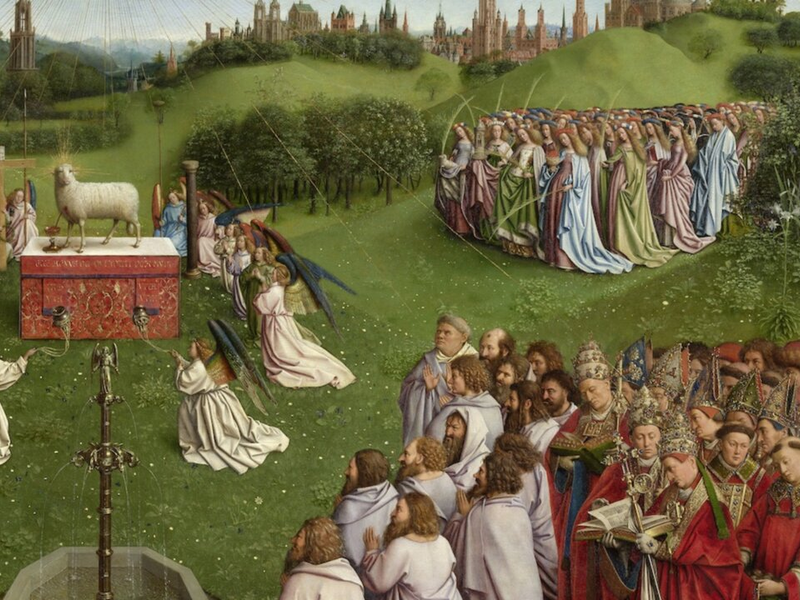
20_van-eyck_bavo-altar_adoration-of-the-lamb-copy-67f4f94b
Culture

An Introduction to the Sacred Music of Josquin

This essay is adapted from my articles in Theopolis’s In Medias Res as a series of Holy Week meditations. Like many celebrities such as Kanye or Beyoncé or Adele, Josquin des Prez (d. 1521) was often known only by his first name, in his own time as now. “Josquin” is…

by John AhernJuly 29, 2025
screenshot-2025-07-22-at-11-57-58-am
Numbers

Sight and Memory: Examining the Monuments of Numbers

Sight is a major theme in the scriptures. The church has long identified sight’s relationship to the future fulfillment of the eschaton. As Paul says, “For now we see only a reflection as in a mirror; then we shall see face to face” (1 Cor 13.12). Sight is associated with…

by Matthew DarbyJuly 22, 2025
tengyart-aaz5-as3io-unsplash
Biblical Theology

Yahweh’s Flame: the Gospel through Symbolism

What is the chief end of man? —yes, to glorify God and enjoy him forever. But how ought man–and all creation–so glorify him? I propose a Theopolitan addition to the catechism, question and answer number 1.5, begun in the last question and answered as follows: Earth’s inhabitants were created to…

by Ben LoveladyJuly 16, 2025
screenshot-2025-07-08-at-8-31-22-am
Culture

Morality and the Practice of Poetry

Naphtali is a hind let loose: he giveth goodly words. Genesis 49:21 Frederick Buechner once said, “We move into the extraordinary by way of the ordinary.” In poetry, this happens by way of a compressed code of analogs; often, two or more very ordinary things begin to reveal something that…

by Garrett SoucyJuly 8, 2025
screenshot-2025-07-03-at-9-26-50-am
Ephesians

The Trinitarian Structure of Obedience

The evangelical milieu of America has often lost a vision of the fruit of repentance. We tend to simplify repentance by asking for forgiveness. After all, Jesus tells Peter to forgive 70 times 7. This verse must be paired with Paul’s scoffing at the question: why not sin more so…

by Matthew CoreyJuly 3, 2025
33255drsdl
Luke

The Hemorrhaging Woman, the Eucharist, and the Sermon

I. The hemorrhaging woman. En route to Jairus’ house, Jesus is touched by a woman with a hemorrhage of blood (Matt 9:18–26; Mk 5:21–34; Lk 8:40–48). The story is one that many of us know very well. She has been yoked to her illness for twelve years, all of her…

by Mark BriansJuly 1, 2025

Showing page 7 of 309

See all

Showing page 28 of 43

See all
Literature

Living in fictions

In a discussion of King Lear , David Bevington suggests that Edgar saves his father at the cliffs of Dover by constructing a cosmology in which the gods are merciful and perform miracles: “Edgar stages his fiction in this particular way because he knows his father well enough to realize…

December 27, 2006
Literature

Tyranny of gratitude

Many of Shakespeare’s plays explore the moral and political consequences of ingratitude, but Shakespeare is also cognizant of the tyrannical uses to which the demand for gratitude may be put. Lear is certainly about ingratitude, the “marble-hearted fiend” that infects and distorts the monsters of ingratitude Goneril and Regan, as…

December 27, 2006
Theology

In praise of Pietism

Friedrich Oetinger was a leading German pietist intellectual and theologian, deeply interested in the science of his day. And critical of science and rationalist philosophy as well. Against thinkers who placed a primacy on reason, Oetinger argued that sheer logical clarity is insufficient “for living knowledge.” Living knowledge takes form…

December 26, 2006

Communion in humor

I tell a joke, and you get it. I include a veiled allusion to, say, Faust in a casual conversation; you catch it; and we exchange a mental wink. Humor provides a pathway into the hermeneutics of texts and communication. It also seems to provide a pathway into the sociology…

December 26, 2006

Keeping in mind

Gadamer notes the ambiguity of “keeping something in mind.” We sometimes hold something in our mental “gaze” in order to knock into it head on. We watch it carefully until we can grab it. But keeping in mind can also be a form of forgetfulness. We might also keep something…

December 26, 2006
History

Mysticism and culture

Gadamer notes that the concept of Bildung (culture) has its origins in medieval and baroque mysticism, and continues to carry a mystical connotation when it begins to be used of the cultivated humanness. Von Humboldt, for instance, says “when in our language we say Bildung, we mean something both higher…

December 26, 2006

Showing page 1747 of 2212

Browse by Category

In Medias Res

Your weekly digest for all things Theopolis.

Donate

Theopolis is nearly 100% donor-supported. Consider joining us on our mission.