Theopolis Logo

Writing

Explore our collection of theological essays, biblical studies, and reflections on faith and culture.

See all
actionvance-t7el2ig3jmc-unsplash
Esther

Genesis 1 and Genesis 8

I mentioned last month ( BH 82) in my essay "Like a Dove" that Genesis 8 is a recapitulation of Genesis 1. Let me explicate that assertion here. Of course, the world after the Flood is a new creation, so we may expect a recapitulation of the first creation. It…

by James B. JordanMarch 28, 1996

ben-white-w8qqn1pmqh0-unsplash
Daniel

Esther: Historical & Chronological Comments (I)

The book of Esther is one of the most neglected of the books of the Bible. To be sure, sermons are preached on it, and commentaries have occasionally been written on it, but almost without exception Esther has been interpreted in isolation from the rest of Biblical history, chronology, and…

by James B. JordanMarch 28, 1996

actionvance-t7el2ig3jmc-unsplash
Biblical Horizons

A Letter on Geocentricity

Dear Mr. ______, . . . Here is how I look at the geocentricity question. Since I don’t recall what I wrote you before, I may be repeating some things. 1. The Bible does not teach it. Biblical passages used to support the idea are being misinterpreted. My original paper…

by James B. JordanMarch 28, 1996

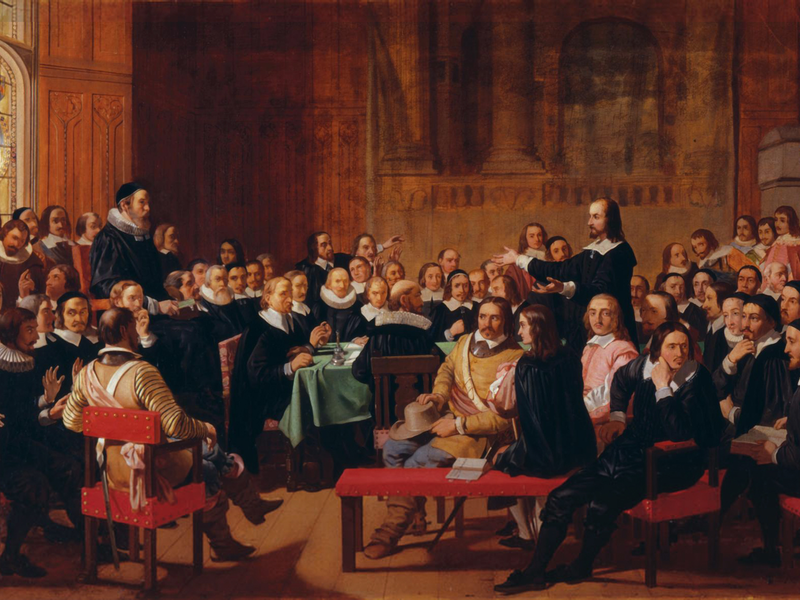
assertion_of_liberty_of_conscience_by_the_independents_of_the_westminster_assembly_of_divines_1644
Biblical Horizons

What is God?

Answer 4 of the Westminster Shorter Catechism is often taken as a magnificent answer to the question, "What is God?" It reads: "God is a Spirit, infinite, eternal, and unchangeable in his being, wisdom, power, holiness, justice, goodness, and truth." Presbyterians are fond of praising this statement, preaching on it,…

by James B. JordanFebruary 28, 1996
screenshot-2023-08-28-at-4-42-36-pm
Baptism

Like a Dove

The gospels tell us that at Jesus’ baptism, the Holy Spirit descended upon Him "in bodily form like a dove" (Luke 3:22 & parallels). Biblically sensitive commentators have associated this event with three Old Testament parallels: (1) the hovering of the Spirit over the creation in Genesis 1:2; (2) the…

by James B. JordanFebruary 28, 1996
tim-wildsmith-gzggi42wggm-unsplash
John

Jesus at Belshazzar’s Feast: Being an Explanatory Disquisition on an Aspect of the Story of the Woman Taken in Adultery

This they said to test him, that they might have some charge to bring against him. Jesus bent down and wrote with his finger on the ground. (John 8:6) The story of the woman taken in adultery (John 7:53-8:11) has been part of the canonical Christian Bible from its earliest…

by James B. JordanFebruary 28, 1996

Showing page 267 of 309

See all

Showing page 28 of 43

See all
Philosophy

Descartes’s Double Self

In his history of modern Western views of the self ( The Idea of the Self , Cambridge 2005), Jerrold Seigel offers what he believes is a fresh interpretation of the implications Descartes’s cogito . He asks, Who is the subject, the “I,” implied by the cogito and the sum…

August 12, 2006
Philosophy

Descartes’s Double Self

In his history of modern Western views of the self ( The Idea of the Self , Cambridge 2005), Jerrold Seigel offers what he believes is a fresh interpretation of the implications Descartes’s cogito . He asks, Who is the subject, the “I,” implied by the cogito and the sum…

August 12, 2006
History

Reaching back

Bruce Holsinger shows that “postmodern” theory reaches back beyond the modern period to find resources for anti-modern critique in the medieval world. Early modern thinkers made a similar move: Stephen McKnight notes (in a Mars Hill Audio interview) that early modern scientists like Francis Bacons claimed to be recovering an…

August 12, 2006
History

Descartes’s ambitions

Descartes’s original title for Discourse on Method was “Project for a Science that Can Raise our Nature to its Highest Degree of Perfection.” And for a number of years he worked on a treatise in which he “resolved to explain all the phenomena of nature, that is all of physics”…

August 12, 2006
History

Descartes’s ambitions

Descartes’s original title for Discourse on Method was “Project for a Science that Can Raise our Nature to its Highest Degree of Perfection.” And for a number of years he worked on a treatise in which he “resolved to explain all the phenomena of nature, that is all of physics”…

August 12, 2006
Theology

Not Quite Postmodern

In his very fine, lucid book, Who’s Afraid of Postmodernism? (Baker 2006), James KA Smith notes that many postmodern theologies, especially influenced by Derrida’s apophaticism, are anti-dogmatic: “postmodern religious faith eschews knowledge and therefore also eschews the particularity of dogma and doctrine. In other words, according to this line of…

August 11, 2006

Showing page 1813 of 2212

Browse by Category

In Medias Res

Your weekly digest for all things Theopolis.

Donate

Theopolis is nearly 100% donor-supported. Consider joining us on our mission.