Theopolis Logo

Writing

Explore our collection of theological essays, biblical studies, and reflections on faith and culture.

See all
tonik-haz3tnzqp6w-unsplash
Anxiety

Viral Anxiety Requires Infectious Wisdom

At the time I write this, many in the United States are under some kind of “lock-down” order. But, thanks to the internet, people are still able to communicate with each other. And people have differing opinions on which medical or scientific projection about our current pandemic is most likely…

by Mark HorneApril 21, 2020

screen-shot-2020-04-14-at-8-53-04-am
Gospels

Shall We Receive Good From God, But Not Calamity?

So Jesus came again to Cana in Galilee, where he had made the water wine. And at Capernaum there was an official whose son was ill. When this man heard that Jesus had come from Judea to Galilee, he went to him and asked him to come down and heal…

by Jeff MeyersApril 14, 2020
morgan-vander-hart-s-m2pamjcvg-unsplash
Family

A Family Liturgy

Throughout the world, pastors and leaders are making sometimes excruciating decisions about whether or not to hold public worship services during the coronavirus pandemic and, if so, how. We at Theopolis encourage you to find creative, safe, reasonable, and submissive ways to meet in person with other believers. For many,…

by Peter LeithartApril 8, 2020
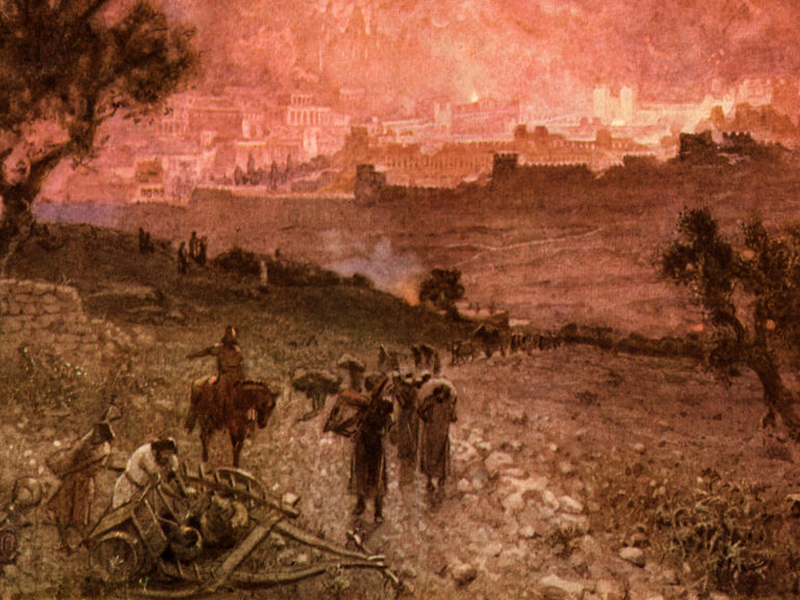
the-destruction-of-jerusalem-by-nebuzar
Covenant

Zion as an Ascension

An excerpt from The End of Israel: Jesus, Paul & AD70 by Michael Bull The Hebrew word olah, translated “whole burnt offering” literally means “go up.” The explanatory “translation” is helpful in its description of the offering but unfortunately for English readers it veils the symbolic meaning. As far as…

by Mike BullApril 7, 2020
e99a2549
Coronavirus

Worship in Exile

The # Coronavirus is trending more frequently than your favorite five celebrities put together. Our culture has exchanged TMZ stories for the primacy of the geeks who once made their living in the privacy of their laboratory. These are now our modern-day celebrities. It’s safe to say the experts surrounding…

by Uri BritoMarch 31, 2020
screen-shot-2020-03-26-at-11-54-58-am
Baptism

A Baptism Letter

In the name of Jesus Christ, our Savior, Lord, and Friend. Dear sister in Christ, Your baptism is firm and certain not because of anything you have done or the pastor who administered your baptism in Christ’s stead and command. Your baptism is firm and certain because of God and…

by Todd HainsMarch 26, 2020

Showing page 68 of 309

See all

Showing page 29 of 43

See all
Literature

Ibsen

Ibsen, Steiner argues, did not write tragedies. Ibsen wrote “dramatic rhetoric” calling society to reform. For real tragedy, there is no such “solution” to be found, there is no remedy, except destructive sacrifice and perhaps a deus ex machina. From this angle, tragedy is perhaps among the STOICHEIA that prepared…

January 7, 2004
Literature

More Quotations from Steiner

Some more quotations from Steiner’s Death of Tragedy : “We cannot understand the romantic movement if we do not perceive at the heart of it the impulse toward drama . . . . The romantic mode is neither an ordering nor a criticism of life; it is a dramatization. And…

January 7, 2004
Theology

NT Wright’s Rutherford House Lecture

Some thoughts on NT Wright’s Rutherford House Lecture, August 2003. I have little disagreement with much of the lecture, and it clarified a number of things for me. Wright’s views on justification, however, continue to puzzle me at a number of points. Here’s an attempt to clarify my (or NTW’s)…

January 7, 2004
Theology

NT Wright’s Rutherford House Lecture

Some thoughts on NT Wright’s Rutherford House Lecture, August 2003. I have little disagreement with much of the lecture, and it clarified a number of things for me. Wright’s views on justification, however, continue to puzzle me at a number of points. Here’s an attempt to clarify my (or NTW’s)…

January 7, 2004
Literature

European Drama

Steiner notes that, following the Renaissance, European drama operated under the shadows of neo-classical and Elizabethan dramatic practice, the former “closed” and rigidly adhering to Aristotelian criteria, the other open and experimental. He discusses the theory of Thomas Rymer (a neo-classicist) at some length, concluding that the controversies that Rymer…

January 6, 2004
Literature

Shakespearean Difference

George Steiner in his Death of Tragedy describes the “Shakespearean difference” as mainly due to Shakespeare’s avoidance of fascination with Hellenic models: “The neo-classic view [which rigidified Aristotelian conceptions of tragedy] expresses a growing perception of the miracle of Greek drama. This perception was fragmentary. There were few translations of…

January 6, 2004

Showing page 2141 of 2212

Browse by Category

In Medias Res

Your weekly digest for all things Theopolis.

Donate

Theopolis is nearly 100% donor-supported. Consider joining us on our mission.