Theopolis Logo

Writing

Explore our collection of theological essays, biblical studies, and reflections on faith and culture.

See all
actionvance-t7el2ig3jmc-unsplash
Esther

Genesis 1 and Genesis 8

I mentioned last month ( BH 82) in my essay "Like a Dove" that Genesis 8 is a recapitulation of Genesis 1. Let me explicate that assertion here. Of course, the world after the Flood is a new creation, so we may expect a recapitulation of the first creation. It…

by James B. JordanMarch 28, 1996

ben-white-w8qqn1pmqh0-unsplash
Daniel

Esther: Historical & Chronological Comments (I)

The book of Esther is one of the most neglected of the books of the Bible. To be sure, sermons are preached on it, and commentaries have occasionally been written on it, but almost without exception Esther has been interpreted in isolation from the rest of Biblical history, chronology, and…

by James B. JordanMarch 28, 1996

actionvance-t7el2ig3jmc-unsplash
Biblical Horizons

A Letter on Geocentricity

Dear Mr. ______, . . . Here is how I look at the geocentricity question. Since I don’t recall what I wrote you before, I may be repeating some things. 1. The Bible does not teach it. Biblical passages used to support the idea are being misinterpreted. My original paper…

by James B. JordanMarch 28, 1996

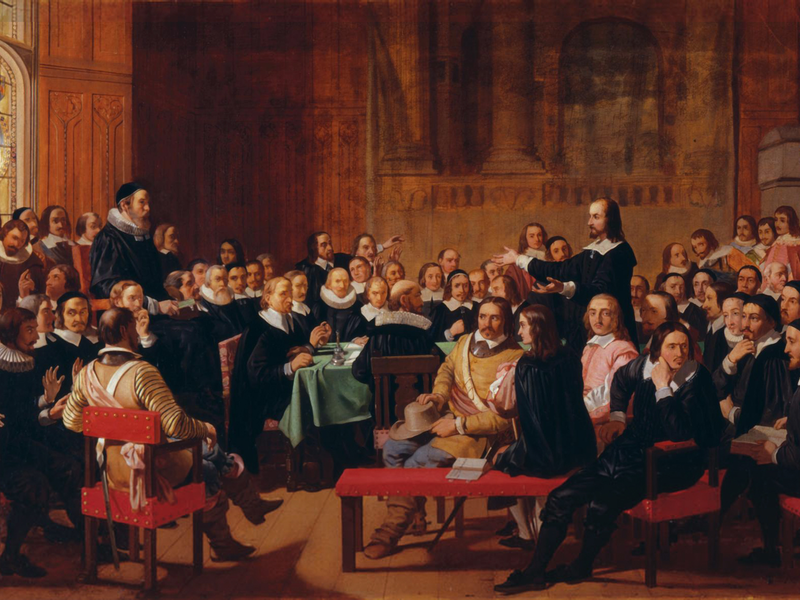
assertion_of_liberty_of_conscience_by_the_independents_of_the_westminster_assembly_of_divines_1644
Biblical Horizons

What is God?

Answer 4 of the Westminster Shorter Catechism is often taken as a magnificent answer to the question, "What is God?" It reads: "God is a Spirit, infinite, eternal, and unchangeable in his being, wisdom, power, holiness, justice, goodness, and truth." Presbyterians are fond of praising this statement, preaching on it,…

by James B. JordanFebruary 28, 1996
screenshot-2023-08-28-at-4-42-36-pm
Baptism

Like a Dove

The gospels tell us that at Jesus’ baptism, the Holy Spirit descended upon Him "in bodily form like a dove" (Luke 3:22 & parallels). Biblically sensitive commentators have associated this event with three Old Testament parallels: (1) the hovering of the Spirit over the creation in Genesis 1:2; (2) the…

by James B. JordanFebruary 28, 1996
tim-wildsmith-gzggi42wggm-unsplash
John

Jesus at Belshazzar’s Feast: Being an Explanatory Disquisition on an Aspect of the Story of the Woman Taken in Adultery

This they said to test him, that they might have some charge to bring against him. Jesus bent down and wrote with his finger on the ground. (John 8:6) The story of the woman taken in adultery (John 7:53-8:11) has been part of the canonical Christian Bible from its earliest…

by James B. JordanFebruary 28, 1996

Showing page 267 of 309

See all
See all

Baptism and personhood

In his recently re-released Bioethics: A Primer for Christians , Gilbert Meilaender discusses baptism to formulate a Christian understanding of the person. Baptism, he points out, is a communal act but also individualizing: “the first thing to note about baptism is that it is a deeply individualizing act. Our parents…

December 21, 2005
Art

Allegory with Venus and Cupid

In his book, Erotic Faith , Robert M. Polhemus offers an intriguing analysis of Bronzino’s Allegory with Venus and Cupid . The allegory suggests that “worship of Venus . . . blinds one to the menace of time and death.” Seeking sexual fulfillment means “betraying self, God, and humankind as…

December 21, 2005
Philosophy

Mirror and Lamp

In his classic study of romanticism and literary theory, The Mirror and the Lamp , MH Abrams points out the crucial change in images of the mind - from the mind as a “mirror” of outside reality to the mind as a “lamp” or a “fountain” that determines what it…

December 21, 2005
History

Consumption v. Culture

Hannah Arendt claimed that “An object is cultural depending on the duration of its permanence: its durable character is opposed to its functional aspect, that aspect which would make it disappear from the phenomenal world through use and wear and tear . . . . Culture finds itself under threat…

December 20, 2005
Literature

Shakespeare and the Law

At the climactic moment of reversal in the court scene in Merchant of Venice , Portia tells Shylock: “This bond doth give thee here no jot of blood.” “Jot” comes to English through the Greek iota , which is linked to the Hebrew YOD through Jesus’ usage in Matthew 5.…

December 20, 2005

Not quite haiku

spectral rime-frosted trees in early morning moonlight cast shadows on the pasture

December 18, 2005

Showing page 1910 of 2212

Browse by Category

In Medias Res

Your weekly digest for all things Theopolis.

Donate

Theopolis is nearly 100% donor-supported. Consider joining us on our mission.