Theopolis Logo

Writing

Explore our collection of theological essays, biblical studies, and reflections on faith and culture.

See all
actionvance-t7el2ig3jmc-unsplash
Esther

Genesis 1 and Genesis 8

I mentioned last month ( BH 82) in my essay "Like a Dove" that Genesis 8 is a recapitulation of Genesis 1. Let me explicate that assertion here. Of course, the world after the Flood is a new creation, so we may expect a recapitulation of the first creation. It…

by James B. JordanMarch 28, 1996

ben-white-w8qqn1pmqh0-unsplash
Daniel

Esther: Historical & Chronological Comments (I)

The book of Esther is one of the most neglected of the books of the Bible. To be sure, sermons are preached on it, and commentaries have occasionally been written on it, but almost without exception Esther has been interpreted in isolation from the rest of Biblical history, chronology, and…

by James B. JordanMarch 28, 1996

actionvance-t7el2ig3jmc-unsplash
Biblical Horizons

A Letter on Geocentricity

Dear Mr. ______, . . . Here is how I look at the geocentricity question. Since I don’t recall what I wrote you before, I may be repeating some things. 1. The Bible does not teach it. Biblical passages used to support the idea are being misinterpreted. My original paper…

by James B. JordanMarch 28, 1996

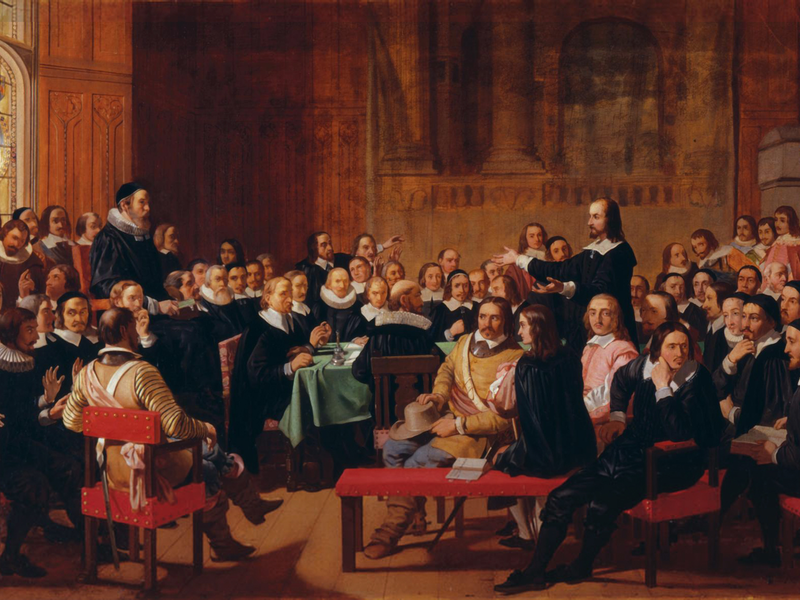
assertion_of_liberty_of_conscience_by_the_independents_of_the_westminster_assembly_of_divines_1644
Biblical Horizons

What is God?

Answer 4 of the Westminster Shorter Catechism is often taken as a magnificent answer to the question, "What is God?" It reads: "God is a Spirit, infinite, eternal, and unchangeable in his being, wisdom, power, holiness, justice, goodness, and truth." Presbyterians are fond of praising this statement, preaching on it,…

by James B. JordanFebruary 28, 1996
screenshot-2023-08-28-at-4-42-36-pm
Baptism

Like a Dove

The gospels tell us that at Jesus’ baptism, the Holy Spirit descended upon Him "in bodily form like a dove" (Luke 3:22 & parallels). Biblically sensitive commentators have associated this event with three Old Testament parallels: (1) the hovering of the Spirit over the creation in Genesis 1:2; (2) the…

by James B. JordanFebruary 28, 1996
tim-wildsmith-gzggi42wggm-unsplash
John

Jesus at Belshazzar’s Feast: Being an Explanatory Disquisition on an Aspect of the Story of the Woman Taken in Adultery

This they said to test him, that they might have some charge to bring against him. Jesus bent down and wrote with his finger on the ground. (John 8:6) The story of the woman taken in adultery (John 7:53-8:11) has been part of the canonical Christian Bible from its earliest…

by James B. JordanFebruary 28, 1996

Showing page 267 of 309

See all
See all

Sermon Outline, February 1

Sermon outline for Feb 1: The Days of the Son of Man, Luke 17:11-37 INTRODUCTION Jesus’ mission was to proclaim “the kingdom of God” (Luke 4:43; 8:1). By this, He meant that God was taking control of the world through Him, and putting a sinful and shattered world back together.…

January 29, 2004
Theology

Faith and Heresy

Barth says that the conflict of faith and heresy is far more serious and important than the conflicts between faith and unbelief. Unbelief cannot be taken with seriousness, he says, because we believe in the forgiveness of sins. But heresy is taken seriously to the extent that it has the…

January 28, 2004
Literature

Chaucer and Tragedy

Henry Ansgar Kelly (pp. 139-140 of Chaucerian Tragedy ) makes this important historical comment at the end of his analysis of Chaucer’s Troilus and Criseyde : “The selection introduction of Aristotelian criteria of excellent in tragedy has been a source of untold confusion in modern discussions of tragedy. For Aristotle,…

January 28, 2004

The Etymology of the “F-word”

While I’m on that subject: I’ve often wondered about the etymology of the “f-word.” The Shorter Oxford says that the derivation is unknown. I have a theory: Medieval courtly love poetry (such as the Roman de la Rose ) traced the development of courtship through several stages. The stage of…

January 28, 2004

The Etymology of the “F-word”

While I’m on that subject: I’ve often wondered about the etymology of the “f-word.” The Shorter Oxford says that the derivation is unknown. I have a theory: Medieval courtly love poetry (such as the Roman de la Rose ) traced the development of courtship through several stages. The stage of…

January 28, 2004

Cahill on Euripedes

In his beautifully written tribute to the ancient Greeks. Thomas Cahill interprets Euripides’ Medea as a cautionary tale to aristocratic Athenian men. The question he poses to the audience is: “What could drive a woman to such extremes that she would kill her own children.” Cahill’s summary of Euripides’ target…

January 28, 2004

Showing page 2130 of 2212

Browse by Category

In Medias Res

Your weekly digest for all things Theopolis.

Donate

Theopolis is nearly 100% donor-supported. Consider joining us on our mission.