Theopolis Logo

Writing

Explore our collection of theological essays, biblical studies, and reflections on faith and culture.

See all
actionvance-t7el2ig3jmc-unsplash
Esther

Genesis 1 and Genesis 8

I mentioned last month ( BH 82) in my essay "Like a Dove" that Genesis 8 is a recapitulation of Genesis 1. Let me explicate that assertion here. Of course, the world after the Flood is a new creation, so we may expect a recapitulation of the first creation. It…

by James B. JordanMarch 28, 1996

ben-white-w8qqn1pmqh0-unsplash
Daniel

Esther: Historical & Chronological Comments (I)

The book of Esther is one of the most neglected of the books of the Bible. To be sure, sermons are preached on it, and commentaries have occasionally been written on it, but almost without exception Esther has been interpreted in isolation from the rest of Biblical history, chronology, and…

by James B. JordanMarch 28, 1996

actionvance-t7el2ig3jmc-unsplash
Biblical Horizons

A Letter on Geocentricity

Dear Mr. ______, . . . Here is how I look at the geocentricity question. Since I don’t recall what I wrote you before, I may be repeating some things. 1. The Bible does not teach it. Biblical passages used to support the idea are being misinterpreted. My original paper…

by James B. JordanMarch 28, 1996

assertion_of_liberty_of_conscience_by_the_independents_of_the_westminster_assembly_of_divines_1644
Biblical Horizons

What is God?

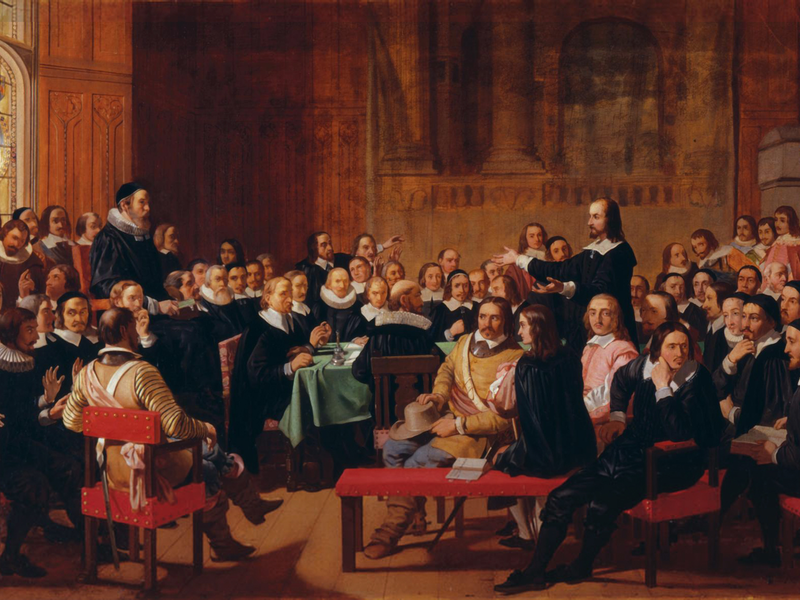
Answer 4 of the Westminster Shorter Catechism is often taken as a magnificent answer to the question, "What is God?" It reads: "God is a Spirit, infinite, eternal, and unchangeable in his being, wisdom, power, holiness, justice, goodness, and truth." Presbyterians are fond of praising this statement, preaching on it,…

by James B. JordanFebruary 28, 1996
screenshot-2023-08-28-at-4-42-36-pm
Baptism

Like a Dove

The gospels tell us that at Jesus’ baptism, the Holy Spirit descended upon Him "in bodily form like a dove" (Luke 3:22 & parallels). Biblically sensitive commentators have associated this event with three Old Testament parallels: (1) the hovering of the Spirit over the creation in Genesis 1:2; (2) the…

by James B. JordanFebruary 28, 1996
tim-wildsmith-gzggi42wggm-unsplash
John

Jesus at Belshazzar’s Feast: Being an Explanatory Disquisition on an Aspect of the Story of the Woman Taken in Adultery

This they said to test him, that they might have some charge to bring against him. Jesus bent down and wrote with his finger on the ground. (John 8:6) The story of the woman taken in adultery (John 7:53-8:11) has been part of the canonical Christian Bible from its earliest…

by James B. JordanFebruary 28, 1996

Showing page 267 of 309

See all
See all

Guilt and Guilt-Bearing

B rad Littlejohn presents a number of criticisms of my account of penal substitution in Delivered from the Elements of the World . I won’t attempt to address all of them, but focus—at once too briefly and at tedious length—on Brad’s central substantive question, which concerns guilt and Jesus’ guilt-bearing.…

September 20, 2016

Atomizing and Abstraction

I ’ve been reading commentaries on Revelation 1:12–20, learning a great deal, but getting increasingly frustrated. Even the best commentators sometimes fall into the twin faults of contemporary interpretation—atomization and abstraction. Let’s take the “robe” that Jesus wears. Many have suggested that the robe designates Jesus as a priest, but…

September 20, 2016

Beyond Language?

I n his Anchor Bible commentary on Revelation , Craig Koester says this about John's initial vision of Jesus: “ The figure’s appearance defies easy description: hair that is white like wool or snow, eyes like a flame of fire, a voice like rushing water, a face like the sun.…

September 19, 2016

Macbeth’s Three Murders

I n a contribution to Harold Bloom’s collection of essays on Macbeth , Robert Lanier Reid observes that ” Interpreters of Macbeth have focused almost exclusively on the first murder, the killing of a king in Acts 1–2, as the basis for understanding the play—its social, psychological, and metaphysical meanings.…

September 16, 2016

Motiveless Malignity

“W hat purpose do the Weird Sisters have for confronting the hero—or what is their masters’ purpose, if they in fact have such masters?” asks Susan Snyder in her contribution to Macbeth . She doesn’t think the play gives a clear answer, and she adds that the play doesn’t explain…

September 16, 2016

Macbeth and the Bible

P eter Milward writes of “meta-drama” in Hamlet and Macbeth in his contribution Shakespeare’s Christianity . He argues (unconvincingly) that Shakespeare had in mind the situation of recusant Catholics in England. Milward’s analysis of the biblical features of the play is more compelling. He notes that “already from the opening…

September 16, 2016

Showing page 252 of 2212

Browse by Category

In Medias Res

Your weekly digest for all things Theopolis.

Donate

Theopolis is nearly 100% donor-supported. Consider joining us on our mission.