Theopolis Logo

Writing

Explore our collection of theological essays, biblical studies, and reflections on faith and culture.

See all
actionvance-t7el2ig3jmc-unsplash
Esther

Genesis 1 and Genesis 8

I mentioned last month ( BH 82) in my essay "Like a Dove" that Genesis 8 is a recapitulation of Genesis 1. Let me explicate that assertion here. Of course, the world after the Flood is a new creation, so we may expect a recapitulation of the first creation. It…

by James B. JordanMarch 28, 1996

ben-white-w8qqn1pmqh0-unsplash
Daniel

Esther: Historical & Chronological Comments (I)

The book of Esther is one of the most neglected of the books of the Bible. To be sure, sermons are preached on it, and commentaries have occasionally been written on it, but almost without exception Esther has been interpreted in isolation from the rest of Biblical history, chronology, and…

by James B. JordanMarch 28, 1996

actionvance-t7el2ig3jmc-unsplash
Biblical Horizons

A Letter on Geocentricity

Dear Mr. ______, . . . Here is how I look at the geocentricity question. Since I don’t recall what I wrote you before, I may be repeating some things. 1. The Bible does not teach it. Biblical passages used to support the idea are being misinterpreted. My original paper…

by James B. JordanMarch 28, 1996

assertion_of_liberty_of_conscience_by_the_independents_of_the_westminster_assembly_of_divines_1644
Biblical Horizons

What is God?

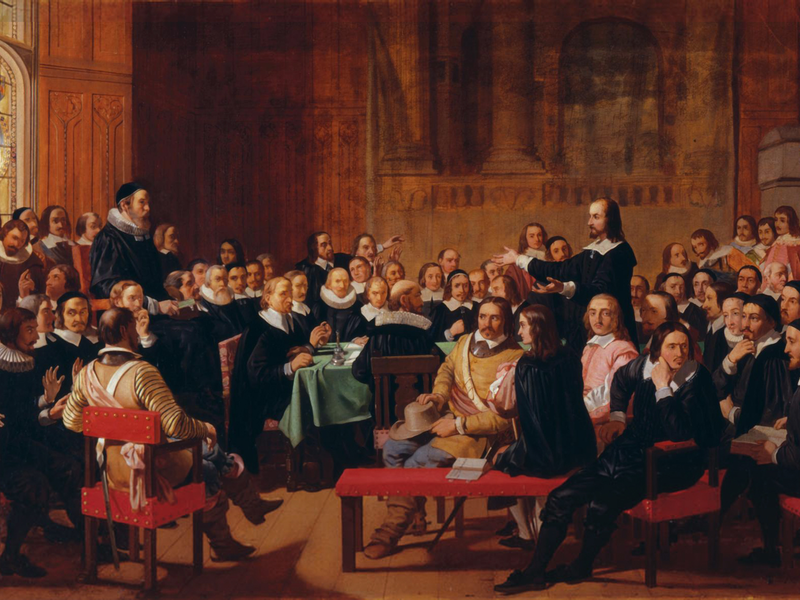
Answer 4 of the Westminster Shorter Catechism is often taken as a magnificent answer to the question, "What is God?" It reads: "God is a Spirit, infinite, eternal, and unchangeable in his being, wisdom, power, holiness, justice, goodness, and truth." Presbyterians are fond of praising this statement, preaching on it,…

by James B. JordanFebruary 28, 1996
screenshot-2023-08-28-at-4-42-36-pm
Baptism

Like a Dove

The gospels tell us that at Jesus’ baptism, the Holy Spirit descended upon Him "in bodily form like a dove" (Luke 3:22 & parallels). Biblically sensitive commentators have associated this event with three Old Testament parallels: (1) the hovering of the Spirit over the creation in Genesis 1:2; (2) the…

by James B. JordanFebruary 28, 1996
tim-wildsmith-gzggi42wggm-unsplash
John

Jesus at Belshazzar’s Feast: Being an Explanatory Disquisition on an Aspect of the Story of the Woman Taken in Adultery

This they said to test him, that they might have some charge to bring against him. Jesus bent down and wrote with his finger on the ground. (John 8:6) The story of the woman taken in adultery (John 7:53-8:11) has been part of the canonical Christian Bible from its earliest…

by James B. JordanFebruary 28, 1996

Showing page 267 of 309

See all
See all

The argument of Romans

Mark Horne continues his studies in Romans at the Trinity House site.

June 17, 2013
American Religion

Founded on founding

Prior to the founding of America, argues Hannah Arendt in On Revolution , political orders were justified and legitimated by appeal to absolutes: “a divinity, not nature but nature’s God, not reason but a divinely informed reason” gave validity to political order and buttressed political power. Over time, the early…

June 16, 2013
Philosophy

Piety and Nihilism

Theory, Nietzsche argued, arises from the will to “correct existence.” Taking his cues from Nietzsche, Lyotard describes the difference between “pious” and “pagan” theorizing. The former is guilty of Nietzsche’s charge: Since Plato, Lyotard argues, philosophers have attempted to formulate a perfect theory of justice or freedom on the grounds…

June 16, 2013

New Frontiers

In their contribution to American Space/American Place: Geographies of the Contemporary United States , John Agnew and Joanne Sharp describe the context and import of Frederick Jackson Turner’s famed “Frontier Thesis.” Turner wrote in the context of the downturn of the 1890s, and his argument was partly about the future…

June 16, 2013
Economics

Papal economics

Michael Miller’s essay in Christian Theology and Market Economics focuses on “Business as a moral enterprise.” In part, he offers a summary of John Paul II’s teaching on economics and business, especially as expressed in the encyclical Centessimus Annus . As one might expect, John Paul puts business into the…

June 13, 2013

Productive Money

In his contribution to Christian Theology and Market Economics , Stephen Grabill reviews the “pre-Enlightenment” history of economic theory. That is to say, scholastic economics. For many economic historians, the notion of a scholastic economic theory is fallacious, and Exhibit #1 is always the scholastic prohibition of usury, grounded in…

June 13, 2013

Showing page 719 of 2212

Browse by Category

In Medias Res

Your weekly digest for all things Theopolis.

Donate

Theopolis is nearly 100% donor-supported. Consider joining us on our mission.