Theopolis Logo

Writing

Explore our collection of theological essays, biblical studies, and reflections on faith and culture.

See all
aaron-burden-h8s0pf2rcqs-unsplash
Galatians

The Restoration of the Galatians

While controversies over the writings of Paul continue in various corners of the intellectual globe, the word of God given through Paul and his scribe and all of the church’s interpreters and translators over the last two millennia is still readily available to the lofty and the lowly. Paul, as…

by Grace LangnessMarch 25, 2013

kiwihug-l4gw27xzn1i-unsplash
Deuteronomy

Law and History: How to Read the Law of Moses (Part 2)

The second in a series of studies in Deuteronomy. Deuteronomy 22:30: A man shall not take his father’s wife, and shall not uncover his father’s wing (Hebrew: kanaf ). There are a number of unusual features in this law that mark it out from the previous context, indicating that it…

by Ralph Allan SmithMarch 20, 2013
200403-moss-pilate-tease_pncfq5
History

Victimhood and the Gospel

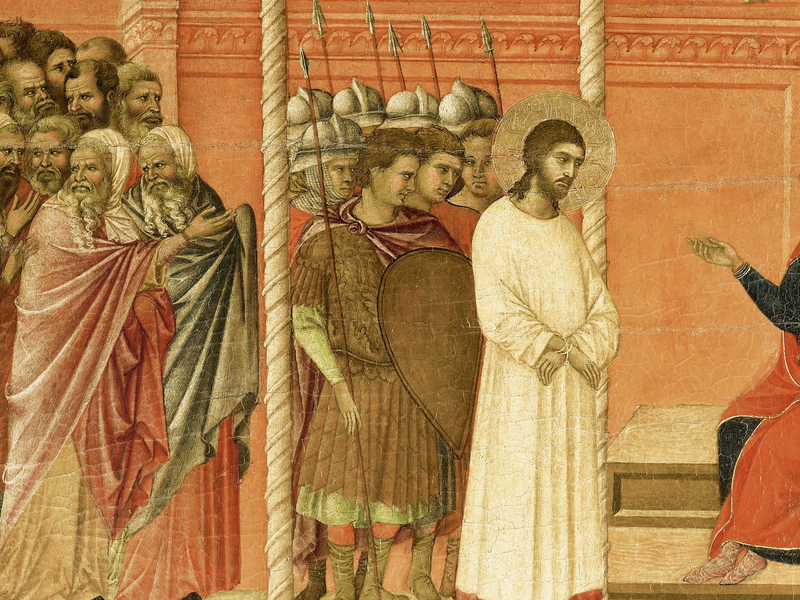
The texts of Christianity have been slowly at work, under the power of the Holy Spirit for 2000 years now. If we could be magically transported back into the world of two millennia ago, modern Americans would be shocked at the cruelty of that world. There was no concern for…

by Richard BledsoeMarch 18, 2013
aaron-burden-1ebsmyrau-s-unsplash
Luke

The Dysfunctional Family of the Gadarene Madman

The Story of the Gadarene Madman is told in all three synoptic Gospels (Matthew 8:28-34, Mark 5:1-20, Luke 8:26-37). Jesus ventures into a Gentile area when He passes over the Sea of Galilee. Upon disembarking from his boat, he is immediately met by a demon-possessed madman. Upon meeting Jesus, he…

by Richard BledsoeMarch 13, 2013
aaron-burden-1ebsmyrau-s-unsplash
Deuteronomy

Law and History: How to Read the Law of Moses

Part 1 of a multi-part series of studies on Deuteronomy 22:30-23:8. Eric Auerbach, in his classic work on Western literature, devotes his first chapter to contrasting Homer with the Bible. Of Homer, he writes of the “need of Homeric style to leave nothing which it mentions half in darkness and…

by Ralph Allan SmithMarch 12, 2013
markus-winkler-aid-xyrtlec-unsplash
Theopolis News

James Jordan in Korea, Japan

Trinity House Fellow James B. Jordan will be a speaker at an International Conference on Biblical Symbolism that will be held in Seoul on Monday, May 27 in 2013. He will address "The Importance of Biblical Symbolism and Symbolic Interpretation of the Bible." The conference will have three other speakers…

by Peter LeithartMarch 9, 2013

Showing page 197 of 309

See all

Showing page 30 of 43

See all

“The King”

2 Kings 16:12 describes Ahaz’s consecration of the altar built from the prototype in Damascus. Three times in that verse he is called “the king,” and in this designation, the author of Kings picks up the technique employed in 1 Kings 13 to describe Jeroboam’s consecration of the altar at…

April 20, 2006

Feminine temple

Psalm 144:12 asks that the Lord make “our daughters as corner pillars cut after the pattern of a palace.” “Pattern” is TABNIT, the noun used to describe the pattern that Moses sees on the mountain and later guides the building of the tabernacle. “Palace” is HEYKAL, the word used for…

April 20, 2006
History

Nature/Supernature, Gift and Grace

McGrath offers the following genealogy of the distinction of nature and supernature: Prior to the 12th century, theologians defined grace as a “gift of God” without distinguishing various kinds of gifts. But this left open the question of whether “all of God’s gifts” should be “identified as God’s grace.” Is…

April 20, 2006
History

Augustine Misunderstood

CS Lewis said that the courtly love tradition arose from “Ovid misunderstood.” Medieval soteriology might be said to have arisen from “Augustine misunderstood.” Everyone was Augustinian and no one wanted to be Pelagian, but Augustine’s actual teaching was confused by transmission problems both of his own works and of conciliar…

April 20, 2006

Faith = Jesus?

What happens to Paul’s doctrine of justification if “faith” in the phrase “justified by faith” is a name for Jesus, as it appears to be in Gal 3:23, 25, on analogy with the use of PISTOS as a name in Rev 19:11? Or, perhaps, if “faith” is shorthand for “faith…

April 20, 2006

Deeper justice

Cicero says, justice is rendering to each man his due, and Pelagius agrees. Paul says, justice is God’s giving ungodly sinners eternal life, and Augustine follows Paul. Remigius of Auxerre noted the contrast: “Mea iustitia est malum pro malo reddere. Tu solus iustus, quam circa nos ostendisti, reddens bonum pro…

April 20, 2006

Showing page 1853 of 2212

Browse by Category

In Medias Res

Your weekly digest for all things Theopolis.

Donate

Theopolis is nearly 100% donor-supported. Consider joining us on our mission.