Theopolis Logo

Writing

Explore our collection of theological essays, biblical studies, and reflections on faith and culture.

See all
ben-white-mo9vkbg5csg-unsplash
Masculinity

Ringing the Brothel Door

Bruce Marshall once wrote that every young man who rings the bell at a brothel is unconsciously looking for God. While it is not necessarily true that the inward desire of every man is ultimately a thirst for righteousness, it is true that every sin is the disordering of a…

by Garrett SoucyOctober 31, 2023

screenshot-2023-08-08-at-11-13-28-am
Ruth

Work and Gratitude in Ruth

In a previous essay , I argued that the story which begins with Lot and culminates in Ruth’s great-grandson David follows God’s five-fold pattern of creative work as laid out by Jim Jordan: taking something in hand (in this case, the Abrahamic family), restructuring it, distributing the product of labor,…

by Josh JensenOctober 27, 2023
screenshot-2023-10-17-at-11-05-18-am
Books

Men, Marriage, and the Feminine Imperative: A Review of "Men and Marriage"

Gilder, George. Men and Marriage. Moscow, ID: Canon Press, 2023. 1 By 1973, the hightide of second-wave feminism had flooded the beaches of American culture. Betty Friedan’s The Feminine Mystique eroded the shores of traditional female roles by naming and stirring up further domestic discontentment. Kate Millet wrote her dissertation-turned-book,…

by Bill SmithOctober 17, 2023
job_and_his_friends
Galatians

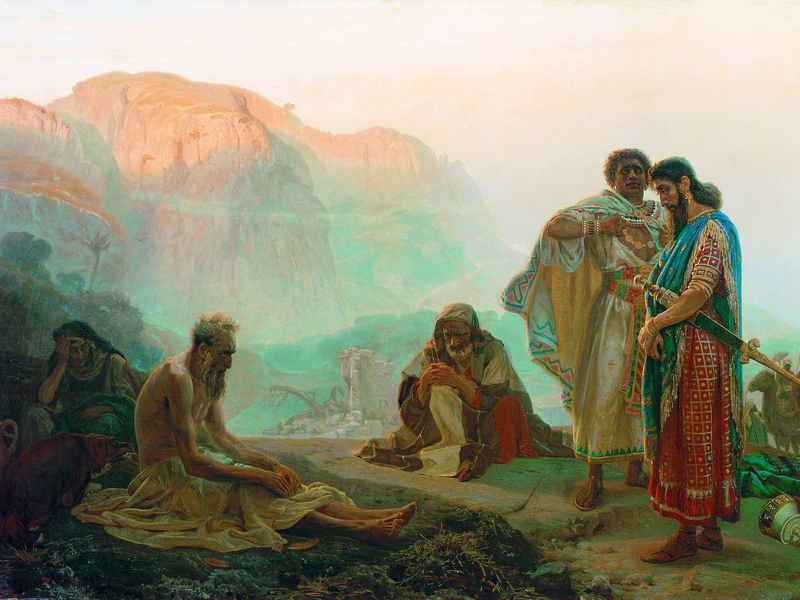
Get Behind Me, Eliphaz!

The Book of Job is a very tortuous book. The arguments of Job and his friends are shot through with truth and error hopelessly mixed together. Every line of contentious poetry stands locked in deadly battle with every other line. As maddening as this can be for a reader who…

by Jonathan WhiteOctober 10, 2023
13071-probablyvalentindeboulogne-saintpaulwritinghi-1
Apostle Paul

Before His Conversion, Paul Knew Jesus

More than once in the last 50 years it has occurred to me that Paul might have known Jesus before He appeared to Paul on the Damascus road, but I had never taken up the notion in earnest until recently when I ran into a book by Stanley Porter titled…

by Ralph Allan SmithOctober 4, 2023
mathew-schwartz-s87bbfzviau-unsplash
Acts

Did Peter Found the Church in Rome?

The question in the title is genuine, not polemic. I could be perfectly happy to follow an ancient — and what is regarded as a well-attested — tradition. But I do not feel compelled to follow it simply because it is tradition. I would like to have arguments that Peter…

by Ralph Allan SmithSeptember 26, 2023

Showing page 27 of 309

See all

Showing page 31 of 43

See all
Literature

Ibsen

Ibsen, Steiner argues, did not write tragedies. Ibsen wrote “dramatic rhetoric” calling society to reform. For real tragedy, there is no such “solution” to be found, there is no remedy, except destructive sacrifice and perhaps a deus ex machina. From this angle, tragedy is perhaps among the STOICHEIA that prepared…

January 7, 2004
Literature

More Quotations from Steiner

Some more quotations from Steiner’s Death of Tragedy : “We cannot understand the romantic movement if we do not perceive at the heart of it the impulse toward drama . . . . The romantic mode is neither an ordering nor a criticism of life; it is a dramatization. And…

January 7, 2004
Theology

NT Wright’s Rutherford House Lecture

Some thoughts on NT Wright’s Rutherford House Lecture, August 2003. I have little disagreement with much of the lecture, and it clarified a number of things for me. Wright’s views on justification, however, continue to puzzle me at a number of points. Here’s an attempt to clarify my (or NTW’s)…

January 7, 2004
Theology

NT Wright’s Rutherford House Lecture

Some thoughts on NT Wright’s Rutherford House Lecture, August 2003. I have little disagreement with much of the lecture, and it clarified a number of things for me. Wright’s views on justification, however, continue to puzzle me at a number of points. Here’s an attempt to clarify my (or NTW’s)…

January 7, 2004
Literature

European Drama

Steiner notes that, following the Renaissance, European drama operated under the shadows of neo-classical and Elizabethan dramatic practice, the former “closed” and rigidly adhering to Aristotelian criteria, the other open and experimental. He discusses the theory of Thomas Rymer (a neo-classicist) at some length, concluding that the controversies that Rymer…

January 6, 2004
Literature

Shakespearean Difference

George Steiner in his Death of Tragedy describes the “Shakespearean difference” as mainly due to Shakespeare’s avoidance of fascination with Hellenic models: “The neo-classic view [which rigidified Aristotelian conceptions of tragedy] expresses a growing perception of the miracle of Greek drama. This perception was fragmentary. There were few translations of…

January 6, 2004

Showing page 2141 of 2212

Browse by Category

In Medias Res

Your weekly digest for all things Theopolis.

Donate

Theopolis is nearly 100% donor-supported. Consider joining us on our mission.