Theopolis Logo

Writing

Explore our collection of theological essays, biblical studies, and reflections on faith and culture.

See all
trnava-university-beeyeib-am8-unsplash
Biblical Horizons

Book Review: The Keys of This Blood: The Struggle for World Dominion Between Pope John Paul II, Mikhail Gorbachev & the Capitalist West

Malachi Martin, The Keys of This Blood: The Struggle for World Dominion Between Pope John Paul II, Mikhail Gorbachev & the Capitalist West (New York: Simon and Schuster, 1990). Reviewed by Peter J. Leithart. The subtitle of this massive volume gives a good idea of its major theme. Martin, the…

by Peter LeithartJuly 6, 1991
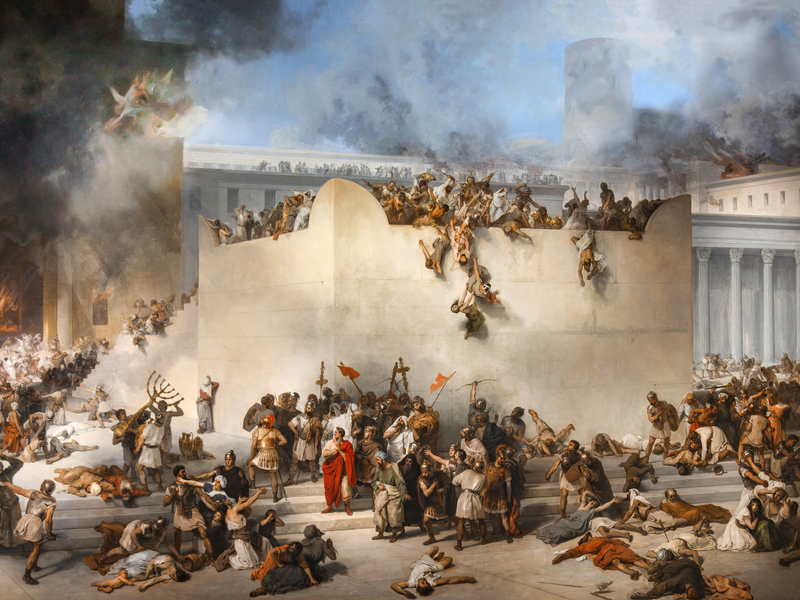
venice-la-distruzione-del-tempio-di-gerusalemme-francesco-hayez-gallerie-accademia-venice
Biblical Horizons

The Abomination of Desolation, Part 3: An Overview of the Pattern

The Abomination of Desolation: PART 1 The Abomination of Desolation: PART 2 What I intend to do in this series of studies is this: First, in the present essay we shall survey the occurrences of the Abomination of Desolation in the Bible in a cursory way, in order to get…

by James B. JordanJune 22, 1991
venice-la-distruzione-del-tempio-di-gerusalemme-francesco-hayez-gallerie-accademia-venice
2 Thessalonians

The Abomination of Desolation, Part 2: The Man of Sin

We previously surveyed what is meant by the abomination of desolation . We suggested that it refers to sacrilegious acts performed by the religious leaders of Israel, captained by their High Priest, right in front of God’s face in the Temple. Later studies in this series will provide evidence for…

by James B. JordanJune 22, 1991
greg-rakozy-ompaz-dn-9i-unsplash-2
Biblical Chronology

The Framework Hypothesis

Throughout history, the Christian Church has had to guard against the heresy of gnosticism. Gnosticism is not an ordinary heresy, because it does not manifest itself as a set of defined beliefs. Rather, gnosticism is a tendency, a tendency to replace the historic facts of Christianity with philosophical ideas. Gnosticism…

by James B. JordanJune 22, 1991
synod-holy-fathers-large
Biblical Horizons

What About the “Seventh Ecumenical Council”?

In Rite Reasons Nos. 9-12, I discussed the errors of Roman Catholicism, Anglo-Catholicism, and Eastern Orthodoxy. I have had several requests to comment further on the so-called Seventh Ecumenical Council, held at Nicaea in A.D. 787. That Council ordered the excommunication of anyone who rejects the veneration of icons. 1…

by James B. JordanJune 22, 1991
debby-hudson-qa74yh6-xlc-unsplash
Philippians

The Theology of the Drink Offering

The drink offering or libation ( nesek ) is mentioned in only three places in the book of Leviticus. When the sheaf of the firstfruits was waved before the Lord, a grain offering was to be burned, along with "its libation, a fourth of a hin of wine [approx. one…

by Peter LeithartMay 30, 1991

Showing page 296 of 309

See all

Showing page 32 of 43

See all

Necessity of Incarnation

Would the Son have been incarnate if Adam had not sinned? 1 Corinthians 15:44-45 provides a prooftext for an affirmative answer. Verse 44 says that the “spiritual body” is implied by the existence of the “natural body.” Human beings were created in a natural state, but they were destined from…

August 12, 2006
Philosophy

Decentered Self of Modernity

Bishop Joseph Butler of Durham worried about the consequences of Locke’s empiricism: “That personality is not a permanent, but a transcient thing: that it lives and dies, begins and ends continually: that no one can any more remain one and the same person two moments together, than two successive moments…

August 12, 2006
History

Embedded mind

Modernity ignores the social, linguistic, and political context of thought, and the way interest shapes the mind; postmodernity foregrounds all this. Perhaps, but . . . . Descartes said that his travels demonstrates that “all those who hold notions strongly contrary to our own are not for that reason barbarians…

August 12, 2006
History

Self and World

For premoderns - ancients and medievals - there was a homology between the self and the world. Man was seen as microcosm, and, as Seigel puts it, they believed that “the world, like the self, is structured so as to fulfill intelligible moral ends.” The initial shift in early modernity,…

August 12, 2006
Philosophy

Birth of the Modern Self?

Seigel views with “considerable skepticism” the notion that Descartes constructed “a general theory of the human self and subject on the basis of the cogito .” In his treatise on the Passions of the Soul , Descartes claimed that the soul was linked with the body, which acts on the…

August 12, 2006
History

Purity

According to Seigel, “Descartes’s view of reason as most pure and solid when it was free of corruption by the world’s confusions implied nothing less than the attempt to break free of all social and cultural experience.” Not for the first time, I wish there were an anthropological history of…

August 12, 2006

Showing page 1812 of 2212

Browse by Category

In Medias Res

Your weekly digest for all things Theopolis.

Donate

Theopolis is nearly 100% donor-supported. Consider joining us on our mission.