Theopolis Logo

Writing

Explore our collection of theological essays, biblical studies, and reflections on faith and culture.

See all
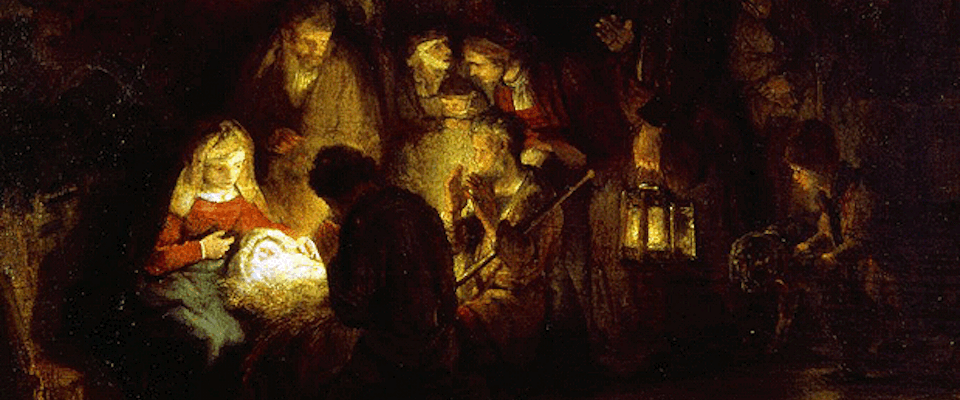
nativity-2
Advent

Joyful Humility

Christmas is a joyful season, but for many it turns into something else. Instead of joy, it is full of disappointment and unhappiness. Instead of an occasion for family fellowship, it becomes an opportunity for opening old wounds, reigniting old arguments, giving new life to rancor that should have died…

by Peter LeithartDecember 19, 2016

sagradafamilia-crop
Biblical Theology

Systematic Typology (Part Five)

The Temple of Time The “covenant-literary matrix” of the Bible is not a pattern imposed upon the text, but the internal logic of its arrangement. This fundamental structure, functioning at multiple levels simultaneously, is a ceaseless reiteration of God’s primary theme. It is an algorithm forged in the furnace of…

by Mike BullDecember 16, 2016
img_1456
Hermeneutics

Exodus in 1 Kings

In the four hundred and eightieth year after the Exodus, Solomon began to build the temple of the Lord in Jerusalem. [1] That the author of Kings should date the start of the building of the temple from the Exodus is noteworthy. In Exodus 15:17, in Moses’ song following the…

by Alastair RobertsDecember 8, 2016
cross-grunwald
Cross

How Mist Gains Weight

Philip Schaff, a German Reformed theologian, states in The Principle of Protestantism that the material principle of Protestantism is “the doctrine of the justification of the sinner before God by the merit of Christ alone through faith.” This is the core message of the Church which leads “to the abandonment…

by Bogumil JarmulakDecember 6, 2016
mountain-top
Biblical Theology

Jesus and Godel's Theorem

“Religion” is an attempt to create or build a tower with a top, or to build a temple that is self-contained. The story of The Tower of Babel in Genesis 11 is the story of mankind’s attempt to create a world that is self-contained and does not need God. All…

by Richard BledsoeDecember 1, 2016
four-evangelists
Matthew

Dating Matthew, (Part 2)

In the first essay in this series, I presented a case for dating Matthew before AD 70, contrary to the present scholarly consensus. In this essay, I intend to present cultural, personal, ecclesiological, and theological arguments for a very early date for Matthew. [1] The cultural argument concerns literacy in…

by Ralph Allan SmithNovember 29, 2016

Showing page 121 of 309

See all

Showing page 32 of 43

See all
Philosophy

Autonomy and Tragedy

Early in his Tragic Sense of Life , Unamuno captures the profound connection between autonomy and tragic character in a passage of hyperventilating passion: “The visible universe, the universe that is created by the instinct of self-preservation, becomes all to narrow for me. It is like a cramped cell, against…

December 10, 2003

Chiasm in Romans 3:19-31

There’s something chiastic going on in 3:19-31 (or maybe 2:25-3:30). A. by works of law no flesh shall be justified, 19-20 B. Apart from law, righteousness of God is revealed, 21 C. righteousness through faith in Jesus—> for all have sinned, 22-23 D. being justified as a gift through Jesus…

December 10, 2003
Literature

Spenserian Humor

A touch of Spenserian humor: Spenser has a witch create a false Florimell (Book 3) for her slothful and unattractive son, who is smitten with the beauty of the real Florimell. The witch uses materials from Petrarchan love sonnets to construct the lady ?Eactual lamps for eyes, actual golden wire…

December 9, 2003
Literature

Spenser and Milbank

Spenser might provide a Milbankian response to Milbank’s endorsement of homosexual sex and “threesomes.” In Book 3 of The Faerie Queene , Spenser’s heroine is Britomart, the lady knight who represents a militant chastity directed toward marital and sexual consummation rather than a fearful virginity that simply avoids sex. Britomart…

December 9, 2003
Literature

Hero and Eros

William Allan Oram in a book on Spenser writes that “one of the fruitful false etymologies of the Renaissance was the derivation of HERO from EROS: by this understanding, love does not hinder noble deeds but spurs them on.”

December 9, 2003
Literature

Shakespeare for Readers

Also in the November 7 TLS (belatedly on my desk) is a review of Lukas Erne’s Shakespeare as Literary Dramatist , in which Erne challenges the popularly accepted notion that Shakespeare was writing for viewers rather than readers. He shows that plays were being written for publication in Shakespeare’s time,…

December 9, 2003

Showing page 2154 of 2212

Browse by Category

In Medias Res

Your weekly digest for all things Theopolis.

Donate

Theopolis is nearly 100% donor-supported. Consider joining us on our mission.