Theopolis Logo

Writing

Explore our collection of theological essays, biblical studies, and reflections on faith and culture.

See all
25f3baab-e5a9-42ec-aab6-649e53879085-3
John

Israel Redux: The Image of Christ in the Gospel According to John (Part IV)

John 18, 19: Latter Prophets and the Writings John 18 and 19 record the arrest, trial, torture, and death of Jesus as laid out in detail in Isaiah 53. After the Roman soldier pierces Jesus’ side, John quotes Zechariah: “They shall look at him whom they pierced” (Zech 12:10). In…

by Geert HeetebrijDecember 6, 2018

25f3baab-e5a9-42ec-aab6-649e53879085-3
John

Israel Redux: The Image of Christ in the Gospel According to John (Part III)

John 12.12 – John 17: Latter Prophets In the Hebrew Scriptures, Kings is followed by the Latter Prophets. John 12:15 quotes Zechariah 9:9 as having prophesied Jesus’ triumphal entry: “Do not be afraid, O Daughter of Zion; see, your king is coming, seated on a donkey’s colt.” [1] N.T. Wright…

by Geert HeetebrijDecember 5, 2018
25f3baab-e5a9-42ec-aab6-649e53879085-3
John

Israel Redux: The Image of Christ in the Gospel According to John (Part II)

John 6.16-70: Joshua The book of Joshua documents the nation of Israel entering the Promised Land. Consider the order of events: (1) Israel is still receiving the daily miracle of manna; (2) Israel miraculously crosses the Jordan on dry foot; (3) The day after Passover , Israel eats produce of…

by Geert HeetebrijNovember 29, 2018
25f3baab-e5a9-42ec-aab6-649e53879085-3
John

Israel Redux: The Image of Christ in the Gospel According to John (Part I)

Since my educational and professional training have revolved around story and narrative structure, I approach John’s Gospel from a literary and narrative perspective. In doing so, I have noticed structural story patterns and followed them where they seem to lead: the Gospel of John parallels the ordering of the books…

by Geert HeetebrijNovember 27, 2018
white-hall-hospital
Art

The Clouds of Mt. Sinai

The Mt. Sinai Hospital was neolithic on the black hill of Hollow, New Hampshire. Winter dampened the trees and the wind bit at the sparse branches, the sidewalks and stairs were perilous with soggy leaves, and the dim yellow light cast a pallor upon the milky stone building. Ambling inside…

by Remy WilkinsNovember 22, 2018
sodom-and-gomorrah-58ecfa883df78c5162cb92b5
Revelation

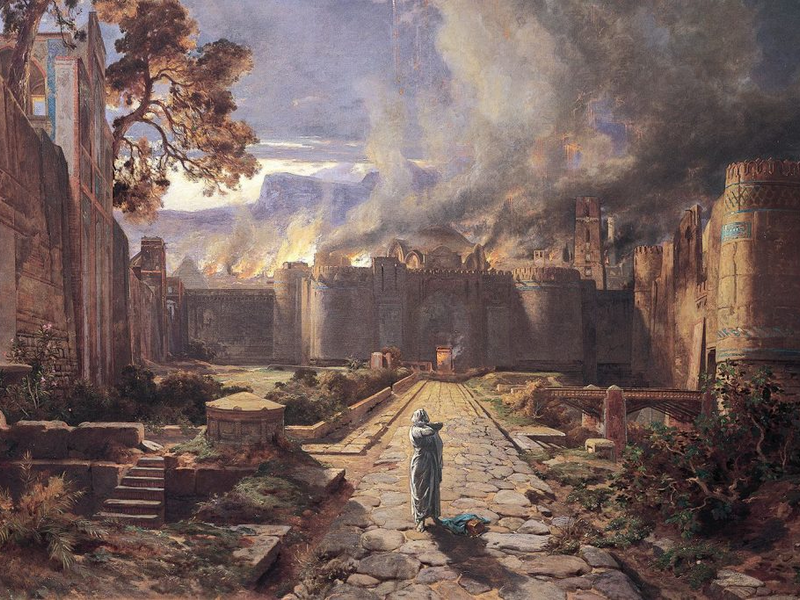
Egypt and Sodom, Where the Lord was Crucified

The Revelation can only be understood in the light of Old Testament symbols and sequences. The same is true of the epistle of Jude, which serves as a blistering hors d’oeuvre to John’s fiery feast. Possibly written by the apostle Judas Thaddaeus (Luke 6:16; Acts 1:13; John 14:22), the epistle…

by Mike BullNovember 20, 2018

Showing page 84 of 309

See all

Showing page 33 of 43

See all
Philosophy

Non-universal Universality

Daniel Barber ( Modern Theology ) notes that “particularity cannot be reduced to universality. Therefore we have a philosophical reason for approaching Jesus through particularity: sufficient reason, when conceived as universality, is insufficient; causal frameworks cannot negotiate sufficiently with elements of chance and contingency; ‘universality’ cannot be thought of as…

May 6, 2009
History

American militarism

Andrew Bacevich ( The New American Militarism: How Americans Are Seduced by War ) writes, “Americans in our time have fallen prey to militarism, manifesting itself in a romanticized view of soldiers, a tendency to see military power as the truest measure of national greatness, and outsized expectations regarding the…

May 5, 2009
History

American empire

Howe, again, points out that the most obvious “imperial” project in US history is the one we take most for granted, the conquest of the American continent: “it is the internal expansion of the continental USA, across the intervening hundred years, which evokes the most direct parallels with empire-building elsewhere.…

May 5, 2009
History

A Cheer for the Habsburgs

Stephen Howe ( Empire: A Very Short Introduction ) admits that nationalists in the Austro-Hungarian empire “scorned it as the ‘prison-house of nations,” and that to the intellectuals of Vienna, the empire was “a senile absurdity.” Still, “the very existence of those nationalist, cultural, and intellectual movements, able to express…

May 5, 2009
Politics

Dangers of Anti-Constantinianism

Gerald Schlabach notes that critiques of Constantinianism pose temptations of various sorts, just as Constantinianism itself does. Insofar as such critiques posit a “fall” for the church, “they tend to be dysfunctional - not just for ecumenical debate, but also for ethical discernment within those churches that historically have defined…

May 4, 2009
History

Yoder and Augustine

Travis Kroeker ( Journal of Religious Ethics , 2005) argues that Yoder is closer to Augustine than his dismissal of Augustine as a “Constantinianism” implies: “Augustine’s theological corpus is nothing if not exegetical and historical, though, of course, it is also true that Augustine freely appropriates the ‘gold and silver…

May 4, 2009

Showing page 1384 of 2212

Browse by Category

In Medias Res

Your weekly digest for all things Theopolis.

Donate

Theopolis is nearly 100% donor-supported. Consider joining us on our mission.