Theopolis Logo

Writing

Explore our collection of theological essays, biblical studies, and reflections on faith and culture.

See all
actionvance-t7el2ig3jmc-unsplash
Esther

Genesis 1 and Genesis 8

I mentioned last month ( BH 82) in my essay "Like a Dove" that Genesis 8 is a recapitulation of Genesis 1. Let me explicate that assertion here. Of course, the world after the Flood is a new creation, so we may expect a recapitulation of the first creation. It…

by James B. JordanMarch 28, 1996

ben-white-w8qqn1pmqh0-unsplash
Daniel

Esther: Historical & Chronological Comments (I)

The book of Esther is one of the most neglected of the books of the Bible. To be sure, sermons are preached on it, and commentaries have occasionally been written on it, but almost without exception Esther has been interpreted in isolation from the rest of Biblical history, chronology, and…

by James B. JordanMarch 28, 1996

actionvance-t7el2ig3jmc-unsplash
Biblical Horizons

A Letter on Geocentricity

Dear Mr. ______, . . . Here is how I look at the geocentricity question. Since I don’t recall what I wrote you before, I may be repeating some things. 1. The Bible does not teach it. Biblical passages used to support the idea are being misinterpreted. My original paper…

by James B. JordanMarch 28, 1996

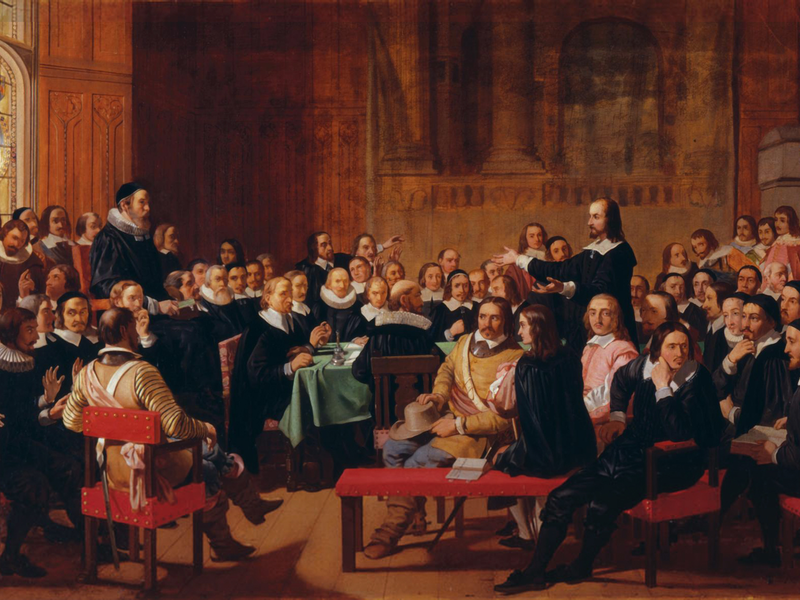
assertion_of_liberty_of_conscience_by_the_independents_of_the_westminster_assembly_of_divines_1644
Biblical Horizons

What is God?

Answer 4 of the Westminster Shorter Catechism is often taken as a magnificent answer to the question, "What is God?" It reads: "God is a Spirit, infinite, eternal, and unchangeable in his being, wisdom, power, holiness, justice, goodness, and truth." Presbyterians are fond of praising this statement, preaching on it,…

by James B. JordanFebruary 28, 1996
screenshot-2023-08-28-at-4-42-36-pm
Baptism

Like a Dove

The gospels tell us that at Jesus’ baptism, the Holy Spirit descended upon Him "in bodily form like a dove" (Luke 3:22 & parallels). Biblically sensitive commentators have associated this event with three Old Testament parallels: (1) the hovering of the Spirit over the creation in Genesis 1:2; (2) the…

by James B. JordanFebruary 28, 1996
tim-wildsmith-gzggi42wggm-unsplash
John

Jesus at Belshazzar’s Feast: Being an Explanatory Disquisition on an Aspect of the Story of the Woman Taken in Adultery

This they said to test him, that they might have some charge to bring against him. Jesus bent down and wrote with his finger on the ground. (John 8:6) The story of the woman taken in adultery (John 7:53-8:11) has been part of the canonical Christian Bible from its earliest…

by James B. JordanFebruary 28, 1996

Showing page 267 of 309

See all

Showing page 33 of 43

See all

Between Beast and Babel

There’s an interview regarding by recent book on empire at http://thegospelcoalition.org/blogs/trevinwax/ this morning.

September 6, 2012
Literature

Tragedy of Shylock

Shylock has been played for sympathy frequently in the past century. But the sense that his character fits badly in a comedy is an old one. Already in 1709, Nicholas Rowe wrote, “Tho’ we have seen that Play Receiv’d and Acted as a Comedy, and the Part of the Jew…

September 5, 2012
Literature

Merchant as Allegory

In an old article in the Shakespeare Quarterly , Barbara Lewalski suggests that Merchant of Venice is a moralistic allegory depicting the character of Christian love. In the play, Christian love involves “giving and forgiving: it demands an attitude of carelessness regarding the things of this world founded upon a…

September 5, 2012

Shylock on the Gospels

Mahood again ( The Merchant of Venice (The New Cambridge Shakespeare) ), describing Shakespeare’s and Shylock’s use of the gospels in the play (p. 198-9). “On Shylock’s first meeting with Bassanio, his detestation of the Christians breaks out in the dactylic rhythm and harsh consonants of ’ to eat of…

September 5, 2012

Shylock is Jacob

In an appendix to his edition of The Merchant of Venice (The New Cambridge Shakespeare) (pp. 197-8) , M. M. Mahood explores Shakespeare’s use of the Bible in the play. He notes the extensive echoes of the Jacob narrative, some explicit some not so much. “Shakespeare is unlikely ever to…

September 5, 2012
Theology

Disinterested love

Should we love God disinterestedly, without expectation or desire for return from Him, without any desire for happiness? It’s a common idea, but Milbank rightly argues against it. He asks “what constitutes God’s loveability”? His answer” “every charm, every attractive feature of anything whatsoever, radiates outwards, rendering things apprehensible and…

September 4, 2012

Showing page 875 of 2212

Browse by Category

In Medias Res

Your weekly digest for all things Theopolis.

Donate

Theopolis is nearly 100% donor-supported. Consider joining us on our mission.