Theopolis Logo

Writing

Explore our collection of theological essays, biblical studies, and reflections on faith and culture.

See all
aaron-burden-h8s0pf2rcqs-unsplash
Galatians

The Restoration of the Galatians

While controversies over the writings of Paul continue in various corners of the intellectual globe, the word of God given through Paul and his scribe and all of the church’s interpreters and translators over the last two millennia is still readily available to the lofty and the lowly. Paul, as…

by Grace LangnessMarch 25, 2013

kiwihug-l4gw27xzn1i-unsplash
Deuteronomy

Law and History: How to Read the Law of Moses (Part 2)

The second in a series of studies in Deuteronomy. Deuteronomy 22:30: A man shall not take his father’s wife, and shall not uncover his father’s wing (Hebrew: kanaf ). There are a number of unusual features in this law that mark it out from the previous context, indicating that it…

by Ralph Allan SmithMarch 20, 2013
200403-moss-pilate-tease_pncfq5
History

Victimhood and the Gospel

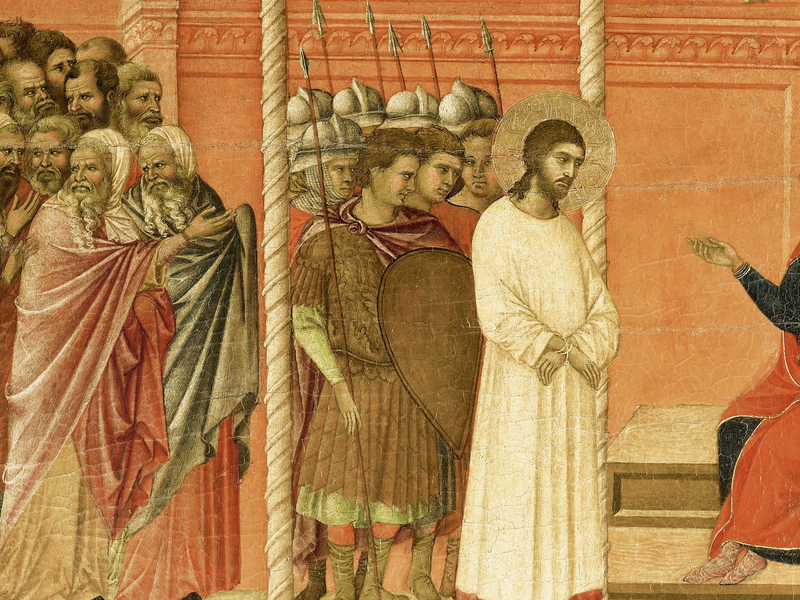
The texts of Christianity have been slowly at work, under the power of the Holy Spirit for 2000 years now. If we could be magically transported back into the world of two millennia ago, modern Americans would be shocked at the cruelty of that world. There was no concern for…

by Richard BledsoeMarch 18, 2013
aaron-burden-1ebsmyrau-s-unsplash
Luke

The Dysfunctional Family of the Gadarene Madman

The Story of the Gadarene Madman is told in all three synoptic Gospels (Matthew 8:28-34, Mark 5:1-20, Luke 8:26-37). Jesus ventures into a Gentile area when He passes over the Sea of Galilee. Upon disembarking from his boat, he is immediately met by a demon-possessed madman. Upon meeting Jesus, he…

by Richard BledsoeMarch 13, 2013
aaron-burden-1ebsmyrau-s-unsplash
Deuteronomy

Law and History: How to Read the Law of Moses

Part 1 of a multi-part series of studies on Deuteronomy 22:30-23:8. Eric Auerbach, in his classic work on Western literature, devotes his first chapter to contrasting Homer with the Bible. Of Homer, he writes of the “need of Homeric style to leave nothing which it mentions half in darkness and…

by Ralph Allan SmithMarch 12, 2013
markus-winkler-aid-xyrtlec-unsplash
Theopolis News

James Jordan in Korea, Japan

Trinity House Fellow James B. Jordan will be a speaker at an International Conference on Biblical Symbolism that will be held in Seoul on Monday, May 27 in 2013. He will address "The Importance of Biblical Symbolism and Symbolic Interpretation of the Bible." The conference will have three other speakers…

by Peter LeithartMarch 9, 2013

Showing page 197 of 309

See all

Showing page 35 of 43

See all
History

Eschatological self

Jerrold Seigel suggests that Locke’s self has “three different aspects”: We are selves to others “by virtue of what they know about our mental and moral life”; we are “selves to ourselves, but incompletely so, through the imperfect consciousness we have of our lives and deeds in the here and…

August 15, 2006
Science

Interior Senses

Murphy goes into admiring detail describing Thomas’s theory of interior senses in higher animals. Apart from its purely historical interest and the anticipations of later scientific theories, Thomas’s discussion has philosophical and theological interest in its own right. He claims, for instance, that there are a number of interior senses…

August 14, 2006
Science

Dueling Theodicies

Robert Young claims that the controversy over Darwinism in the 19th century was not so much a religion-v.-science controversy as a duel between competing theodicies. At one level, he argues, “the protagonists in the debate were in fundamental agreement. They were fighting over the best ways of rationalizing the same…

August 14, 2006
Philosophy

Mind-Body and Energy

Murphy offers an amusing discussion of the question, Assuming a Cartesian dualism of mind and body, how can the mind cause a physical object like the body to move? If one assumes that physicists are correct that physical energy can be transferred to a physical system, it has to arise…

August 14, 2006
Theology

Effects of dualism

Murphy makes this interesting comment, which she admits is an oversimplification: “the adoption of a dualist anthropology in the early centuries of the church was largely responsible for changing Christians’ conception of what Christianity is basically all about. I am suggesting that original Christianity is better understood in socio-political terms…

August 14, 2006
Theology

Physicalism and the Bible

In her Bodies and Souls, or Spirited Bodies? (Cambridge, 2006), Nancey Murphy argues for a non-reductionist version of physicalism on the question of the “body-soul” problem: “This is the view that humans are composed of only one ‘part,’ a physical body.” She spends a bit over six pages near the…

August 14, 2006

Showing page 1810 of 2212

Browse by Category

In Medias Res

Your weekly digest for all things Theopolis.

Donate

Theopolis is nearly 100% donor-supported. Consider joining us on our mission.