Theopolis Logo

Writing

Explore our collection of theological essays, biblical studies, and reflections on faith and culture.

See all
actionvance-t7el2ig3jmc-unsplash
Esther

Genesis 1 and Genesis 8

I mentioned last month ( BH 82) in my essay "Like a Dove" that Genesis 8 is a recapitulation of Genesis 1. Let me explicate that assertion here. Of course, the world after the Flood is a new creation, so we may expect a recapitulation of the first creation. It…

by James B. JordanMarch 28, 1996

ben-white-w8qqn1pmqh0-unsplash
Daniel

Esther: Historical & Chronological Comments (I)

The book of Esther is one of the most neglected of the books of the Bible. To be sure, sermons are preached on it, and commentaries have occasionally been written on it, but almost without exception Esther has been interpreted in isolation from the rest of Biblical history, chronology, and…

by James B. JordanMarch 28, 1996

actionvance-t7el2ig3jmc-unsplash
Biblical Horizons

A Letter on Geocentricity

Dear Mr. ______, . . . Here is how I look at the geocentricity question. Since I don’t recall what I wrote you before, I may be repeating some things. 1. The Bible does not teach it. Biblical passages used to support the idea are being misinterpreted. My original paper…

by James B. JordanMarch 28, 1996
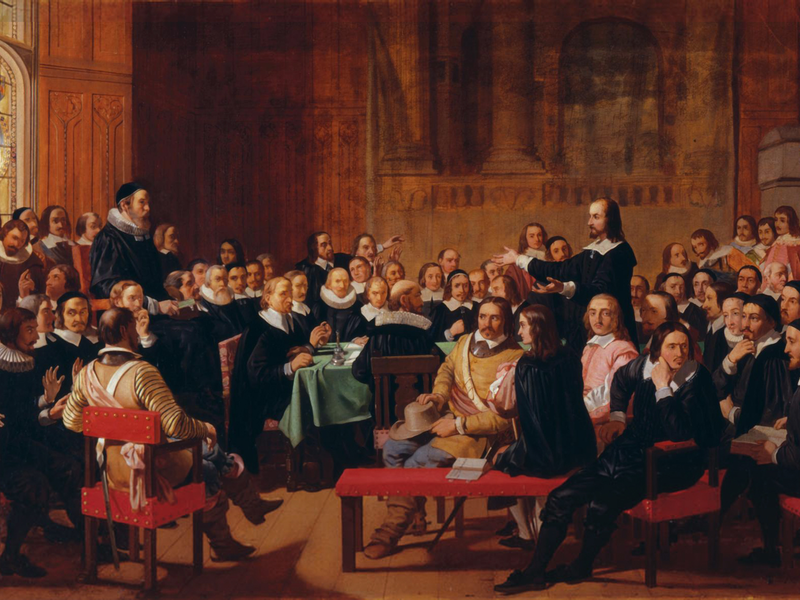
assertion_of_liberty_of_conscience_by_the_independents_of_the_westminster_assembly_of_divines_1644
Biblical Horizons

What is God?

Answer 4 of the Westminster Shorter Catechism is often taken as a magnificent answer to the question, "What is God?" It reads: "God is a Spirit, infinite, eternal, and unchangeable in his being, wisdom, power, holiness, justice, goodness, and truth." Presbyterians are fond of praising this statement, preaching on it,…

by James B. JordanFebruary 28, 1996
screenshot-2023-08-28-at-4-42-36-pm
Baptism

Like a Dove

The gospels tell us that at Jesus’ baptism, the Holy Spirit descended upon Him "in bodily form like a dove" (Luke 3:22 & parallels). Biblically sensitive commentators have associated this event with three Old Testament parallels: (1) the hovering of the Spirit over the creation in Genesis 1:2; (2) the…

by James B. JordanFebruary 28, 1996
tim-wildsmith-gzggi42wggm-unsplash
John

Jesus at Belshazzar’s Feast: Being an Explanatory Disquisition on an Aspect of the Story of the Woman Taken in Adultery

This they said to test him, that they might have some charge to bring against him. Jesus bent down and wrote with his finger on the ground. (John 8:6) The story of the woman taken in adultery (John 7:53-8:11) has been part of the canonical Christian Bible from its earliest…

by James B. JordanFebruary 28, 1996

Showing page 267 of 309

See all

Showing page 35 of 43

See all
Theology

Robbins and Against Christianity

John Robbins ‘s current Trinity Review is devoted to a sharply negative review of my book Against Christianity . So far as I can tell, Robbins caught me in one error: I did, as he said, misuse the phrase “beg the question” at one point. Otherwise, I would say that…

April 28, 2004
Biblical Studies

Sermon Outline, May 2

Again, much of this is from Jim Jordan ‘s From Bread to Wine . Kingly Rule, 1 Kings 3:1-28 INTRODUCTION Israel moved from its priestly to its kingly phase through a process of destruction and renewal. The Mosaic order broke down after the battle of Aphek (1 Samuel 4-6), and…

April 28, 2004

Pattern or Person

David Yeago makes this important comment about Luther’s “catholic” turn after 1518: “For Luther after 1518, Christ is central not as pattern but as person; we are saved by the faith that acknowledges his authority, competence, and willingness to rescue those who call upon him. The gospel that is proclaimed…

April 27, 2004

Imputation

McGrath gives an account of the development of the doctrine of imputation within early Reformation theology. He notes that there are elements of the doctrine already in the early Luther: “The reinterpretation of grace as an absolute external, and faith as a partial internal, quality permits Luther to maintain what…

April 27, 2004

Necessity of Works?

Who wrote this? ” opera sunt necessaria ad salutem, sed non causant salutem, quia fides sola dat vitam ” (works are necessary to salvation, yet they do not cause salvation, for faith alone gives life). Norman Shepherd would be a good guess, except that he doesn’t write in Latin. Calvin…

April 27, 2004

Grace and Reformation

Alister McGrath’s discussion of Luther’s theology of justification in his standard work, Iustitia Dei , shows that understanding grace as favor Dei rather than as a “medicinal substance” was an essential part of the Reformation doctrine of grace. He writes, “The most significant discussion of faith [in Luther’s earler writings]…

April 27, 2004

Showing page 2095 of 2212

Browse by Category

In Medias Res

Your weekly digest for all things Theopolis.

Donate

Theopolis is nearly 100% donor-supported. Consider joining us on our mission.