Theopolis Logo

Writing

Explore our collection of theological essays, biblical studies, and reflections on faith and culture.

See all
sculptor
Art

The Artist's Litany

If we say that we have no sin, we deceive ourselves, and the truth is not in us. (1 John 1:8) O God the Father, creator of heaven and earth, Alpha and Omega, beginning and end, who inspired Creation with the breath of your nostrils, who placed Adam in the…

by Christian LeithartFebruary 2, 2016
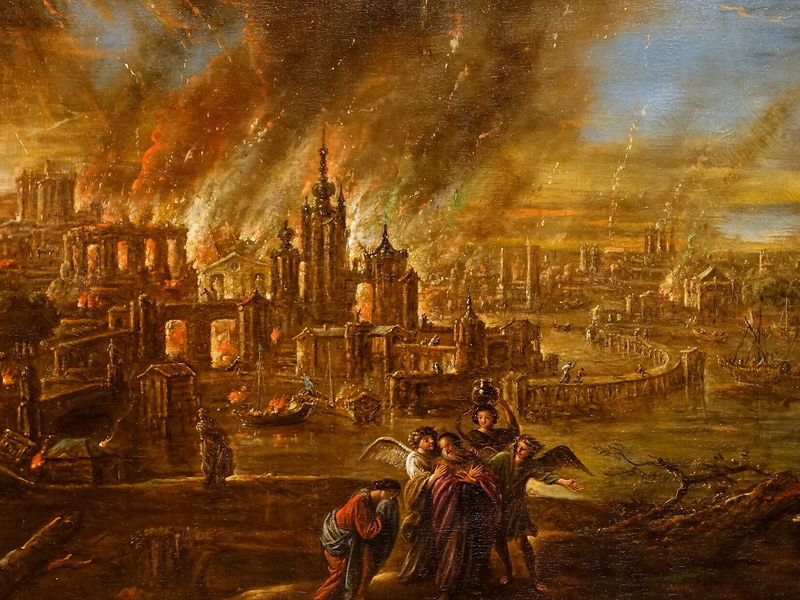
sodom_and_gomorrah_afire_by_jacob_jacobsz-_de_wet_d-_j-_probably_koln_c-_1680_oil_on_canvas_-_hessisches_landesmuseum_darmstadt_-_darmstadt_germany_-_dsc01149-e1632540497247
American Culture

American Sodom

For nearly a half-century, Sodom has been a key symbol in the American culture wars. On the one side, we have an aggressive movement among homosexuals that has first decriminalized homosexual conduct, then to force cultural and legal recognition of homosexuals as a minority and to normalize homosexual behaviors, finally…

by Peter LeithartJanuary 28, 2016
image-20150409-15244-1r08rsu
Biblical Theology

The Meaning of the Mount of Olives

Speaking of the Church, Romans 11:16-17 says, "And if the root be holy, the branches are also. But if some of the branches were broken off, and you, being a wild olive were grafted in among them and became partaker with them of the root of the fatness of the…

by James B. JordanJanuary 26, 2016
img_6134
Isaiah

No Sabbath for God

At the end of Isaiah 61, Yahweh's Servant rejoices because the Lord clothes Him with salvation and righteousness. He decks Him like a bridegroom with a garland on His head. He wears jewels like a bride. He is a new bridegroom in a new garden of Eden, a garden of…

by Peter LeithartJanuary 21, 2016
hebrew-manuscript-2
Biblical Law

Approaching the Torah

Before anything else, a word about “Torah” may be in order. I have been persuaded that “law” is a bad translation of “Torah,” even though it is evident that what is called “Torah” does have commandments, statutes, and ordinances in abundance. Why not “law?” “Law” as a translation for “Torah”…

by Ralph Allan SmithJanuary 19, 2016
jane-austen-2
Biblical Horizons

Jane Austen, Pundit

Few novelists seem as innocent of the temptation to punditry as Jane Austen. Though living through a period that witnessed the birth of an independent United States, the French Revolution and the Terror, the Napoleonic wars and the rise of revolutionary romanticism, and the upheavals of the Industrial Revolution, she…

by Peter LeithartJanuary 14, 2016

Showing page 137 of 309

See all

Showing page 35 of 43

See all

They Knew God

Natural law arguments often conclude that every human being can know, without the help of revelation, that there is some deity, an ultimate reality, an absolute. Paul says that human beings know “about God” from creation, but also that they “knew God ” (Romans 1:19, 21)—that is, from creation they…

January 21, 2014

Apocalyptic Politics

My latest First Things column sparked some reflections on apocalyptic politics from the Economist’s Erasmus columnist. He moves my observations about apocalyptic philosophy to apocalyptic politics. It comes up in all sorts of places. “Iran’s former president, Mahmoud Ahmadinejad, seemed obsessed with eschatology to a degree that irritated the country’s…

January 21, 2014
Uncategorized

Bashing Twitter’s Bashers

Roger Cohen is tired of Twitter bashers: “It’s not easy, being of a certain generation, to avoid the dinner conversation that veers into a lament about the short attention spans, constant device distraction, sad superficiality and online exhibitionism of a younger generation geared to life in 140 characters or less.…

January 21, 2014
Uncategorized

Charismatic work

“Work is charismatic,” writes Craig Keen in After Crucifixion (80-1). Keen elaborates in a beautiful passage: “What we are given to work upon precedes us, a gift sent our way the first five days of creation, the days when the Spirit hovered over the face of the waters, before our…

January 21, 2014
Uncategorized

Progress(es)

Progress, Eugen Rosenstock-Huessy points out ( Christian Future ), was originally a plural term. “ Les progres ” was Condorcet’s phrase. What he had in mind were improvements, new gadgets and machines and gizmos. The singular form of the term came from early Christianity and referred to the spiritual improvement…

January 21, 2014
Uncategorized

Science and Society

Sciences today often occupy ruts, separated from each other, each as incomprehensible to non-specialists as languages were at the tower of Babel, and separated too from the larger currents of culture. But it is a myth, Rosenstock-Huessy says ( Christian Future ), to believe that “sciences can advance without regard…

January 21, 2014

Showing page 702 of 2212

Browse by Category

In Medias Res

Your weekly digest for all things Theopolis.

Donate

Theopolis is nearly 100% donor-supported. Consider joining us on our mission.