Theopolis Logo

Writing

Explore our collection of theological essays, biblical studies, and reflections on faith and culture.

See all
actionvance-t7el2ig3jmc-unsplash
Esther

Genesis 1 and Genesis 8

I mentioned last month ( BH 82) in my essay "Like a Dove" that Genesis 8 is a recapitulation of Genesis 1. Let me explicate that assertion here. Of course, the world after the Flood is a new creation, so we may expect a recapitulation of the first creation. It…

by James B. JordanMarch 28, 1996

ben-white-w8qqn1pmqh0-unsplash
Daniel

Esther: Historical & Chronological Comments (I)

The book of Esther is one of the most neglected of the books of the Bible. To be sure, sermons are preached on it, and commentaries have occasionally been written on it, but almost without exception Esther has been interpreted in isolation from the rest of Biblical history, chronology, and…

by James B. JordanMarch 28, 1996

actionvance-t7el2ig3jmc-unsplash
Biblical Horizons

A Letter on Geocentricity

Dear Mr. ______, . . . Here is how I look at the geocentricity question. Since I don’t recall what I wrote you before, I may be repeating some things. 1. The Bible does not teach it. Biblical passages used to support the idea are being misinterpreted. My original paper…

by James B. JordanMarch 28, 1996
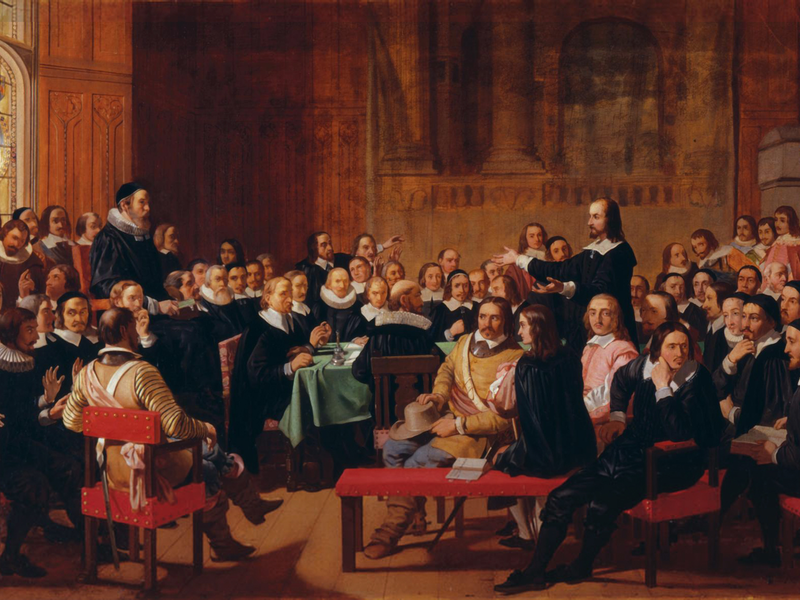
assertion_of_liberty_of_conscience_by_the_independents_of_the_westminster_assembly_of_divines_1644
Biblical Horizons

What is God?

Answer 4 of the Westminster Shorter Catechism is often taken as a magnificent answer to the question, "What is God?" It reads: "God is a Spirit, infinite, eternal, and unchangeable in his being, wisdom, power, holiness, justice, goodness, and truth." Presbyterians are fond of praising this statement, preaching on it,…

by James B. JordanFebruary 28, 1996
screenshot-2023-08-28-at-4-42-36-pm
Baptism

Like a Dove

The gospels tell us that at Jesus’ baptism, the Holy Spirit descended upon Him "in bodily form like a dove" (Luke 3:22 & parallels). Biblically sensitive commentators have associated this event with three Old Testament parallels: (1) the hovering of the Spirit over the creation in Genesis 1:2; (2) the…

by James B. JordanFebruary 28, 1996
tim-wildsmith-gzggi42wggm-unsplash
John

Jesus at Belshazzar’s Feast: Being an Explanatory Disquisition on an Aspect of the Story of the Woman Taken in Adultery

This they said to test him, that they might have some charge to bring against him. Jesus bent down and wrote with his finger on the ground. (John 8:6) The story of the woman taken in adultery (John 7:53-8:11) has been part of the canonical Christian Bible from its earliest…

by James B. JordanFebruary 28, 1996

Showing page 267 of 309

See all

Showing page 37 of 43

See all
Theology

Grace and nature

According to Fergus Kerr, it was Bonaventure, not Thomas, who first employed the axiom “grace does not destroy nature, but perfects it,” in his commentary on Peter Lombard’s Sentences.

March 31, 2006
Politics

Neutral public space

Markus wants to distinguish between the fact that people who act in the public realm always act with ultimate ends in view, and that their actions are either moral or immoral from the notion that there is a neutral public space. The public sphere, he claims, shouldn’t be thought of…

March 30, 2006
History

Constantinianism and Protest

RA Markus (Christianity and the Secular) argues that as the church celebrated the triumph of Christianity in the fourth century, they also wanted to maintain their continuity with the church that gave them birth - the persecuted church of the martyrs: “The great need felt by Christians of the post-Constantinian…

March 30, 2006
Politics

Two Modes of Secularism

Charles Taylor has suggested that secularism was an “exit strategy” from religious conflict. There were two exit strategies. In the summary by RA Markus, “The first, ‘the common ground strategy,’ assumes a certain range of beliefs shared by all Christians (or all theists) and minimises or eliminates confessional differences that…

March 30, 2006
Politics

Locke on religion

John Locke drew up the basic contours of the modern conception of religion as internal and private in his “Letter Concerning Toleration.” He made a sharp distinction between religious and civil realms: “The end of a religious society, as has already been said, is the public worship of God, and,…

March 30, 2006
Theology

Aquinas on Gratitude

Comments primarily on Aquinas on Gratitude/Ingratitude (primarily ST, II-II, qs 106-7). Aquinas describes gratitude as a virtue “annexed” to justice, and so to understand his discussion of gratitude, we must get some handle on what he means by justice. In ST II-II, q. 58, he describes justice as a virtue.…

March 30, 2006

Showing page 1864 of 2212

Browse by Category

In Medias Res

Your weekly digest for all things Theopolis.

Donate

Theopolis is nearly 100% donor-supported. Consider joining us on our mission.