
Theopolis Logo

Writing

Explore our collection of theological essays, biblical studies, and reflections on faith and culture.

See all
diego-gonzalez-i8ldurtfao-unsplash
Architecture

Arts and Play, Part 3

Let us now switch gears and move to a discussion of art, literature, architecture, and music. In English, we speak of "playing" games and also of "playing" musical instruments. There is a connection between the two, in that both involve some degree of pleasure and recreation. At the same time,…

by James B. JordanJanuary 23, 1992
venice-la-distruzione-del-tempio-di-gerusalemme-francesco-hayez-gallerie-accademia-venice
Daniel

The Abomination of Desolation, Part 4b: Abominable and Detestable

Leviticus 20:22-26 22. And you shall guard all My decrees and all My laws and do them, so that the land will not vomit you out, where I am bringing you thither to live in it. 23. And you shall not walk in the decrees of the nation that I…

by James B. JordanDecember 23, 1991
v4mkpbd70x7bkvc7mqvu
American Politics

The Original Low-Down Filthy Male Chauvinist Pig-Dog

For a year or so we have been reading about date rape. It amazes me how many "conservative" commentators have taken the attitude that "boys will be boys," and that it is somehow the girl’s fault if she lets the boy go too far. I have to agree that we…

by James B. JordanDecember 23, 1991
screen-shot-2023-04-04-at-5-01-54-pm
Biblical Chronology

Chronologies and Kings, Part 6: The Formation of the Remnant

According to 1 Kings 16:29, Ahab came to the throne of Israel in the 38th year of Asa of Judah, which was the year A.M. 3087. He reigned 22 years, dying in the year 3108. Ahab married a princess of Tyre named Jezebel (Jeze-baal). Under Jezebel’s influence, Ahab turned away…

by James B. JordanDecember 23, 1991
venice-la-distruzione-del-tempio-di-gerusalemme-francesco-hayez-gallerie-accademia-venice
Luke

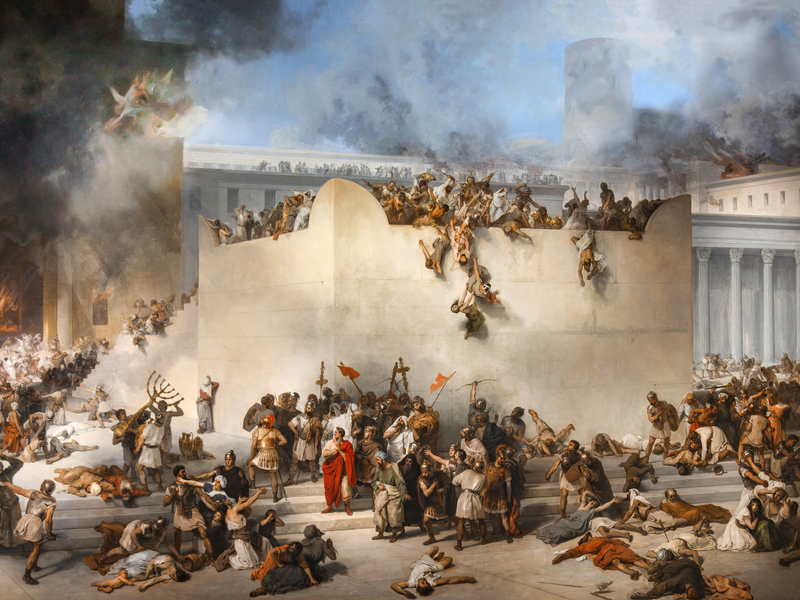
The Abomination of Desolation: Part 4, Abominable and Detestable

Part 1 Part 2 Part 3 Most Christians today, when they hear the phrase "abomination of desolation," think of some political figure who is to arrive on the scene some time in the future, and who will oppress God’s people. More careful exegetes have seen that the prophecies concerning "abomination…

by James B. JordanNovember 22, 1991
skyler-gerald-akljfvj5ym4-unsplash
Deuteronomy

Chronologies and Kings, Part 5: Testimonies of Two Witnesses

Deuteronomy 17:6 tells us that a matter is to be regarded as established if it is testified by two or three witnesses. One of the most important characteristics of Biblical chronology is that it is very often supported by more than one witness. A case in point is the fact…

by James B. JordanNovember 22, 1991

Showing page 293 of 309

See all

Showing page 39 of 43

See all
Literature

Ibsen

Ibsen, Steiner argues, did not write tragedies. Ibsen wrote “dramatic rhetoric” calling society to reform. For real tragedy, there is no such “solution” to be found, there is no remedy, except destructive sacrifice and perhaps a deus ex machina. From this angle, tragedy is perhaps among the STOICHEIA that prepared…

January 7, 2004
Literature

More Quotations from Steiner

Some more quotations from Steiner’s Death of Tragedy : “We cannot understand the romantic movement if we do not perceive at the heart of it the impulse toward drama . . . . The romantic mode is neither an ordering nor a criticism of life; it is a dramatization. And…

January 7, 2004
Theology

NT Wright’s Rutherford House Lecture

Some thoughts on NT Wright’s Rutherford House Lecture, August 2003. I have little disagreement with much of the lecture, and it clarified a number of things for me. Wright’s views on justification, however, continue to puzzle me at a number of points. Here’s an attempt to clarify my (or NTW’s)…

January 7, 2004
Theology

NT Wright’s Rutherford House Lecture

Some thoughts on NT Wright’s Rutherford House Lecture, August 2003. I have little disagreement with much of the lecture, and it clarified a number of things for me. Wright’s views on justification, however, continue to puzzle me at a number of points. Here’s an attempt to clarify my (or NTW’s)…

January 7, 2004
Literature

European Drama

Steiner notes that, following the Renaissance, European drama operated under the shadows of neo-classical and Elizabethan dramatic practice, the former “closed” and rigidly adhering to Aristotelian criteria, the other open and experimental. He discusses the theory of Thomas Rymer (a neo-classicist) at some length, concluding that the controversies that Rymer…

January 6, 2004
Literature

Shakespearean Difference

George Steiner in his Death of Tragedy describes the “Shakespearean difference” as mainly due to Shakespeare’s avoidance of fascination with Hellenic models: “The neo-classic view [which rigidified Aristotelian conceptions of tragedy] expresses a growing perception of the miracle of Greek drama. This perception was fragmentary. There were few translations of…

January 6, 2004

Showing page 2141 of 2212

Browse by Category

In Medias Res

Your weekly digest for all things Theopolis.

Donate

Theopolis is nearly 100% donor-supported. Consider joining us on our mission.