Theopolis Logo

Writing

Explore our collection of theological essays, biblical studies, and reflections on faith and culture.

See all
denise-jans-dpemksg59la-unsplash
Art

Glorifications Versus Debasement

Because of sin, the arts sometimes do not serve to glorify but to debase. Sinful men make their environments ugly, and create ugly art to “enhance” their ugly words. But since all men are still God’s images, no men are able to live with such ugliness all the time. Thus,…

by James B. JordanMay 25, 1994

jeremy-yap-j39x2xx_8cq-unsplash
Art

Words and Glory

Arts and literature reviews in most evangelical Christian publications generally approach their subjects in terms of ideology. We are told whether or not the film or book is acceptable in terms of morals, sexual graphicness, and theological accuracy. While there is definitely a place for such reviews, I fear that…

by James B. JordanMay 25, 1994
screen-shot-2018-04-12-at-9-48-08-am
Biblical Horizons

Broadening Our View of the Trinity

We speak of God as Father, Son, and Holy Spirit. The early Church tended to speak of Him as Father, Word, and Spirit. In this short essay, I want to suggest some other ways to think of the Trinity, ways that I have found pastorally helpful in my own life…

by James B. JordanMay 5, 1994
Biblical Studies

Thousands of Generations

I, Yahweh your God, am a jealous God, visiting the iniquity of the fathers on the children, on the third and fourth of those who hate Me, but showing lovingkindness to thousands, to those who love Me and guard My commandments (Ex. 20:5-6). The Second Word forbids acts of ceremonial…

by James B. JordanMay 5, 1994
ben-white-w8qqn1pmqh0-unsplash
Biblical Chronology

The Chronology of the Pentateuch (Part 3)

8. The Table of Nations If we assume births every two years, and about 30 years between generations (cp. Gen. 11:12-24), we can come up with an approximate series of dates for the generations recorded in Genesis 10. We shall assume that all three of Noah’s sons had their firstborn…

by James B. JordanMay 5, 1994
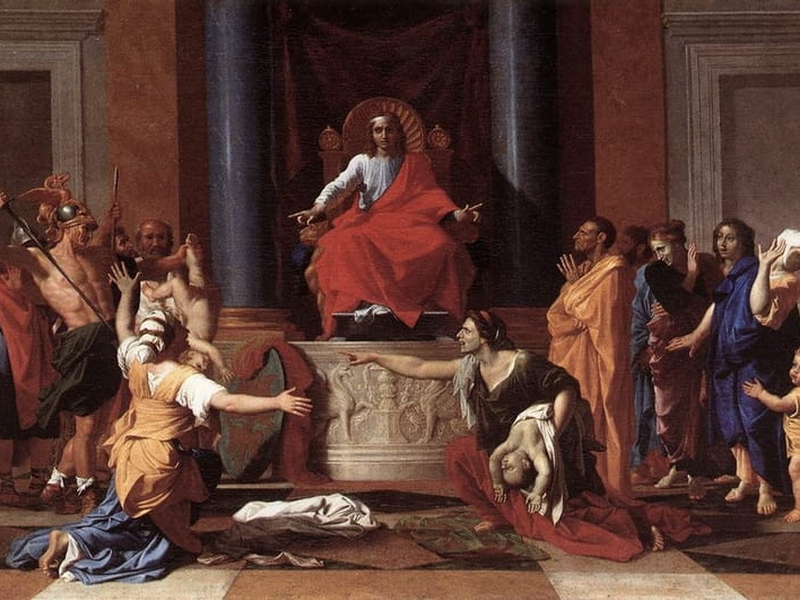
49980-nicolas_poussin_-_the_judgment_of_solomon_-_wga18330-800w-tn
Biblical Studies

The Eighth Month

Zechariah’s first prophecy (Zech. 1:1-6) was delivered in the eighth month of the second year of Darius. The notation of this date serves a number of purposes. Most obviously, it relates Zechariah’s prophecies to those of Haggai. By the time Zechariah delivered his first prophecy, Haggai had already chided the…

by Peter LeithartApril 23, 1994

Showing page 279 of 309

See all
See all
Politics

Machiavelli on Ingratitude

From Book 1 of the Discourses on Livy: FOR WHAT REASONS THE ROMANS WERE LESS UNGRATEFUL TO THEIR CITIZENS THAN THE ATHENIANS Whoever reads of the things done by Republics will find in all of them some species of ingratitude against their citizens, but he will find less in Rome…

March 21, 2006

What Plato Owed Athens

Socrates’ explanation of his willingness to submit to the laws of Athens, from the Crito. Since he owes the city his very existence, he has no right to renounce the laws when they turn against him: Soc. “And was that our agreement with you?” the law would say, “or were…

March 21, 2006
History

Renaissance on ingratitude

A few quotations from Renaissance writers on the subject of ingratitude, drawn from Catherine Dunn’s excellent 1946 CUA dissertation on the subject: Lodowick Bryskett argued that ingratitude was contrary to reason: “How shamefull a thing is it therefore to man, that brute beasts should give him examples of gratitude; and…

March 21, 2006

Persians and ingratitude

Xenophon describes the Persian training of boys in the Cyropaedia (1.2.6-7), highlighting the effects of ingratitude: “The boys go to school and give their time to learning justice and righteousness: they will tell you they come for that purpose, and the phrase is as natural with them as it is…

March 21, 2006

Aristotelian gratitude

Some excerpts from Aristotle’s discussion relevant to gratitude in Nicomachian Ethics. First, a treatment of the reasons for making return on a benefit received (from 9.1): “But who is to fix the worth of the service; he who makes the sacrifice or he who has got the advantage? At any…

March 21, 2006

Parenthood

Katherine Marsh writes in the March 13 TNR that parenthood is not what it was cracked up to be. Instead of bringing fulfillment and happiness, it turns out that parenthood is difficult, and a number of recent articles and studies have suggested that parents are more “sad, distracted or depressed”…

March 14, 2006

Showing page 1869 of 2212

Browse by Category

In Medias Res

Your weekly digest for all things Theopolis.

Donate

Theopolis is nearly 100% donor-supported. Consider joining us on our mission.