
Theopolis Logo

Writing

Explore our collection of theological essays, biblical studies, and reflections on faith and culture.

See all
screen-shot-2022-08-04-at-9-36-57-am
John

How Jesus Saved the World, Part 1

We are too used to reading the Gospels’ stories of Jesus’ arrest, trial, condemnation, and death from a devotional perspective and so we miss a lot of what’s going on. We actually have a difficult time trying to figure out the meaning of the details of the story. Of course,…

by Jeff MeyersFebruary 21, 2013
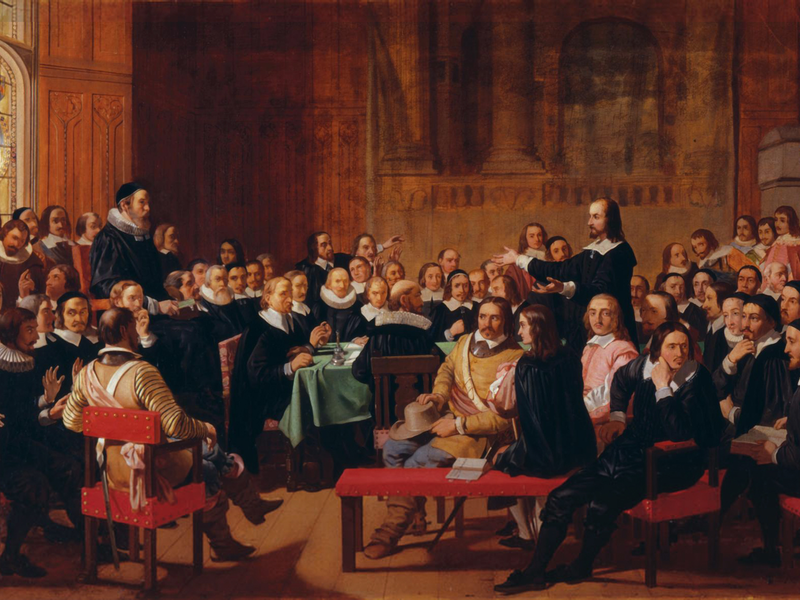
assertion_of_liberty_of_conscience_by_the_independents_of_the_westminster_assembly_of_divines_1644
Protestantism

The Forgotten Reformation?

This is the first in a series of essays on "Continuing the Reformation." Many different churches descend from the original Protestant Reformation, and those that are the most conservative are often insistent that they are largely if not completely true to the Reformation, or to the branch from which they…

by James B. JordanFebruary 19, 2013
markus-winkler-aid-xyrtlec-unsplash
Theopolis News

Reading the Bible

Trinity House fellow James B. Jordan will be teaching a one-day seminar on "How to Read the Bible for the First Time . . . Again" next Friday, February 22, in North London. The event is sponsored by Emmanuel Evangelical Church, Southgate, costs 20 pounds (10 for theology students) and…

by Peter LeithartFebruary 16, 2013
chris-leboutillier-be8mnfxzbgo-unsplash
Church Calendar

A Primer on Ash Wednesday

Audio Reading of this Post https://theopolis-blogcast.simplecast.com/episodes/a-primer-on-ash-wednesday What is Ash Wednesday? Ash Wednesday is the first day of Lent, a season focused on the sufferings and cross of Jesus. But Jesus’ death on the cross cannot be separated from the cross we are called to bear in union with him, so…

by Rich LuskFebruary 13, 2013
aaron-burden-qjdzyt_k8xg-unsplash
Theopolis News

Welcome

Welcome to the Trinity House web site. It’s unfinished, as you’ll soon discover, but it’s more finished than it was, and for that we are very grateful. Thanks to David Dalbey for the design, and to my son Sheffield for the execution. Trinity House exists to advance the reformation of…

by Peter LeithartFebruary 13, 2013
screen-shot-2022-05-12-at-12-07-23-pm
Biblical Horizons

More on the “Regeneration” Business

In our I hope brief blog-versation, Doug Wilson has posted a couple more things to think about. In one he asks who our father/Father is. We either have God or the devil as our father. Well, yes and no. I’m with Doug in what he’s getting at, I think, but…

by James B. JordanJune 23, 2012

Showing page 199 of 309

See all
See all
Philosophy

Hermeneutics v. Semiology

According to Michel Foucault, what Marx, Nietzsche, and Freud introduce is an age of interpretation. He develops one of the implications of this by suggesting there is a “fierce war” between semiology and hermeneutics, between treating words as signs and treating them as interpretations. Nietzsche in particular, Foucault claims, develops…

August 26, 2006
Literature

Shakespeare and Bible

Steven Marx’s Shakespeare and the Bible (Oxford, 2000), purports to be the “first book to explore the pattern and significance” of Shakespeare’s biblical allusions. Perhaps. The results are mixed. Each chapter of Marx’s book attempts to show structural, plot, and thematic parallels between a section of Scripture and a play…

August 26, 2006
Literature

Ubiquitous Shakespeare

Exploring Lake Superior in 1840, one Charles W Penny wrote, “We read the Bible I dare say much more than we would have done had we been in Detroit. Shakespeare was duly honoured, as he is every day when we travel. When on the water, some one of the party…

August 26, 2006

Divine Love

The Persons of the Trinity live out an eternal round of self-sacrificing love. If a proof text is needed, John 15 supplies it. 1) Jesus says, “as the Father loved Me, I have also loved you” (v. 9). Jesus’ love for the disciples is modeled on the Father’s for Him.…

August 26, 2006

Queen of the Sciences

John Stuart Mill declared at the beginning of his book on logic that “Logic is the common judge and arbiter of all particulars investigations. It does not undertake to find evidence, but to determine whether it has been found. Logic neither observes, nor invents, nor discovers; it judges.”

August 24, 2006
History

New

Hans Jonas writes in an essay on technological and scientific advance that one of the key cultural shifts in the sixteenth and seventeenth centuries was a, well, new understanding of “new,” and a corresponding revision of traditional ways of thinking about history: “A sign of this spreading mood is the…

August 24, 2006

Showing page 1804 of 2212

Browse by Category

In Medias Res

Your weekly digest for all things Theopolis.

Donate

Theopolis is nearly 100% donor-supported. Consider joining us on our mission.