Theopolis Logo

Writing

Explore our collection of theological essays, biblical studies, and reflections on faith and culture.

See all
kristina-flour-bcjdbykwquw-unsplash
Culture

On Foul Language

The Stranger: Do you have to use so many cuss words? The Dude: What the f*ck you talking about? - The Big Lebowski There was a man I knew, an elder at his church, who, whenever he was called upon to announce a pregnancy, preferred the euphemism “with child” because…

by Remy WilkinsJanuary 12, 2016

organ-pipes
How to Worship

Pipes Worth Playing

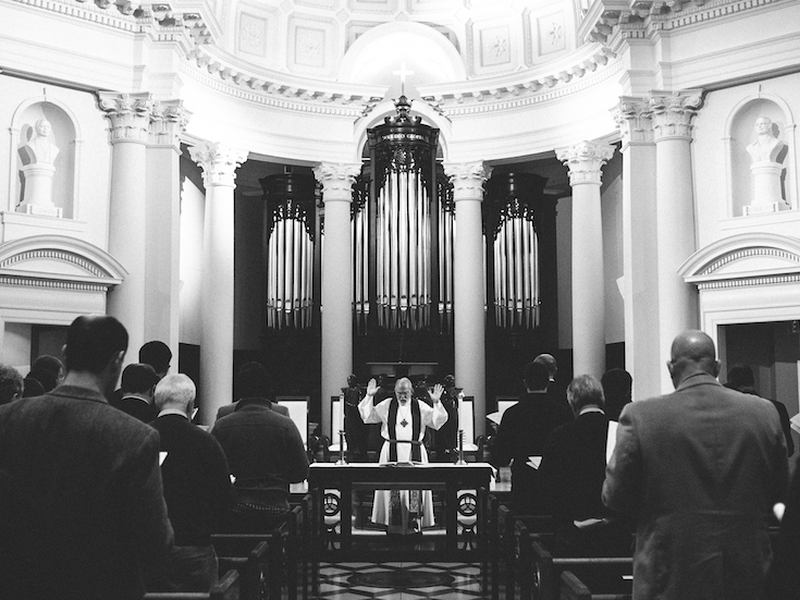
I know what you’re thinking. Organ: funeral, ball game, grand dusty cathedral. Why should modern Christians of such a technological age revisit a thousand year-old instrument? Don’t worry, I will not be trying to punch another hole in my Weird Music Preferences and Opinions card here. The truth is, our…

by Jarrod RicheyJanuary 7, 2016
tree-2
James

Do Things Have Natures?

Do things have natures? As I am posing the question, it is not simply a question of whether there are particular kinds of things in the world that have characteristic features, patterns of behavior, trajectories of growth and development. If that is what the word means, then the answer is…

by Peter LeithartJanuary 5, 2016
jim-leading-worship
Theopolis News

2016 Nevin Lectures with Father John Behr

We are excited to announce our 2016 Nevin Lectures featuring Father John Behr. Fr. John is the Dean of St. Vladimir's Seminary and Professor of Patristics, as well as the author of multiple works. He will be delivering three lectures over the course of two days dealing with "What Protestants…

by Brian MoatsJanuary 4, 2016
times-square
Creation

Time, Curse or Gift?

New Year's Day makes one reflective, at least about the past year, perhaps about life, perhaps, more broadly, about time itself. Many view time as a curse. Some see it as a curse because of missed chances. As one day or year moves on to the next, all we can…

by Peter LeithartDecember 31, 2015
nativity-2
Advent

The Manger

It seems a truism to say that we live in the world: that the world is outside of us. In reality the world is very much inside of us too. In fact the world passes through us as much as we pass through it. We breathe in its air, using…

by Arthur KayDecember 29, 2015

Showing page 138 of 309

See all
See all

Necessity of Incarnation

Would the Son have been incarnate if Adam had not sinned? 1 Corinthians 15:44-45 provides a prooftext for an affirmative answer. Verse 44 says that the “spiritual body” is implied by the existence of the “natural body.” Human beings were created in a natural state, but they were destined from…

August 12, 2006
Philosophy

Decentered Self of Modernity

Bishop Joseph Butler of Durham worried about the consequences of Locke’s empiricism: “That personality is not a permanent, but a transcient thing: that it lives and dies, begins and ends continually: that no one can any more remain one and the same person two moments together, than two successive moments…

August 12, 2006
History

Embedded mind

Modernity ignores the social, linguistic, and political context of thought, and the way interest shapes the mind; postmodernity foregrounds all this. Perhaps, but . . . . Descartes said that his travels demonstrates that “all those who hold notions strongly contrary to our own are not for that reason barbarians…

August 12, 2006
History

Self and World

For premoderns - ancients and medievals - there was a homology between the self and the world. Man was seen as microcosm, and, as Seigel puts it, they believed that “the world, like the self, is structured so as to fulfill intelligible moral ends.” The initial shift in early modernity,…

August 12, 2006
Philosophy

Birth of the Modern Self?

Seigel views with “considerable skepticism” the notion that Descartes constructed “a general theory of the human self and subject on the basis of the cogito .” In his treatise on the Passions of the Soul , Descartes claimed that the soul was linked with the body, which acts on the…

August 12, 2006
History

Purity

According to Seigel, “Descartes’s view of reason as most pure and solid when it was free of corruption by the world’s confusions implied nothing less than the attempt to break free of all social and cultural experience.” Not for the first time, I wish there were an anthropological history of…

August 12, 2006

Showing page 1812 of 2212

Browse by Category

In Medias Res

Your weekly digest for all things Theopolis.

Donate

Theopolis is nearly 100% donor-supported. Consider joining us on our mission.