Theopolis Logo

Writing

Explore our collection of theological essays, biblical studies, and reflections on faith and culture.

See all
timothy-eberly-djj49s6ud2o-unsplash
Leviticus

Yahweh's War Against Death

Stories, frankly all human stories are practically always about one thing aren’t they? Death. The inevitability of death. . . . “There is no such thing as a natural death. Nothing that happens to man is ever natural, since his presence calls the whole world into question. All men must…

by Brian MarrApril 14, 2014

screenshot-2023-09-21-at-4-52-42-pm
Matthew

Inescapable Blood

Matthew is organized around 5 discourses, which trace out the history of Jesus as a recapitulation of the history of God and Israel in the Old Testament. Jesus first speaks as a new Moses, instructing His disciples on a mountain about a righteousness that surpasses the righteousness of the scribes…

by Peter LeithartApril 10, 2014
screen-shot-2022-05-12-at-12-07-23-pm
Angels

Did Angels Marry People? The Sin of Cultural Intermarriage

The fall of the Sethites in Genesis 6 is the third fall of mankind, or the third degree of Adam’s original fall. Adam sinned in a Garden against his Father by stealing something he was supposed to wait to obtain. (“Every tree shall be food for you” Genesis 1:29.) Cain…

by James B. JordanApril 7, 2014
sixteen-miles-out-al48tflf4e8-unsplash
Angels

Did Angels Marry People? The Sons of God in Genesis 6

The recent fantasy film Noah and a slightly related blog comment by my friend Douglas Wilson have stirred up again the question of whether the “sons of God” in Genesis 6 who married the “daughters of men” were fallen angels or the priestly line of Seth. Doug argues for angels,…

by James B. JordanApril 4, 2014
kiwihug-l4gw27xzn1i-unsplash
Angels

The Angels of Jude

The prophecy of Jude concerns apostasy. An illustration of apostasy and its consequences is found in verse 6, which the New American Standard Bible translates this way: "And angels who did not keep their own domain, but abandoned their proper abode, He has kept in eternal bonds under darkness for…

by James B. JordanApril 3, 2014
screenshot-2023-09-21-at-4-22-42-pm
Matthew

Women at the Cross

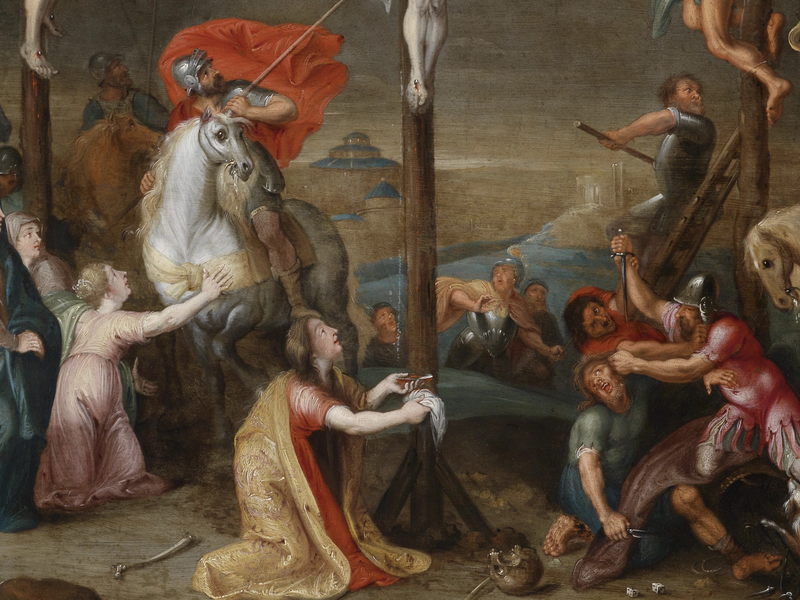
At His death, Jesus is surrounded by a Roman centurion and his cohort of Gentile solders. Matthew doesn't say that any disciples are there. But women are, and so is Joseph of Arimathea, identified as a “disciple” but, as John tells us, a “secret disciple for fear of the Jews,”…

by Peter LeithartMarch 31, 2014

Showing page 176 of 309

See all
See all
Theology

Image of God

Gil Baillie, working in a Girardian framework, suggests that the claim that man is made in the image of God means “this creature can only fulfill its destiny by becoming like someone else. So counterinstinctual and counterintuitive is such a thing, that the likelihood of this creature actually fulfilling such…

April 29, 2006
History

Creative destruction

Vitz suggests that postmodern thought has been largely an act of “creative destruction” serving as an “expose, in the best sense of the term.” The result is “a much large intellectual framework within which everyone, including Christians, can function. It provides a much bigger framework than that which existed fifty…

April 29, 2006
History

Modern self

Paul Vitz describes the modern self this way: “The modern self is characterized by such things as freedom and autonomy, by a strong will, and by the presumption that the self is self-created by the will, operating freely in its construction. The self is assumed to be strong, capable, and…

April 29, 2006
Philosophy

Metanarratives

Many Christians find Lyotard’s claim that postmodernity is incredulity toward metanarratives directly contrary to Christian faith, but James KA Smith offers an interpretation of Lyotard’s that is not hostile to Christianity. For Lyotard, he argues, the issue is not so much the scope of the narrative as the claims they…

April 29, 2006
History

Anti-antimedievalism

David Burrell writes, “Modernity was fairly constituted by a quite specific opposition to medieval thought, as we have noted, so could be called ‘post’ or even ‘antimedieval’ . . . this mode of thinking proceeded by avoiding, if not aggressively removing, any reference to creation and the creator/creature relation. It…

April 29, 2006

Cosmic mediation

Philo’s views on the mediation of the logos are summarized in the TDNT article on mediator: “Stretching from the middle of the world to the ends, and back from the extreme edges to the middle . . . [the logos] holds together all the parts of the world . .…

April 29, 2006

Showing page 1849 of 2212

Browse by Category

In Medias Res

Your weekly digest for all things Theopolis.

Donate

Theopolis is nearly 100% donor-supported. Consider joining us on our mission.