Theopolis Logo

Writing

Explore our collection of theological essays, biblical studies, and reflections on faith and culture.

See all
hebrew-manuscript-2
Atonement

Footstool of His Feet

The translation and theology of the Hebrew term kapporet have long been puzzling to scholars. On the translation of the term, I have nothing new to offer. I wish instead to concentrate on the theological symbolism of the kapporet . The kapporet was the solid gold slab that laid "above"…

by Peter LeithartMarch 9, 2017

screen-shot-2016-03-31-at-9-32-11-am
Art

The Hermeneutics of Haiku

“Three lines are enough” -Rabindranath Tagore My second favorite((I frequently use the “my second favorite” as a figure of speech meaning: “here’s a good one” and to also prompt the question, “What’s your first favorite?”)) haiku was written by some internet wag: Haikus are easy But sometimes they don’t make…

by Remy WilkinsMarch 7, 2017
neon-bible
Biblical Studies

The Scriptures Made Strange

The history of the Reformation couldn’t adequately be recounted without discussing the remarkable role played by the relatively recent innovations and developments in book production and printing. The printing press facilitated the rapid production and dissemination of multiple copies of pamphlets and books, which enabled the Reformers to circulate their…

by Alastair RobertsMarch 2, 2017
cross-grunwald
Church Calendar

School of Suffering

As evangelicals, we’re convinced that Christ’s work is finished, complete, and utterly sufficient. For many evangelicals, this is the gospel: Nothing can take away from Christ’s work, and surely nothing can be added to it by my works or my penance, by self-denial or sacraments or sacrifice. Nothing is lacking…

by Peter LeithartFebruary 28, 2017
img_0166
Eucharist

Worship and Ceremony: Part 1

Evangelicalism needs a return to formal and Biblical worship. Worship is a public act, performed on the surface of God's true altar, the world, before His throne. Man's chief end is to glorify and enjoy God, and worship is done for God's pleasure. It is man's highest privilege to dance…

by James B. JordanFebruary 23, 2017
paul
Romans

Grace Reigns In Death

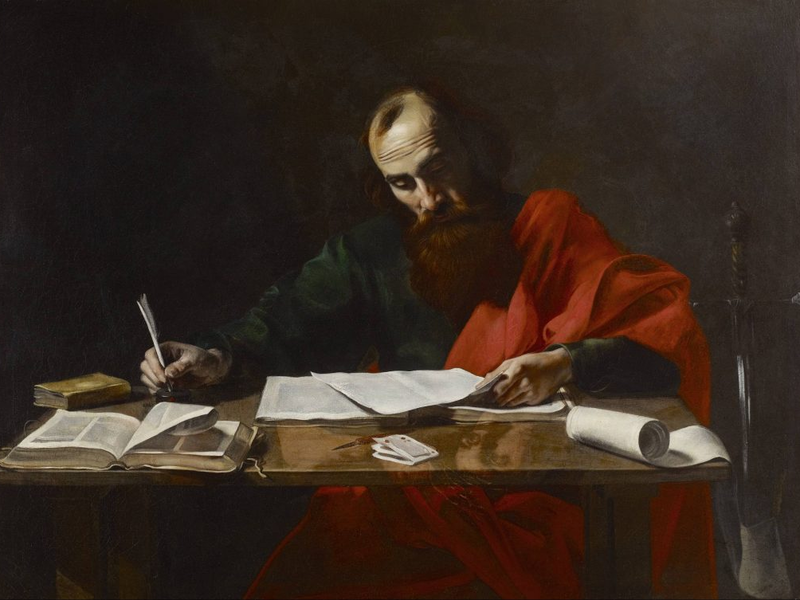
The evidence of sin and its death ruling in the world is clear. Paul describes the situation vividly in the opening section of his letter to the Romans. No matter who you are, Jew or Gentile, you have the same problem: you are “under sin” (Romans 3:9). Being under sin…

by Bill SmithFebruary 21, 2017

Showing page 116 of 309

See all
See all
Philosophy

Autonomy and Tragedy

Early in his Tragic Sense of Life , Unamuno captures the profound connection between autonomy and tragic character in a passage of hyperventilating passion: “The visible universe, the universe that is created by the instinct of self-preservation, becomes all to narrow for me. It is like a cramped cell, against…

December 10, 2003

Chiasm in Romans 3:19-31

There’s something chiastic going on in 3:19-31 (or maybe 2:25-3:30). A. by works of law no flesh shall be justified, 19-20 B. Apart from law, righteousness of God is revealed, 21 C. righteousness through faith in Jesus—> for all have sinned, 22-23 D. being justified as a gift through Jesus…

December 10, 2003
Literature

Spenserian Humor

A touch of Spenserian humor: Spenser has a witch create a false Florimell (Book 3) for her slothful and unattractive son, who is smitten with the beauty of the real Florimell. The witch uses materials from Petrarchan love sonnets to construct the lady ?Eactual lamps for eyes, actual golden wire…

December 9, 2003
Literature

Spenser and Milbank

Spenser might provide a Milbankian response to Milbank’s endorsement of homosexual sex and “threesomes.” In Book 3 of The Faerie Queene , Spenser’s heroine is Britomart, the lady knight who represents a militant chastity directed toward marital and sexual consummation rather than a fearful virginity that simply avoids sex. Britomart…

December 9, 2003
Literature

Hero and Eros

William Allan Oram in a book on Spenser writes that “one of the fruitful false etymologies of the Renaissance was the derivation of HERO from EROS: by this understanding, love does not hinder noble deeds but spurs them on.”

December 9, 2003
Literature

Shakespeare for Readers

Also in the November 7 TLS (belatedly on my desk) is a review of Lukas Erne’s Shakespeare as Literary Dramatist , in which Erne challenges the popularly accepted notion that Shakespeare was writing for viewers rather than readers. He shows that plays were being written for publication in Shakespeare’s time,…

December 9, 2003

Showing page 2154 of 2212

Browse by Category

In Medias Res

Your weekly digest for all things Theopolis.

Donate

Theopolis is nearly 100% donor-supported. Consider joining us on our mission.