Theopolis Logo

Writing

Explore our collection of theological essays, biblical studies, and reflections on faith and culture.

See all
actionvance-t7el2ig3jmc-unsplash
Esther

Genesis 1 and Genesis 8

I mentioned last month ( BH 82) in my essay "Like a Dove" that Genesis 8 is a recapitulation of Genesis 1. Let me explicate that assertion here. Of course, the world after the Flood is a new creation, so we may expect a recapitulation of the first creation. It…

by James B. JordanMarch 28, 1996

ben-white-w8qqn1pmqh0-unsplash
Daniel

Esther: Historical & Chronological Comments (I)

The book of Esther is one of the most neglected of the books of the Bible. To be sure, sermons are preached on it, and commentaries have occasionally been written on it, but almost without exception Esther has been interpreted in isolation from the rest of Biblical history, chronology, and…

by James B. JordanMarch 28, 1996

actionvance-t7el2ig3jmc-unsplash
Biblical Horizons

A Letter on Geocentricity

Dear Mr. ______, . . . Here is how I look at the geocentricity question. Since I don’t recall what I wrote you before, I may be repeating some things. 1. The Bible does not teach it. Biblical passages used to support the idea are being misinterpreted. My original paper…

by James B. JordanMarch 28, 1996

assertion_of_liberty_of_conscience_by_the_independents_of_the_westminster_assembly_of_divines_1644
Biblical Horizons

What is God?

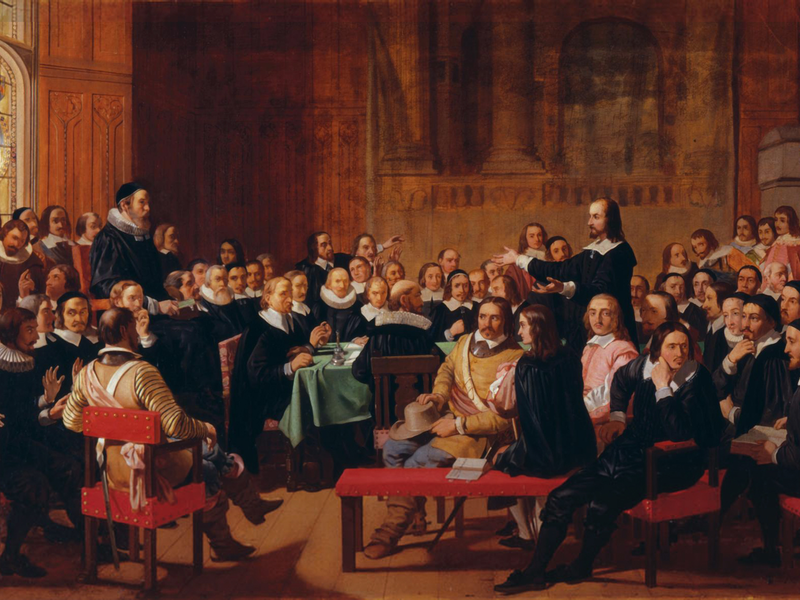
Answer 4 of the Westminster Shorter Catechism is often taken as a magnificent answer to the question, "What is God?" It reads: "God is a Spirit, infinite, eternal, and unchangeable in his being, wisdom, power, holiness, justice, goodness, and truth." Presbyterians are fond of praising this statement, preaching on it,…

by James B. JordanFebruary 28, 1996
screenshot-2023-08-28-at-4-42-36-pm
Baptism

Like a Dove

The gospels tell us that at Jesus’ baptism, the Holy Spirit descended upon Him "in bodily form like a dove" (Luke 3:22 & parallels). Biblically sensitive commentators have associated this event with three Old Testament parallels: (1) the hovering of the Spirit over the creation in Genesis 1:2; (2) the…

by James B. JordanFebruary 28, 1996
tim-wildsmith-gzggi42wggm-unsplash
John

Jesus at Belshazzar’s Feast: Being an Explanatory Disquisition on an Aspect of the Story of the Woman Taken in Adultery

This they said to test him, that they might have some charge to bring against him. Jesus bent down and wrote with his finger on the ground. (John 8:6) The story of the woman taken in adultery (John 7:53-8:11) has been part of the canonical Christian Bible from its earliest…

by James B. JordanFebruary 28, 1996

Showing page 267 of 309

See all

Showing page 5 of 43

See all

Really Lost

Last year, we got the first season of Lost on DVD and were instantly hooked. These guys sure know how to hold an audience. But for me the hold is weakening as we begin watching the second seson, as it becomes increasingly clear that all these people escaped from a…

September 21, 2006

In Praise of Coffee

An early modern document celebrates the purifying qualities of coffee: Coffee is good for “fat persons whose thickened humors circulate with difficulty.” And, it reduces impurities and generally clears out the system: “it restores the stomach, consumes its superfluous humidity, dissipates wind, dissolves the phlegm of the bowels, where it…

September 20, 2006
History

Descartes’s exorcism

Madness in what Foucault calls the “classical period” is conceived as a dazzlement - the madman is darkened with excessive light. In this context, “the Cartesian formula of doubt is certainly the great exorcism of madness. Descartes closes his eyes and plugs up his ears the better to see the…

September 20, 2006
History

Divine madness

For the Renaissance, Foucault argues, the line between madness and reason was thin and easily crossed. The madman, in fact, frequently gained insight that the sane did not; think Lear howling on the heath. Over time, madness and truth had been clearly distinguished, and madness ceased to be instructive. Foucault…

September 20, 2006

Exorcizing Zwingli

Dr Jim West is annoyed at me (http://drjimwest.wordpress.com/2006/09/19/confession-time-im-annoyed), though he doesn’t name me. He is responding to an article I wrote attacking what I called “Zwinglian poetics,” where I suggested that Protestants must “exorcise the ghost of Zwingli” if we are going to develop a solid Protestant poetics, which, I…

September 20, 2006

Showing page 1790 of 2212

Browse by Category

In Medias Res

Your weekly digest for all things Theopolis.

Donate

Theopolis is nearly 100% donor-supported. Consider joining us on our mission.