Theopolis Logo

Writing

Explore our collection of theological essays, biblical studies, and reflections on faith and culture.

See all
aaron-burden-h8s0pf2rcqs-unsplash
Galatians

The Restoration of the Galatians

While controversies over the writings of Paul continue in various corners of the intellectual globe, the word of God given through Paul and his scribe and all of the church’s interpreters and translators over the last two millennia is still readily available to the lofty and the lowly. Paul, as…

by Grace LangnessMarch 25, 2013

kiwihug-l4gw27xzn1i-unsplash
Deuteronomy

Law and History: How to Read the Law of Moses (Part 2)

The second in a series of studies in Deuteronomy. Deuteronomy 22:30: A man shall not take his father’s wife, and shall not uncover his father’s wing (Hebrew: kanaf ). There are a number of unusual features in this law that mark it out from the previous context, indicating that it…

by Ralph Allan SmithMarch 20, 2013
200403-moss-pilate-tease_pncfq5
History

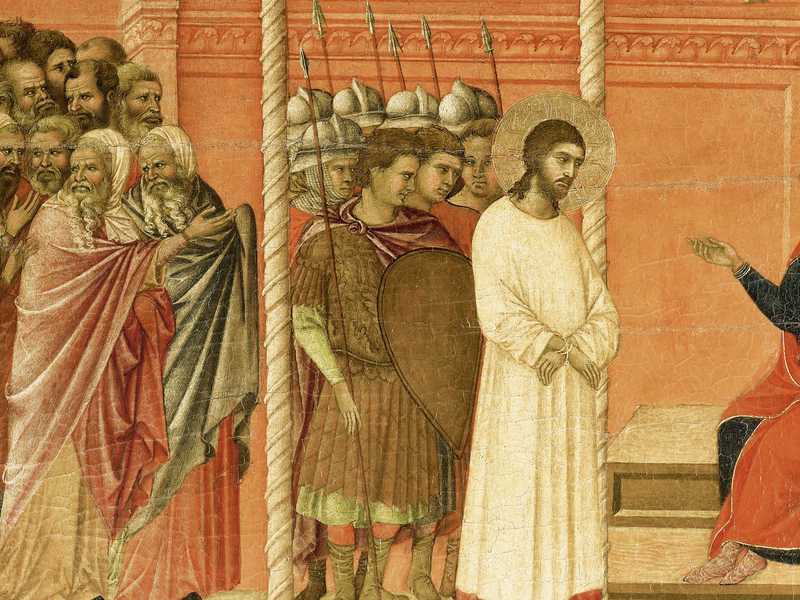
Victimhood and the Gospel

The texts of Christianity have been slowly at work, under the power of the Holy Spirit for 2000 years now. If we could be magically transported back into the world of two millennia ago, modern Americans would be shocked at the cruelty of that world. There was no concern for…

by Richard BledsoeMarch 18, 2013
aaron-burden-1ebsmyrau-s-unsplash
Luke

The Dysfunctional Family of the Gadarene Madman

The Story of the Gadarene Madman is told in all three synoptic Gospels (Matthew 8:28-34, Mark 5:1-20, Luke 8:26-37). Jesus ventures into a Gentile area when He passes over the Sea of Galilee. Upon disembarking from his boat, he is immediately met by a demon-possessed madman. Upon meeting Jesus, he…

by Richard BledsoeMarch 13, 2013
aaron-burden-1ebsmyrau-s-unsplash
Deuteronomy

Law and History: How to Read the Law of Moses

Part 1 of a multi-part series of studies on Deuteronomy 22:30-23:8. Eric Auerbach, in his classic work on Western literature, devotes his first chapter to contrasting Homer with the Bible. Of Homer, he writes of the “need of Homeric style to leave nothing which it mentions half in darkness and…

by Ralph Allan SmithMarch 12, 2013
markus-winkler-aid-xyrtlec-unsplash
Theopolis News

James Jordan in Korea, Japan

Trinity House Fellow James B. Jordan will be a speaker at an International Conference on Biblical Symbolism that will be held in Seoul on Monday, May 27 in 2013. He will address "The Importance of Biblical Symbolism and Symbolic Interpretation of the Bible." The conference will have three other speakers…

by Peter LeithartMarch 9, 2013

Showing page 197 of 309

See all

Showing page 5 of 43

See all

Exhortation, Third Epiphany

According to what has become the “traditional” interpretation of the Constitution, every American woman has the right to kill her unborn baby. Since the Roe v. Wade decision in January of 1973, over 45 million babies have been killed, and, though the abortion rate has slowed since 1990, more than…

January 22, 2006
Philosophy

Same and Other

Evaluating Levinas and his criticisms of Husserl, Derrida probes the coherence of Levinas’ notion of “infinitely other.” Contrary to Levinas, who argues that we are incorrectly seduced by everyday life to think of the other as an “alter ego,” Derrida says: “The other as alter ego signifies the other as…

January 21, 2006
Media

Art for Art

Adorno points out in an essay on television that “it would be romanticizing to assume that formlerly art was entirely pure, that the creative artist thought only in terms of the inner consistency of the artifact and not also of its effect upon the spectators. Theatrical art, in particular, cannot…

January 20, 2006

Sermons and such

Auden said, “In my opinion sermons should be a) fewer b) longer c) more theologically instructive and less exhortatory. I must confess that in my life I have very seldom heard a sermon from which I derived any real spiritual benefit. Most of them told me that I should love…

January 20, 2006

Totality and Dialogue

In “Violence and Metaphysics,” Derrida says that no “logos as absolute knowledge can comprehend the dialogue and the trajectory toward the other” because “the other is the other” and “all speech is for the other.” For Derrida, “A total logos still, in order to be logos, would have to let…

January 19, 2006
Philosophy

Eros and epistemology

For Aquinas, knowledge begins with knowledge of the effects of a thing. When faced with those effects, we naturally have a “desire to know about the cause what it is. This desire is one of wonder and causes inquiry.” The inquiry ceases when we arrive at knowledge of the essence…

January 19, 2006

Showing page 1896 of 2212

Browse by Category

In Medias Res

Your weekly digest for all things Theopolis.

Donate

Theopolis is nearly 100% donor-supported. Consider joining us on our mission.