Theopolis Logo

Writing

Explore our collection of theological essays, biblical studies, and reflections on faith and culture.

See all
noahs-ark-genesis
Biblical Horizons

Who Rules the Land? The Meaning of the Noahic Covenant, Part 1

It is commonly held in Reformed thought that the Noahic Covenant is given to all men equally. The Noahic Covenant concerns "man," not simply "church," and establishes civil government as an institution among "mankind" — that is the theory. Sometimes the Noahic Covenant is regarded as a "covenant of common…

by James B. JordanNovember 23, 1990

tanner-mardis-xuxghzhibn4-unsplash-1-2
Daniel

The Babylonian Connection

The Fall of Jerusalem we have dated (provisionally) at 3426 Anno Mundi. In current B.C. dates this is 586 B.C. From this point forward in Biblical chronology we are required to make use of prophetic numbers rather than historical ones. Jeremiah prophesied that the captivity would last 70 years, but…

by James B. JordanNovember 16, 1990
screen-shot-2021-08-12-at-2-57-54-pm
Biblical Horizons

Taking the Situation Seriously

Evangelicals have in recent years become more interested in looking into their Bibles for wisdom to deal with modern problems. This is undoubtedly a welcome development, after many years of neglect. But there are dangers and costs as well. One of these is the tendency to fall into a modern…

by Peter LeithartOctober 19, 1990
carlo-alberto-burato-smdx3gleu_m-unsplash
Hermeneutics

The Unseen Things

Now faith is the substance of things hoped for, the evidence of things not seen (Hebrews 11:1). The famous definition of faith with which the eleventh chapter of Hebrews opens has received a number of different interpretations. The crux of the problem is the interpretation of the words translated in…

by Peter LeithartOctober 19, 1990
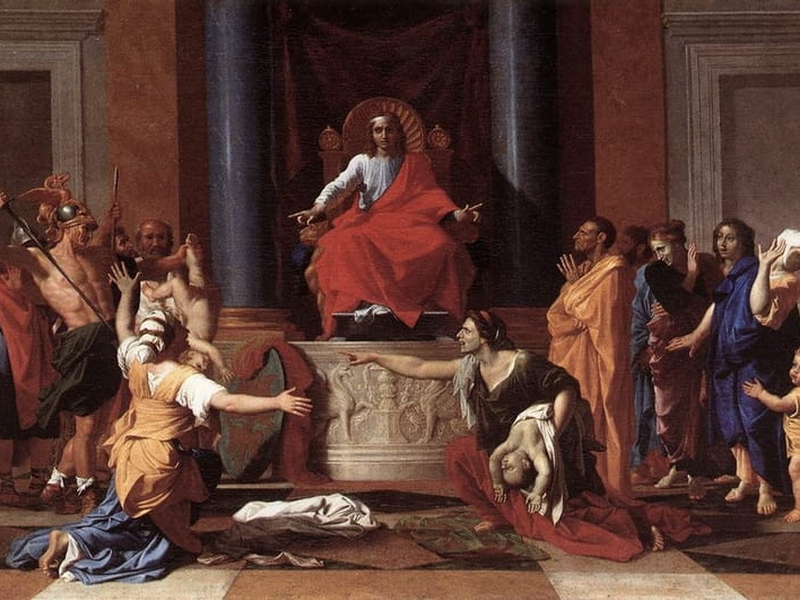
49980-nicolas_poussin_-_the_judgment_of_solomon_-_wga18330-800w-tn
Proverbs

Advice From a Sojourner, Part 8

15. The leech has two daughters, "Give," "Give." There are three things that will not be satisfied, Four that will not say, "Enough": 16. Sheol, And the barren womb, Earth, that is never satisfied with water, And fire that never says, "Enough." We are assuming, at least for the purposes…

by James B. JordanOctober 16, 1990
tanner-mardis-xuxghzhibn4-unsplash-1-2
Biblical Chronology

Confusion Among the Kings

As we have seen in previous installments in this series, the Old Testament is quite concerned with chronology, and carefully records chronological data for our use. For this reason, we can assume when we come to the chronology of the kings of Judah and Israel that the writers of the…

by James B. JordanOctober 2, 1990

Showing page 301 of 309

See all

Showing page 6 of 43

See all

Necessity of Incarnation

Would the Son have been incarnate if Adam had not sinned? 1 Corinthians 15:44-45 provides a prooftext for an affirmative answer. Verse 44 says that the “spiritual body” is implied by the existence of the “natural body.” Human beings were created in a natural state, but they were destined from…

August 12, 2006
Philosophy

Decentered Self of Modernity

Bishop Joseph Butler of Durham worried about the consequences of Locke’s empiricism: “That personality is not a permanent, but a transcient thing: that it lives and dies, begins and ends continually: that no one can any more remain one and the same person two moments together, than two successive moments…

August 12, 2006
History

Embedded mind

Modernity ignores the social, linguistic, and political context of thought, and the way interest shapes the mind; postmodernity foregrounds all this. Perhaps, but . . . . Descartes said that his travels demonstrates that “all those who hold notions strongly contrary to our own are not for that reason barbarians…

August 12, 2006
History

Self and World

For premoderns - ancients and medievals - there was a homology between the self and the world. Man was seen as microcosm, and, as Seigel puts it, they believed that “the world, like the self, is structured so as to fulfill intelligible moral ends.” The initial shift in early modernity,…

August 12, 2006
Philosophy

Birth of the Modern Self?

Seigel views with “considerable skepticism” the notion that Descartes constructed “a general theory of the human self and subject on the basis of the cogito .” In his treatise on the Passions of the Soul , Descartes claimed that the soul was linked with the body, which acts on the…

August 12, 2006
History

Purity

According to Seigel, “Descartes’s view of reason as most pure and solid when it was free of corruption by the world’s confusions implied nothing less than the attempt to break free of all social and cultural experience.” Not for the first time, I wish there were an anthropological history of…

August 12, 2006

Showing page 1812 of 2212

Browse by Category

In Medias Res

Your weekly digest for all things Theopolis.

Donate

Theopolis is nearly 100% donor-supported. Consider joining us on our mission.