Theopolis Logo

Writing

Explore our collection of theological essays, biblical studies, and reflections on faith and culture.

See all
emmanuel-phaeton-1bwmfmvybi8-unsplash
Biblical Studies

The Impracticality of Application

I have never heard anyone say that the Bible is impractical, but I have heard people, after an in depth exegesis of a passage, ask for the practical application. Offer a class on childrearing, marriage, finance and the church members flock to it; offer a course on Leviticus, the visions…

by Remy WilkinsJuly 4, 2017

abraham-and-isaac-from-below
Biblical Theology

Stones and Fruit: Divination and Procreation – (Part One)

Stones External and Internal The modern practice of dismantling the Bible into a shambles of documents authored in response to disparate historical events rather than viewing it as a unified testimony inspired by God is a surefire way to miss what is actually going on in the text. This failure…

by Mike BullJune 29, 2017
asa

The Tragedy of Asa

King Asa of Judah made a strong start, purging the land of idols, altars, and images, and winning a war against the ginormous Cushite army led by Zerach. It all unraveled in his final years. From his thirty-fifth year to the forty-first year, when his reign came to an end,…

by Peter LeithartJune 27, 2017
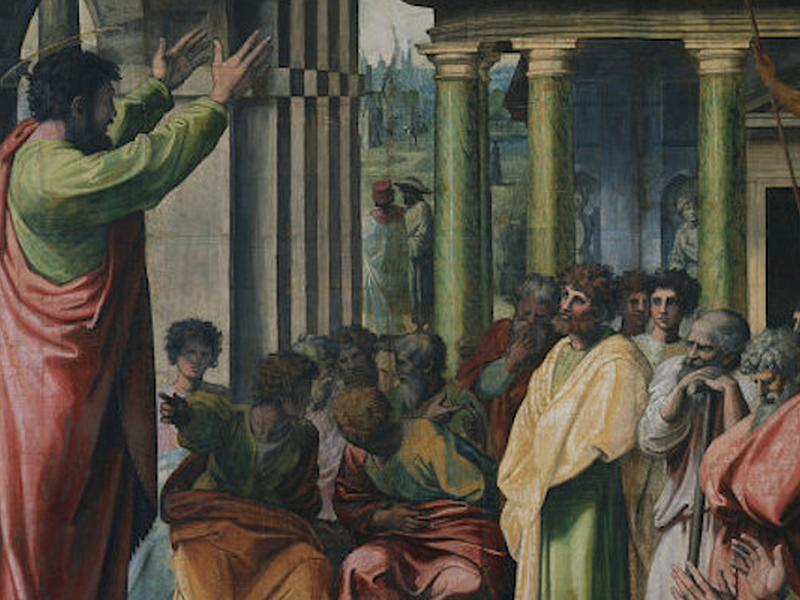
paul-athens
Romans

Justified by the King

What appears to be Paul’s first recorded statement on justification comes in Acts 13, in a sermon at Pisidian Antioch. It's can serve as a summary of Paul's letter to the Romans, and throws some important light on the themes of that letter. Paul begins his sermon with a quick…

by Peter LeithartJune 22, 2017
e99a2994
Literature

Biblical Allusion and the Meaning of Othello, (Part 2)

Iago as Tempter The answer to our first question — whether or not Othello is really great tragedy — has already pointed the way to the answer for the second question — Was Othello a noble Moor or a fool? The two questions, of course, are necessarily related. The fall…

by Ralph Allan SmithJune 20, 2017
e99a9331-2
Theopolis News

Adam McIntosh Completes the Certificate Program

When Adam McIntosh was ordained as Pastor of Saint David’s Church (CREC) in Houston on June 11, 2017, it was the culmination of decades of preparation. Adam is the product of two continents and three Christian traditions. Born in Paducah, Kentucky, he lived his early years partly in Jericho, where…

by Peter LeithartJune 17, 2017

Showing page 110 of 309

See all

Showing page 7 of 43

See all
Literature

Living in fictions

In a discussion of King Lear , David Bevington suggests that Edgar saves his father at the cliffs of Dover by constructing a cosmology in which the gods are merciful and perform miracles: “Edgar stages his fiction in this particular way because he knows his father well enough to realize…

December 27, 2006
Literature

Tyranny of gratitude

Many of Shakespeare’s plays explore the moral and political consequences of ingratitude, but Shakespeare is also cognizant of the tyrannical uses to which the demand for gratitude may be put. Lear is certainly about ingratitude, the “marble-hearted fiend” that infects and distorts the monsters of ingratitude Goneril and Regan, as…

December 27, 2006
Theology

In praise of Pietism

Friedrich Oetinger was a leading German pietist intellectual and theologian, deeply interested in the science of his day. And critical of science and rationalist philosophy as well. Against thinkers who placed a primacy on reason, Oetinger argued that sheer logical clarity is insufficient “for living knowledge.” Living knowledge takes form…

December 26, 2006

Communion in humor

I tell a joke, and you get it. I include a veiled allusion to, say, Faust in a casual conversation; you catch it; and we exchange a mental wink. Humor provides a pathway into the hermeneutics of texts and communication. It also seems to provide a pathway into the sociology…

December 26, 2006

Keeping in mind

Gadamer notes the ambiguity of “keeping something in mind.” We sometimes hold something in our mental “gaze” in order to knock into it head on. We watch it carefully until we can grab it. But keeping in mind can also be a form of forgetfulness. We might also keep something…

December 26, 2006
History

Mysticism and culture

Gadamer notes that the concept of Bildung (culture) has its origins in medieval and baroque mysticism, and continues to carry a mystical connotation when it begins to be used of the cultivated humanness. Von Humboldt, for instance, says “when in our language we say Bildung, we mean something both higher…

December 26, 2006

Showing page 1747 of 2212

Browse by Category

In Medias Res

Your weekly digest for all things Theopolis.

Donate

Theopolis is nearly 100% donor-supported. Consider joining us on our mission.