Theopolis Logo

Writing

Explore our collection of theological essays, biblical studies, and reflections on faith and culture.

See all
denise-jans-dpemksg59la-unsplash
Art

Glorifications Versus Debasement

Because of sin, the arts sometimes do not serve to glorify but to debase. Sinful men make their environments ugly, and create ugly art to “enhance” their ugly words. But since all men are still God’s images, no men are able to live with such ugliness all the time. Thus,…

by James B. JordanMay 25, 1994

jeremy-yap-j39x2xx_8cq-unsplash
Art

Words and Glory

Arts and literature reviews in most evangelical Christian publications generally approach their subjects in terms of ideology. We are told whether or not the film or book is acceptable in terms of morals, sexual graphicness, and theological accuracy. While there is definitely a place for such reviews, I fear that…

by James B. JordanMay 25, 1994

screen-shot-2018-04-12-at-9-48-08-am
Biblical Horizons

Broadening Our View of the Trinity

We speak of God as Father, Son, and Holy Spirit. The early Church tended to speak of Him as Father, Word, and Spirit. In this short essay, I want to suggest some other ways to think of the Trinity, ways that I have found pastorally helpful in my own life…

by James B. JordanMay 5, 1994
Biblical Studies

Thousands of Generations

I, Yahweh your God, am a jealous God, visiting the iniquity of the fathers on the children, on the third and fourth of those who hate Me, but showing lovingkindness to thousands, to those who love Me and guard My commandments (Ex. 20:5-6). The Second Word forbids acts of ceremonial…

by James B. JordanMay 5, 1994
ben-white-w8qqn1pmqh0-unsplash
Biblical Chronology

The Chronology of the Pentateuch (Part 3)

8. The Table of Nations If we assume births every two years, and about 30 years between generations (cp. Gen. 11:12-24), we can come up with an approximate series of dates for the generations recorded in Genesis 10. We shall assume that all three of Noah’s sons had their firstborn…

by James B. JordanMay 5, 1994
49980-nicolas_poussin_-_the_judgment_of_solomon_-_wga18330-800w-tn
Biblical Studies

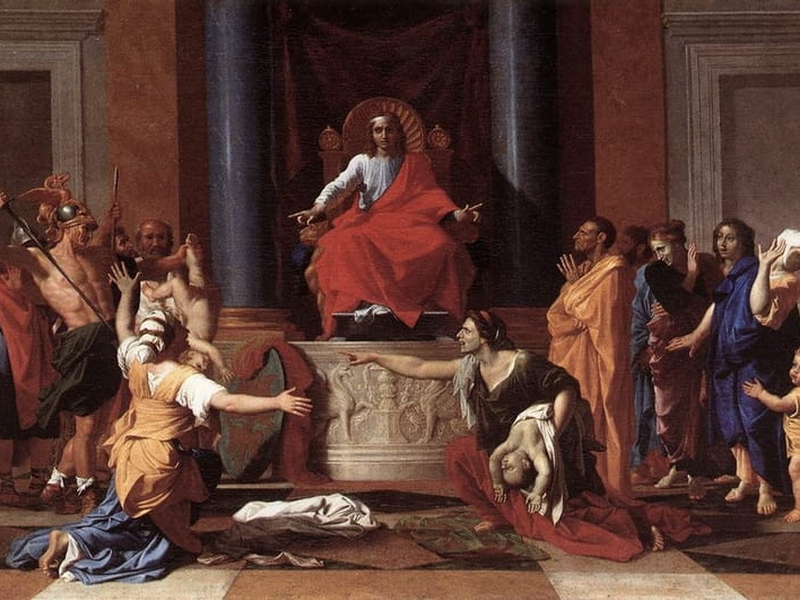
The Eighth Month

Zechariah’s first prophecy (Zech. 1:1-6) was delivered in the eighth month of the second year of Darius. The notation of this date serves a number of purposes. Most obviously, it relates Zechariah’s prophecies to those of Haggai. By the time Zechariah delivered his first prophecy, Haggai had already chided the…

by Peter LeithartApril 23, 1994

Showing page 279 of 309

See all

Showing page 7 of 43

See all
Theology

Image of God

Gil Baillie, working in a Girardian framework, suggests that the claim that man is made in the image of God means “this creature can only fulfill its destiny by becoming like someone else. So counterinstinctual and counterintuitive is such a thing, that the likelihood of this creature actually fulfilling such…

April 29, 2006
History

Creative destruction

Vitz suggests that postmodern thought has been largely an act of “creative destruction” serving as an “expose, in the best sense of the term.” The result is “a much large intellectual framework within which everyone, including Christians, can function. It provides a much bigger framework than that which existed fifty…

April 29, 2006
History

Modern self

Paul Vitz describes the modern self this way: “The modern self is characterized by such things as freedom and autonomy, by a strong will, and by the presumption that the self is self-created by the will, operating freely in its construction. The self is assumed to be strong, capable, and…

April 29, 2006
Philosophy

Metanarratives

Many Christians find Lyotard’s claim that postmodernity is incredulity toward metanarratives directly contrary to Christian faith, but James KA Smith offers an interpretation of Lyotard’s that is not hostile to Christianity. For Lyotard, he argues, the issue is not so much the scope of the narrative as the claims they…

April 29, 2006
History

Anti-antimedievalism

David Burrell writes, “Modernity was fairly constituted by a quite specific opposition to medieval thought, as we have noted, so could be called ‘post’ or even ‘antimedieval’ . . . this mode of thinking proceeded by avoiding, if not aggressively removing, any reference to creation and the creator/creature relation. It…

April 29, 2006

Cosmic mediation

Philo’s views on the mediation of the logos are summarized in the TDNT article on mediator: “Stretching from the middle of the world to the ends, and back from the extreme edges to the middle . . . [the logos] holds together all the parts of the world . .…

April 29, 2006

Showing page 1849 of 2212

Browse by Category

In Medias Res

Your weekly digest for all things Theopolis.

Donate

Theopolis is nearly 100% donor-supported. Consider joining us on our mission.