Theopolis Logo

Writing

Explore our collection of theological essays, biblical studies, and reflections on faith and culture.

See all
diego-gonzalez-i8ldurtfao-unsplash
Architecture

Arts and Play, Part 3

Let us now switch gears and move to a discussion of art, literature, architecture, and music. In English, we speak of "playing" games and also of "playing" musical instruments. There is a connection between the two, in that both involve some degree of pleasure and recreation. At the same time,…

by James B. JordanJanuary 23, 1992
venice-la-distruzione-del-tempio-di-gerusalemme-francesco-hayez-gallerie-accademia-venice
Daniel

The Abomination of Desolation, Part 4b: Abominable and Detestable

Leviticus 20:22-26 22. And you shall guard all My decrees and all My laws and do them, so that the land will not vomit you out, where I am bringing you thither to live in it. 23. And you shall not walk in the decrees of the nation that I…

by James B. JordanDecember 23, 1991
v4mkpbd70x7bkvc7mqvu
American Politics

The Original Low-Down Filthy Male Chauvinist Pig-Dog

For a year or so we have been reading about date rape. It amazes me how many "conservative" commentators have taken the attitude that "boys will be boys," and that it is somehow the girl’s fault if she lets the boy go too far. I have to agree that we…

by James B. JordanDecember 23, 1991
screen-shot-2023-04-04-at-5-01-54-pm
Biblical Chronology

Chronologies and Kings, Part 6: The Formation of the Remnant

According to 1 Kings 16:29, Ahab came to the throne of Israel in the 38th year of Asa of Judah, which was the year A.M. 3087. He reigned 22 years, dying in the year 3108. Ahab married a princess of Tyre named Jezebel (Jeze-baal). Under Jezebel’s influence, Ahab turned away…

by James B. JordanDecember 23, 1991
venice-la-distruzione-del-tempio-di-gerusalemme-francesco-hayez-gallerie-accademia-venice
Luke

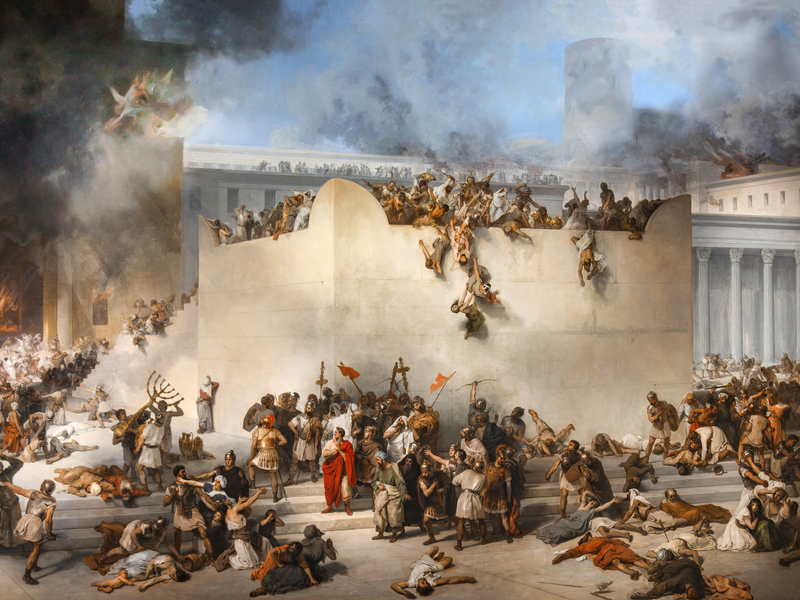
The Abomination of Desolation: Part 4, Abominable and Detestable

Part 1 Part 2 Part 3 Most Christians today, when they hear the phrase "abomination of desolation," think of some political figure who is to arrive on the scene some time in the future, and who will oppress God’s people. More careful exegetes have seen that the prophecies concerning "abomination…

by James B. JordanNovember 22, 1991
skyler-gerald-akljfvj5ym4-unsplash
Deuteronomy

Chronologies and Kings, Part 5: Testimonies of Two Witnesses

Deuteronomy 17:6 tells us that a matter is to be regarded as established if it is testified by two or three witnesses. One of the most important characteristics of Biblical chronology is that it is very often supported by more than one witness. A case in point is the fact…

by James B. JordanNovember 22, 1991

Showing page 293 of 309

See all

Showing page 8 of 43

See all

Conveniens

Bauerschmidt notes that Aquinas frequently argues, especially when speaking of the incarnation, not for “proof” of doctrine but for its “fittingness.” Reason has the role of “manifesting how [the incarnation] fits together (convenire means literally ‘to come together’) with other things that Christians hold true about God.” Perhaps this can…

March 23, 2006

Extra-Augustinisticum

In Epistle 137, Augustine writes: “The Christian teaching nowhere holds that God was so poured into human flesh as either to desert or lose - or to transfer and, as it were, compress within this frail body - the care of governing the universe. This is the thought of people…

March 23, 2006

Thomas on Merit

Commenting on ST I-II, q. 109, Frederick Bauerschmidt says that Thomas uses the word “merit” analogically when we speak of God rewarding human action “since we can act in the first place only because God has given us the capacity to act.” This applies even to Jesus: “even when Thomas…

March 23, 2006

On Seneca, de Beneficiis, Books 1-2

Seneca suggests that ingratitude is the worst of vices, and nothing is more “harmful to society” than ingratitude (I.1). Later in Book I, he lists a series of moral ills that plague society – “homicides, tyrants, thieves, adulterers, ravishers, sacrilegious, traitors” – but concludes that “worse than all these is…

March 23, 2006
Literature

Prospero the Magus

I am grateful to Ralph Smith for references to Frances Yates’ work on Shakespeare’s plays. In an analysis of The Tempest, Frances Yates writes: “It is inevitable and unavoidable in thinking of Prospero to bring in the name of John Dee, the great mathematical magus of whom Shakespeare must have…

March 22, 2006
History

Elizabethan Magic

Educated Elizabethans lived in a world of similitudes. As EMW Tillyard argued, the Elizabethan world picture was constituted by a series of analogous chains of being. The social world manifested and was manifested by the natural world; the universe as a whole resembled human beings; there was a hierarchy among…

March 22, 2006

Showing page 1867 of 2212

Browse by Category

In Medias Res

Your weekly digest for all things Theopolis.

Donate

Theopolis is nearly 100% donor-supported. Consider joining us on our mission.