Theopolis Logo

Writing

Explore our collection of theological essays, biblical studies, and reflections on faith and culture.

See all
actionvance-t7el2ig3jmc-unsplash
Esther

Genesis 1 and Genesis 8

I mentioned last month ( BH 82) in my essay "Like a Dove" that Genesis 8 is a recapitulation of Genesis 1. Let me explicate that assertion here. Of course, the world after the Flood is a new creation, so we may expect a recapitulation of the first creation. It…

by James B. JordanMarch 28, 1996

ben-white-w8qqn1pmqh0-unsplash
Daniel

Esther: Historical & Chronological Comments (I)

The book of Esther is one of the most neglected of the books of the Bible. To be sure, sermons are preached on it, and commentaries have occasionally been written on it, but almost without exception Esther has been interpreted in isolation from the rest of Biblical history, chronology, and…

by James B. JordanMarch 28, 1996

actionvance-t7el2ig3jmc-unsplash
Biblical Horizons

A Letter on Geocentricity

Dear Mr. ______, . . . Here is how I look at the geocentricity question. Since I don’t recall what I wrote you before, I may be repeating some things. 1. The Bible does not teach it. Biblical passages used to support the idea are being misinterpreted. My original paper…

by James B. JordanMarch 28, 1996

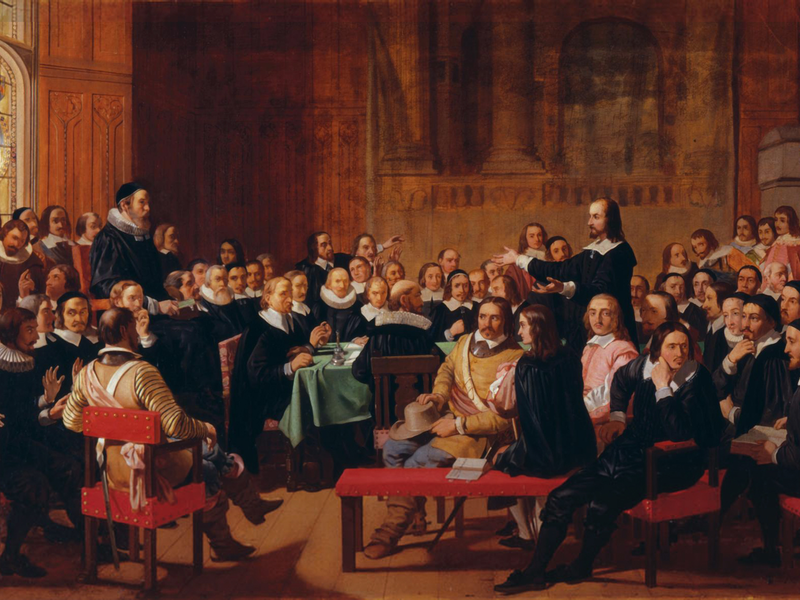
assertion_of_liberty_of_conscience_by_the_independents_of_the_westminster_assembly_of_divines_1644
Biblical Horizons

What is God?

Answer 4 of the Westminster Shorter Catechism is often taken as a magnificent answer to the question, "What is God?" It reads: "God is a Spirit, infinite, eternal, and unchangeable in his being, wisdom, power, holiness, justice, goodness, and truth." Presbyterians are fond of praising this statement, preaching on it,…

by James B. JordanFebruary 28, 1996
screenshot-2023-08-28-at-4-42-36-pm
Baptism

Like a Dove

The gospels tell us that at Jesus’ baptism, the Holy Spirit descended upon Him "in bodily form like a dove" (Luke 3:22 & parallels). Biblically sensitive commentators have associated this event with three Old Testament parallels: (1) the hovering of the Spirit over the creation in Genesis 1:2; (2) the…

by James B. JordanFebruary 28, 1996
tim-wildsmith-gzggi42wggm-unsplash
John

Jesus at Belshazzar’s Feast: Being an Explanatory Disquisition on an Aspect of the Story of the Woman Taken in Adultery

This they said to test him, that they might have some charge to bring against him. Jesus bent down and wrote with his finger on the ground. (John 8:6) The story of the woman taken in adultery (John 7:53-8:11) has been part of the canonical Christian Bible from its earliest…

by James B. JordanFebruary 28, 1996

Showing page 267 of 309

See all
See all
Theology

Hegel the pietist

Still further evidence that a) Hegel can’t get away from Kant’s pietism and b) Hamann would have been as right about Hegel as he was about Kant.  Jean-Marie Schaeffer writes of the impact of the incarnation on history: “it is through God’s becoming man, through the life and passion of…

September 22, 2009
Music

Music and modernity

Andrew Bowie ( Aesthetics and Subjectivity : From Kant to Nietzsche ) challenges the typical postmodern characterization of modern philosophy by highlighting music.  Heidegger views “the growth of the importance of music in modernity as grounded in an attitude to art based just upon feeling ‘which has been left to…

September 22, 2009

Scapegoat

Esau is a “hairy man” ( sa’iyr ), something we learn only when Jacob dresses himself in goat hair to approach his father (Genesis 27:11, 23). Jacob becomes a hairy one, subbing in for his brother. The only other use of the word in Genesis is in 37:31, where it…

September 22, 2009

Yahweh and Pharaoh

When Moses objects that he cannot speak, Yahweh assigns his “brother Aaron” to be his spokesman and prophet (Exodus 4:14; 7:1-2).  The next time Aaron is identified as Moses’ brother is in Exodus 28, where he is given the garments of glory and beauty to approach Yahweh, and the phrase…

September 22, 2009
Art

Christian art

Greek art, Hegel says, brings art to its summit.  This presents a difficulty: The greatest sensuous artistic form occurs within a polytheistic, inadequate religion. In Jean-Marie Schaeffer’s summary, Hegel resolves this by pointing to the very brokenness of the bodily form of Christ in Christian art: “in Christian art, Christ…

September 21, 2009
Philosophy

Against Empiricism

Heidegger got it exactly right: “We never really first perceive a throng of sensations, e.g., tones and noises, in the appearance of things . . . rather we hear the storm whistling in the chimney, we hear the three-motored plane, we hear the Mercedes in immediate distinction from the Volkswagen.…

September 21, 2009

Showing page 1347 of 2212

Browse by Category

In Medias Res

Your weekly digest for all things Theopolis.

Donate

Theopolis is nearly 100% donor-supported. Consider joining us on our mission.