Theopolis Logo

Writing

Explore our collection of theological essays, biblical studies, and reflections on faith and culture.

See all
actionvance-t7el2ig3jmc-unsplash
Esther

Genesis 1 and Genesis 8

I mentioned last month ( BH 82) in my essay "Like a Dove" that Genesis 8 is a recapitulation of Genesis 1. Let me explicate that assertion here. Of course, the world after the Flood is a new creation, so we may expect a recapitulation of the first creation. It…

by James B. JordanMarch 28, 1996

ben-white-w8qqn1pmqh0-unsplash
Daniel

Esther: Historical & Chronological Comments (I)

The book of Esther is one of the most neglected of the books of the Bible. To be sure, sermons are preached on it, and commentaries have occasionally been written on it, but almost without exception Esther has been interpreted in isolation from the rest of Biblical history, chronology, and…

by James B. JordanMarch 28, 1996

actionvance-t7el2ig3jmc-unsplash
Biblical Horizons

A Letter on Geocentricity

Dear Mr. ______, . . . Here is how I look at the geocentricity question. Since I don’t recall what I wrote you before, I may be repeating some things. 1. The Bible does not teach it. Biblical passages used to support the idea are being misinterpreted. My original paper…

by James B. JordanMarch 28, 1996

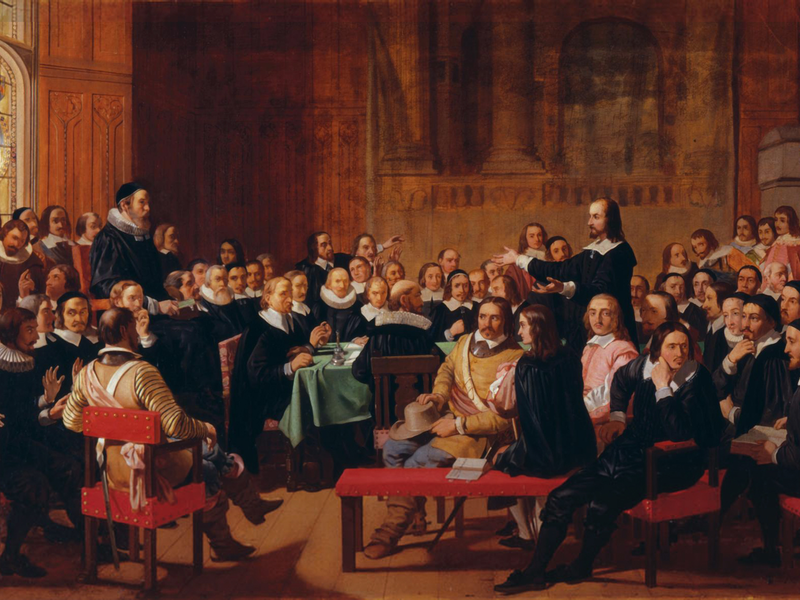
assertion_of_liberty_of_conscience_by_the_independents_of_the_westminster_assembly_of_divines_1644
Biblical Horizons

What is God?

Answer 4 of the Westminster Shorter Catechism is often taken as a magnificent answer to the question, "What is God?" It reads: "God is a Spirit, infinite, eternal, and unchangeable in his being, wisdom, power, holiness, justice, goodness, and truth." Presbyterians are fond of praising this statement, preaching on it,…

by James B. JordanFebruary 28, 1996
screenshot-2023-08-28-at-4-42-36-pm
Baptism

Like a Dove

The gospels tell us that at Jesus’ baptism, the Holy Spirit descended upon Him "in bodily form like a dove" (Luke 3:22 & parallels). Biblically sensitive commentators have associated this event with three Old Testament parallels: (1) the hovering of the Spirit over the creation in Genesis 1:2; (2) the…

by James B. JordanFebruary 28, 1996
tim-wildsmith-gzggi42wggm-unsplash
John

Jesus at Belshazzar’s Feast: Being an Explanatory Disquisition on an Aspect of the Story of the Woman Taken in Adultery

This they said to test him, that they might have some charge to bring against him. Jesus bent down and wrote with his finger on the ground. (John 8:6) The story of the woman taken in adultery (John 7:53-8:11) has been part of the canonical Christian Bible from its earliest…

by James B. JordanFebruary 28, 1996

Showing page 267 of 309

See all
See all

Articulated time

According to Pickstock, Augustine’s musical ontology is not a mere subordination of space to time, or a univocal “Dionysian flow”: “just as important as the priority of time, for Augustine, is the insistence on articulation into distinct musical units or phrases, the very move which allows a stress upon the simultaneity…

September 14, 2009

Creation ex nihilo

Nothing comes from nothing.  That seems obvious, and Christians have traditionally had some difficulty explaining why creatio ex nihilo is a defensible violation of that basic principle. According to Catherine Pickstock, Augustine viewed creation ex nihilo as the most rational position.  All around us, “things are continuously coming to be…

September 14, 2009
Politics

Secular

In responding to Milbank’s analysis of Augustine on the secular, RA Markus ( Christianity And the Secular (Blessed Pope John XXIII Lecture Series in Theology and Culture) ) borrows MJ Hollerich’s summary of Milbank that there is no “neutral public sphere in which people can act politically without reference to…

September 14, 2009
Art

Kantradictions

Jean-Marie Schaeffer ( Art of the Modern Age: Philosophy of Art from Kant to Heidegger (New French Thought Series) has a blast pointing out the contradictions in Kant’s aesthetics. Most of them arise from Kant’s insistence that the judgment of taste is founded on “the form of a finality” that…

September 12, 2009
Philosophy

Effects and Causes

Can effects double as causes? Kant, still working with some form of final causality, thinks so: There are cases when “the thing that for the moment is designated effect deserves none the less, if we take the series regressively, to be called the cause of the thing of which it…

September 12, 2009
Art

Gnostikant

Evidence that Hamann had Kant right: In explaining taste as a common sense, he notes that this common sense of beauty can be arrived at by a process of stripping off whatever belongs to our perception and prejudice. That is, we put “ourselves in the position of every one else,…

September 12, 2009

Showing page 1351 of 2212

Browse by Category

In Medias Res

Your weekly digest for all things Theopolis.

Donate

Theopolis is nearly 100% donor-supported. Consider joining us on our mission.