Theopolis Logo

Writing

Explore our collection of theological essays, biblical studies, and reflections on faith and culture.

See all
timothy-eberly-djj49s6ud2o-unsplash
Leviticus

Yahweh's War Against Death

Stories, frankly all human stories are practically always about one thing aren’t they? Death. The inevitability of death. . . . “There is no such thing as a natural death. Nothing that happens to man is ever natural, since his presence calls the whole world into question. All men must…

by Brian MarrApril 14, 2014

screenshot-2023-09-21-at-4-52-42-pm
Matthew

Inescapable Blood

Matthew is organized around 5 discourses, which trace out the history of Jesus as a recapitulation of the history of God and Israel in the Old Testament. Jesus first speaks as a new Moses, instructing His disciples on a mountain about a righteousness that surpasses the righteousness of the scribes…

by Peter LeithartApril 10, 2014
screen-shot-2022-05-12-at-12-07-23-pm
Angels

Did Angels Marry People? The Sin of Cultural Intermarriage

The fall of the Sethites in Genesis 6 is the third fall of mankind, or the third degree of Adam’s original fall. Adam sinned in a Garden against his Father by stealing something he was supposed to wait to obtain. (“Every tree shall be food for you” Genesis 1:29.) Cain…

by James B. JordanApril 7, 2014
sixteen-miles-out-al48tflf4e8-unsplash
Angels

Did Angels Marry People? The Sons of God in Genesis 6

The recent fantasy film Noah and a slightly related blog comment by my friend Douglas Wilson have stirred up again the question of whether the “sons of God” in Genesis 6 who married the “daughters of men” were fallen angels or the priestly line of Seth. Doug argues for angels,…

by James B. JordanApril 4, 2014
kiwihug-l4gw27xzn1i-unsplash
Angels

The Angels of Jude

The prophecy of Jude concerns apostasy. An illustration of apostasy and its consequences is found in verse 6, which the New American Standard Bible translates this way: "And angels who did not keep their own domain, but abandoned their proper abode, He has kept in eternal bonds under darkness for…

by James B. JordanApril 3, 2014
screenshot-2023-09-21-at-4-22-42-pm
Matthew

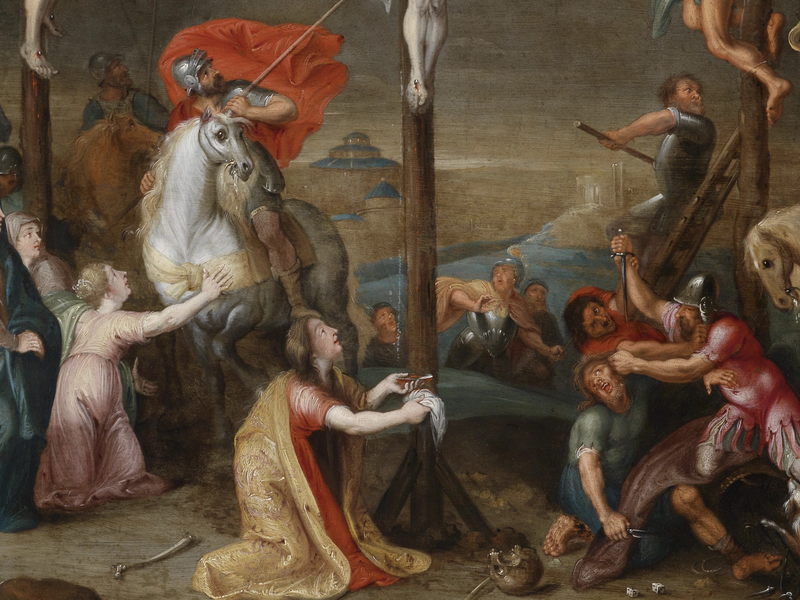
Women at the Cross

At His death, Jesus is surrounded by a Roman centurion and his cohort of Gentile solders. Matthew doesn't say that any disciples are there. But women are, and so is Joseph of Arimathea, identified as a “disciple” but, as John tells us, a “secret disciple for fear of the Jews,”…

by Peter LeithartMarch 31, 2014

Showing page 176 of 309

See all
See all
Philosophy

Non-universal Universality

Daniel Barber ( Modern Theology ) notes that “particularity cannot be reduced to universality. Therefore we have a philosophical reason for approaching Jesus through particularity: sufficient reason, when conceived as universality, is insufficient; causal frameworks cannot negotiate sufficiently with elements of chance and contingency; ‘universality’ cannot be thought of as…

May 6, 2009
History

American militarism

Andrew Bacevich ( The New American Militarism: How Americans Are Seduced by War ) writes, “Americans in our time have fallen prey to militarism, manifesting itself in a romanticized view of soldiers, a tendency to see military power as the truest measure of national greatness, and outsized expectations regarding the…

May 5, 2009
History

American empire

Howe, again, points out that the most obvious “imperial” project in US history is the one we take most for granted, the conquest of the American continent: “it is the internal expansion of the continental USA, across the intervening hundred years, which evokes the most direct parallels with empire-building elsewhere.…

May 5, 2009
History

A Cheer for the Habsburgs

Stephen Howe ( Empire: A Very Short Introduction ) admits that nationalists in the Austro-Hungarian empire “scorned it as the ‘prison-house of nations,” and that to the intellectuals of Vienna, the empire was “a senile absurdity.” Still, “the very existence of those nationalist, cultural, and intellectual movements, able to express…

May 5, 2009
Politics

Dangers of Anti-Constantinianism

Gerald Schlabach notes that critiques of Constantinianism pose temptations of various sorts, just as Constantinianism itself does. Insofar as such critiques posit a “fall” for the church, “they tend to be dysfunctional - not just for ecumenical debate, but also for ethical discernment within those churches that historically have defined…

May 4, 2009
History

Yoder and Augustine

Travis Kroeker ( Journal of Religious Ethics , 2005) argues that Yoder is closer to Augustine than his dismissal of Augustine as a “Constantinianism” implies: “Augustine’s theological corpus is nothing if not exegetical and historical, though, of course, it is also true that Augustine freely appropriates the ‘gold and silver…

May 4, 2009

Showing page 1384 of 2212

Browse by Category

In Medias Res

Your weekly digest for all things Theopolis.

Donate

Theopolis is nearly 100% donor-supported. Consider joining us on our mission.