Theopolis Logo

Writing

Explore our collection of theological essays, biblical studies, and reflections on faith and culture.

See all
e99a9541
Abortion

To Kill or Not to Kill

It seems to be old news, but I was unaware of it until recently. Australian academics argued that mothers should be allowed to terminate the life of a newborn child. [i] Why would they promote such an idea? Because before the child is born it is not always possible to…

by Ralph Allan SmithSeptember 12, 2019

pascal
Philosophy

Is the Betting Rigged in Pascal's Wager?

This is the second of two essays introducing Pascal’s Wager. Click HERE for Part 1. In “The Pop Star and the Mathematician” I gave an overview of the apologetic approach commonly called Pascal’s Wager. In that Wager, 17 th -century French mathematician Blaise Pascal argued that the choice between Christian…

by Alexander WhitakerSeptember 10, 2019
pascal
Philosophy

The Mathematician and the Pop Star: A Pascal's Wager Primer

This is the first of two essays aiming to introduce the reader to Pascal’s Wager. The second will address criticisms of the Wager. In the early 1990s, a perennially popular British pop star was interviewed on British television about his very public evangelical Christian faith. “What if,” the reporter asked…

by Alexander WhitakerSeptember 5, 2019
screen-shot-2019-09-03-at-7-00-44-am-2
Matthew

The Secret of the Middle of Matthew

Matthew 13 is about secrets. In this chapter, Jesus teaches eight parables and tells the disciples that they reveal the secrets of the kingdom (13:11). And much like Samson who both tells riddles and is himself a riddle that the reader must solve, so Jesus not only tells secrets but…

by John HigginsSeptember 3, 2019
david-with-goliaths-head-and-soldiers-crop
Biblical Theology

David, Goliath, and the Body of Moses, (Part 2)

Click HERE for part One. THE TEXT AS TABERNACLE Creation – Initiation – Genesis (1 Samuel 17:1-11) The gathered armies not only remind the reader of Ebal and Gerizim, but also of the very reason that Israel was established (Creation) , set apart from the other nations by the circumcision…

by Mike BullAugust 29, 2019
job
Job

The Man in the Middle

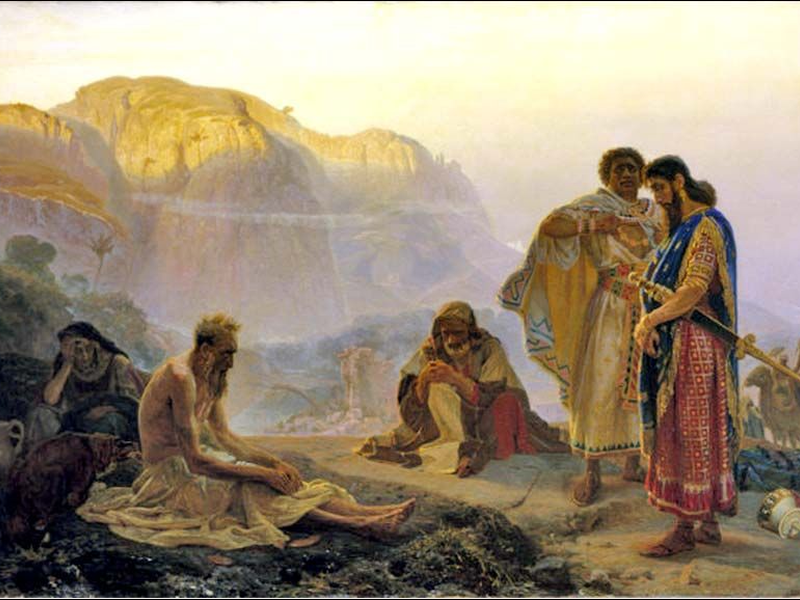
What to do with Job’s Final “Friend,” Elihu Elihu is a strange character, at least in the sense of how and where he appears in the book of Job. Why does he not appear with the other three “friends?” Does his argument differ from any of the first three who…

by Eric RobinsonAugust 27, 2019

Showing page 75 of 309

See all
See all
Politics

Liberalism, again

Jim Rogers of Texas A&M responds to my posts about liberalism, where I quoted a couple of passages from a recent essay by John Milbank. Rogers writes: “I do think that there is probably a liberal anthropology that can be criticized in a way similar to Milbank. But sometimes I…

October 13, 2008

Ville des expiations

When Jesus tells Peter to forgive “seventy times seven” times, He is only alluding to the climax of God’s dealings with Israel that Daniel prophesied; he is He is also is alluding to Lamech, who threatened to avenge himself “seventy-sevenfold” (Genesis 4:22-23). Lamech was the descendant of Cain. Cain was…

October 12, 2008

Seventy times seven

In the first year of Darius, Daniel was studying the book of Jeremiah’s prophecies when he came upon the prophecy that Israel would be released from captivity after 70 years. The 70th year of exile was coming, and so Daniel began fasting in sackcloth and ashes, and be began confessing…

October 12, 2008
Philosophy

Getting Hamann Wrong

Frederick Beiser’s ( Fate of Reason ) account of Hamann is a mess. He gets the history right (so far as I know it), but his summary of Hamann’s thought is not only mistaken; it’s incoherent. For Hamann, Beiser says, “faith is an immediate experience,” like sense experience, but on…

October 10, 2008
Uncategorized

Outsidelessness

Hamann does believe, as many postmoderns do, that we have no access to reality without language. But for Hamann this does not mean that we suffer “linguistic claustropobia,” or “outsidelessness.” Dickson again: “the fact that perceiving and understanding are inseparable from speaking is commonsensical; one no more need despair over…

October 10, 2008

Honoring the author

Hamann says that the historical-critical method of biblical interpretation does not, despite its apparent attention to the human author, really honor the author. This is because historical-critical interpretation is “castrated,” removing all passion and kerygmatic intention. Dickson writes, “The desires and kerygmatic intentions of the biblical authors are appreciated, and…

October 10, 2008

Showing page 1461 of 2212

Browse by Category

In Medias Res

Your weekly digest for all things Theopolis.

Donate

Theopolis is nearly 100% donor-supported. Consider joining us on our mission.