Theopolis Logo

Writing

Explore our collection of theological essays, biblical studies, and reflections on faith and culture.

See all
johann-siemens-epy0gbjzzzu-unsplash
Apologetics

A Sabbath Conversation: How Old is the Earth?

As Adam and Eve walked to the center of the Garden of Eden to meet with the LORD on their first Sabbath they conversed about the origin and age of the earth. Adam: You know, honey, we spent a lot of time yesterday making preparations for our house, and we…

by Jeff MeyersOctober 3, 1997

img_1043
Biblical Horizons

Psalms for Exile: The Narrative Progression in the Fifth Book of the Psalter

Some of our forefathers believed in reading/singing the psalms in order. Today, when the psalms are even used at all, they tend to be used randomly, though sometimes tied to a church calendar or to the pastor’s sermon. The Bible does not bind us to any particular practice, but there…

by James B. JordanSeptember 4, 1997
jordan-wozniak-xp_agmeea6s-unsplash-2
Biblical Chronology

The Anthropomorphic Days of C. John Collins, Part 2

Dr. Collins begins his essay with a brief statement of the Day Age view and then a brief statement of the Six Day view, focussing on the challenge to that view posed by modern "science." He ends this discussion by writing: "Two crucial points are at stake here: first, the…

by James B. JordanSeptember 4, 1997
john-salzarulo-wtjrpjzabcq-unsplash
Biblical Horizons

Paperweights and the Puzzles of Secularism

In his The Construction of Social Reality , Berkeley philosopher John Searle puzzles over the ontology of the products of human construction. Certain things – granite, platypi, weeping willows – occur naturally; while other realities – stone walls, zoos and parks, Chase Manhattan Bank – exist only as products of…

by Peter LeithartAugust 27, 1997
ales-krivec-4mibe6zg5r0-unsplash
Biblical Chronology

The Anthropomorphic Days of C. John Collins, Part 1

In the journal Presbyterion 20 (1994):109-130, published by Covenant Theological Seminary, Dr. C. John Collins sets forth a revision of the Day Age approach in his essay, "How Old Is the Earth? Anthropomorphic Days in Genesis 1:1–2:3." Dr. Collins’s essay has been widely accepted in evangelical Presbyterian circles as an…

by James B. JordanAugust 4, 1997
screenshot-2023-09-04-at-10-37-01-am
Biblical Horizons

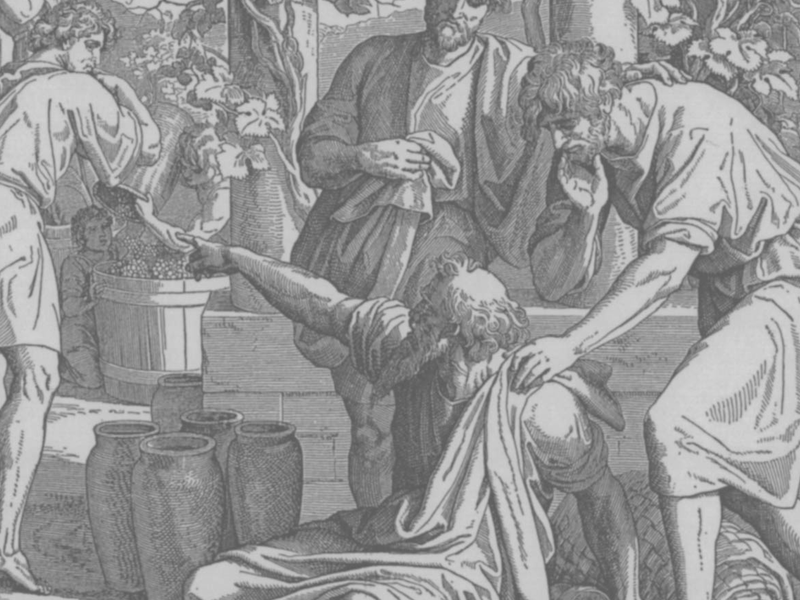
The Sin of Ham and the Curse of Canaan, Part 3 (An Exposition of Genesis 9:20-27)

The Righteousness of Shem and Japheth As noted above, the action of Shem and Japheth was purely symbolic. They did not need to cover Noah with a garment, for he was already covered by the tent. Their action was a symbolic affirmation of Noah’s authority, a symbolic rejection of Ham’s…

by James B. JordanAugust 4, 1997

Showing page 254 of 309

See all
See all
Philosophy

Hamann and Mendelssohn

I fell for it. Hamann begins a brief discussion of the temporality of truth apparently agreeing with Mendelssohn, “I, too, know of no eternal truths except those who are unceasingly temporal.” Stephen Dunning ( Tongues of Men ) explains the dense irony of the statement. Hamann is responding to Mendelssohn’s…

September 27, 2008
Uncategorized

Observation and prophecy

Hamann writes, “The spirit of observation and the spirit of prophecy are the wings of human genius. All that is present belongs to the domain of the former; all that is absent, the past and the future, belongs to the domain of the latter. Philosophical genius expresses its power through…

September 27, 2008
Uncategorized

Words and meanings

Hamann (“Metacritique”) says that “words as undetermined objects of empirical concepts are entitled critical appearances, specters, non-words or unwords, and become determinate objects for the understanding only through their institution and meaning in usage. This meaning and its determination arises, as everyone knows, from the combination of a word-sign, which…

September 27, 2008
Philosophy

Temporality of truth

Hamann agreed with Mendelssohn that there are “no eternal truths save as incessant temporality,” and in this he locates the difference between Judaism and Christianity: “it is solely a matter of temporal truths of history, which occurred once and never come again - of facts which have become true at…

September 27, 2008
History

Prophetic history

Hamann from “Golgotha and Sheblimini”: “the entire range of human events and the whole course of their vicissitudes would be encompassed and divided into subsections just as the starry firmament is divided into figures, without knowing the stars’ number. Hence the entire history of the Jewish people, by the allegory…

September 27, 2008

Multiplied curse

Before God tells creatures to “be fruitful and multiply,” He blesses them. Blessing is a verbal pronouncement that proliferates. But so is curse: “Your sorrows will be multiplied,” Yahweh tells Eve at the gate of the garden, and later wicked people multiply on the earth, long before the righteous do.

September 27, 2008

Showing page 1466 of 2212

Browse by Category

In Medias Res

Your weekly digest for all things Theopolis.

Donate

Theopolis is nearly 100% donor-supported. Consider joining us on our mission.