Theopolis Logo

Writing

Explore our collection of theological essays, biblical studies, and reflections on faith and culture.

See all
actionvance-t7el2ig3jmc-unsplash
Esther

Genesis 1 and Genesis 8

I mentioned last month ( BH 82) in my essay "Like a Dove" that Genesis 8 is a recapitulation of Genesis 1. Let me explicate that assertion here. Of course, the world after the Flood is a new creation, so we may expect a recapitulation of the first creation. It…

by James B. JordanMarch 28, 1996

ben-white-w8qqn1pmqh0-unsplash
Daniel

Esther: Historical & Chronological Comments (I)

The book of Esther is one of the most neglected of the books of the Bible. To be sure, sermons are preached on it, and commentaries have occasionally been written on it, but almost without exception Esther has been interpreted in isolation from the rest of Biblical history, chronology, and…

by James B. JordanMarch 28, 1996

actionvance-t7el2ig3jmc-unsplash
Biblical Horizons

A Letter on Geocentricity

Dear Mr. ______, . . . Here is how I look at the geocentricity question. Since I don’t recall what I wrote you before, I may be repeating some things. 1. The Bible does not teach it. Biblical passages used to support the idea are being misinterpreted. My original paper…

by James B. JordanMarch 28, 1996

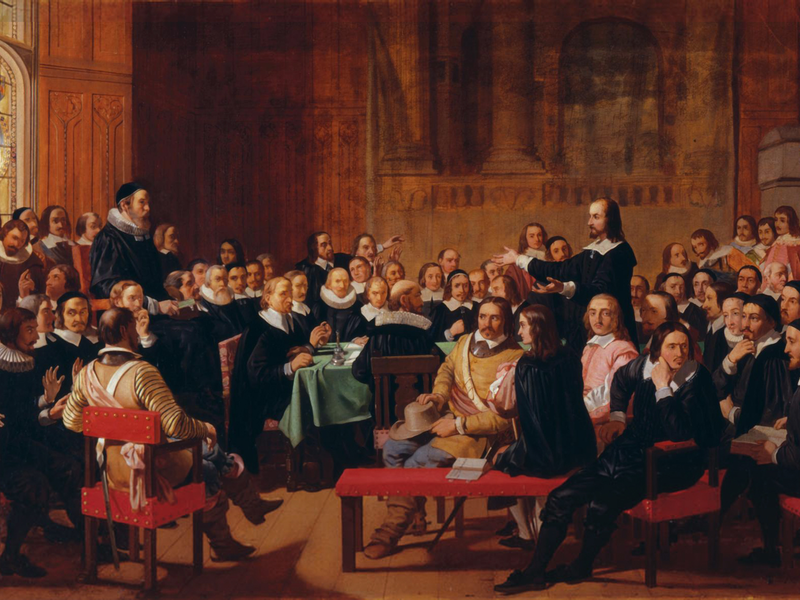
assertion_of_liberty_of_conscience_by_the_independents_of_the_westminster_assembly_of_divines_1644
Biblical Horizons

What is God?

Answer 4 of the Westminster Shorter Catechism is often taken as a magnificent answer to the question, "What is God?" It reads: "God is a Spirit, infinite, eternal, and unchangeable in his being, wisdom, power, holiness, justice, goodness, and truth." Presbyterians are fond of praising this statement, preaching on it,…

by James B. JordanFebruary 28, 1996
screenshot-2023-08-28-at-4-42-36-pm
Baptism

Like a Dove

The gospels tell us that at Jesus’ baptism, the Holy Spirit descended upon Him "in bodily form like a dove" (Luke 3:22 & parallels). Biblically sensitive commentators have associated this event with three Old Testament parallels: (1) the hovering of the Spirit over the creation in Genesis 1:2; (2) the…

by James B. JordanFebruary 28, 1996
tim-wildsmith-gzggi42wggm-unsplash
John

Jesus at Belshazzar’s Feast: Being an Explanatory Disquisition on an Aspect of the Story of the Woman Taken in Adultery

This they said to test him, that they might have some charge to bring against him. Jesus bent down and wrote with his finger on the ground. (John 8:6) The story of the woman taken in adultery (John 7:53-8:11) has been part of the canonical Christian Bible from its earliest…

by James B. JordanFebruary 28, 1996

Showing page 267 of 309

See all
See all

Feuerbach on the Trinity

Feuerbach wrote that the Trinity “is the secret of the necessity of the ‘thou’ for an ‘I’; it is the truth that no being - be it man, God, mind or ego - is for itself alone a true, perfect, and absolute being, that truth and perfection are only the…

July 12, 2008

Googled?

Nicholas Carr asks in the July/August issue of the Atlantic whether Google is making us stupid. He points out that the web tends to scatter attention and diffuse concentration by bringing information from various sources at us all at once. As the web comes to dominate our access to news…

July 12, 2008
Theology

Postmodern imagination

Garrett Green ( Theology, Hermeneutics, and Imagination ) thinks that Feuerbach serves up raw what the masters of suspicion - Marx, Nietzsche, and Freud - cooked and covered with sauces. The fundamental objection to religion in Feuerbach, and in his successors, is the notion that “religion is the produce of…

July 9, 2008
Philosophy

A-Time, B-Time

In his introduction, Ganssle provides a lucid description of McTaggert’s A and B series (or theories) of time: “The B-theory holds that the most important thing about locating events in time is their relation to other events. So something happens before, after or at the same time as something else.…

July 9, 2008
Theology

God and Time

I’ve just begun to look at Gregory Ganssle’s God and Time , but the index worries. In a book about time, there are no entries for “calendar” or “clock.” More worrying, there are only four dispersed references to the Trinity.

July 9, 2008

Direct, Indirect, and Trinity

Richard Swinburne describes God’s omnipresence in these terms: “God is supposed to be able to move any part of the universe directly; he does not need to use one part of the universe to make another part move. He can make any part move as a basic action . .…

July 9, 2008

Showing page 1494 of 2212

Browse by Category

In Medias Res

Your weekly digest for all things Theopolis.

Donate

Theopolis is nearly 100% donor-supported. Consider joining us on our mission.