Theopolis Logo

Writing

Explore our collection of theological essays, biblical studies, and reflections on faith and culture.

See all
timothy-eberly-djj49s6ud2o-unsplash
Leviticus

Yahweh's War Against Death

Stories, frankly all human stories are practically always about one thing aren’t they? Death. The inevitability of death. . . . “There is no such thing as a natural death. Nothing that happens to man is ever natural, since his presence calls the whole world into question. All men must…

by Brian MarrApril 14, 2014

screenshot-2023-09-21-at-4-52-42-pm
Matthew

Inescapable Blood

Matthew is organized around 5 discourses, which trace out the history of Jesus as a recapitulation of the history of God and Israel in the Old Testament. Jesus first speaks as a new Moses, instructing His disciples on a mountain about a righteousness that surpasses the righteousness of the scribes…

by Peter LeithartApril 10, 2014
screen-shot-2022-05-12-at-12-07-23-pm
Angels

Did Angels Marry People? The Sin of Cultural Intermarriage

The fall of the Sethites in Genesis 6 is the third fall of mankind, or the third degree of Adam’s original fall. Adam sinned in a Garden against his Father by stealing something he was supposed to wait to obtain. (“Every tree shall be food for you” Genesis 1:29.) Cain…

by James B. JordanApril 7, 2014
sixteen-miles-out-al48tflf4e8-unsplash
Angels

Did Angels Marry People? The Sons of God in Genesis 6

The recent fantasy film Noah and a slightly related blog comment by my friend Douglas Wilson have stirred up again the question of whether the “sons of God” in Genesis 6 who married the “daughters of men” were fallen angels or the priestly line of Seth. Doug argues for angels,…

by James B. JordanApril 4, 2014
kiwihug-l4gw27xzn1i-unsplash
Angels

The Angels of Jude

The prophecy of Jude concerns apostasy. An illustration of apostasy and its consequences is found in verse 6, which the New American Standard Bible translates this way: "And angels who did not keep their own domain, but abandoned their proper abode, He has kept in eternal bonds under darkness for…

by James B. JordanApril 3, 2014
screenshot-2023-09-21-at-4-22-42-pm
Matthew

Women at the Cross

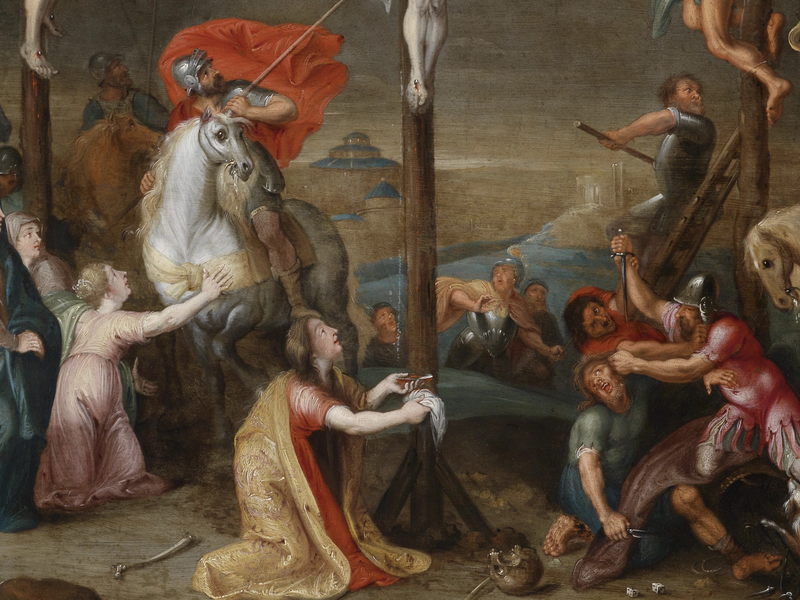
At His death, Jesus is surrounded by a Roman centurion and his cohort of Gentile solders. Matthew doesn't say that any disciples are there. But women are, and so is Joseph of Arimathea, identified as a “disciple” but, as John tells us, a “secret disciple for fear of the Jews,”…

by Peter LeithartMarch 31, 2014

Showing page 176 of 309

See all
See all
Philosophy

Idiocy

Desmond offers an intriguing argument for a unified self, for an “idiotic” self in the original sense of idiotes , what is one’s own. There is an irreducible “mineness” to all our actions and experience, a mineness that cannot be reduced to categories or analyzed in terms of outside forces:…

May 14, 2008
Philosophy

Ontological Metaphor

Desmond takes another enthralling step. If “seeing is” may be “seeing is,” then metaphor might reveal being. “Metaphor may be a revelation of reality. Metapherein - the thing carries itself across to revelation, metaphorizes itself; this is its spread beyond univocal identity. In its self-metaphorizing, it reaches out to more,…

May 14, 2008
Philosophy

Definiteness and dynamism

It might seem that saying things have determinate qualities undermines their dynamism, while emphasizing things dynamism of things fuzzies all the boundaries to the point where there are no things at all. Desmond, again, demurs. We cannot have a pure flux without any determinacy, because then “there would be no…

May 14, 2008
Philosophy

Diminished things

Modern thought is often materialist. Whatever happens to spirit in such an outlook, at least we’ve got things left. Right? Not so, argues William Desmond ( Being and the Between ) . The doctrine of primary and secondary qualities, he says, is a “classic bifurcation of thinghood into two extremes…

May 14, 2008
Philosophy

More on Identities

As I noted a few weeks ago, Nobel Laureate Amartya Sen points out that everyone has multiple identities, and that these identities slip into the foreground and background in different settings. At a family reunion, our family identity is prominent. At a political rally, family identity recedes as we join…

May 14, 2008

Limited historicism

In separating philosophy and theology, Spinoza mounts a kind of historicist critique of the Bible; its authors are bound by the assumptions of their time and culture. Besides that, the Bible and philosophy are completely different in method and style; the Bible is narrative, and its truth depends on the…

May 13, 2008

Showing page 1519 of 2212

Browse by Category

In Medias Res

Your weekly digest for all things Theopolis.

Donate

Theopolis is nearly 100% donor-supported. Consider joining us on our mission.