Theopolis Logo

Writing

Explore our collection of theological essays, biblical studies, and reflections on faith and culture.

See all
actionvance-t7el2ig3jmc-unsplash
Esther

Genesis 1 and Genesis 8

I mentioned last month ( BH 82) in my essay "Like a Dove" that Genesis 8 is a recapitulation of Genesis 1. Let me explicate that assertion here. Of course, the world after the Flood is a new creation, so we may expect a recapitulation of the first creation. It…

by James B. JordanMarch 28, 1996

ben-white-w8qqn1pmqh0-unsplash
Daniel

Esther: Historical & Chronological Comments (I)

The book of Esther is one of the most neglected of the books of the Bible. To be sure, sermons are preached on it, and commentaries have occasionally been written on it, but almost without exception Esther has been interpreted in isolation from the rest of Biblical history, chronology, and…

by James B. JordanMarch 28, 1996

actionvance-t7el2ig3jmc-unsplash
Biblical Horizons

A Letter on Geocentricity

Dear Mr. ______, . . . Here is how I look at the geocentricity question. Since I don’t recall what I wrote you before, I may be repeating some things. 1. The Bible does not teach it. Biblical passages used to support the idea are being misinterpreted. My original paper…

by James B. JordanMarch 28, 1996

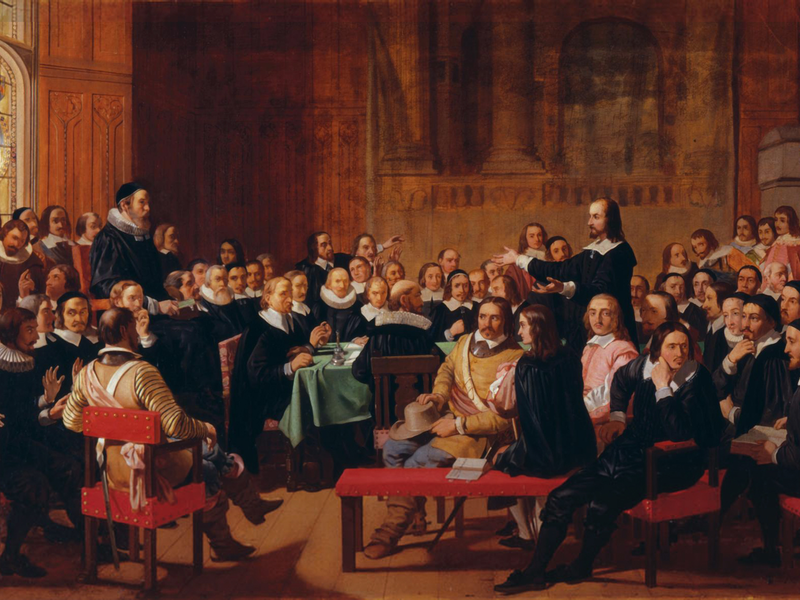
assertion_of_liberty_of_conscience_by_the_independents_of_the_westminster_assembly_of_divines_1644
Biblical Horizons

What is God?

Answer 4 of the Westminster Shorter Catechism is often taken as a magnificent answer to the question, "What is God?" It reads: "God is a Spirit, infinite, eternal, and unchangeable in his being, wisdom, power, holiness, justice, goodness, and truth." Presbyterians are fond of praising this statement, preaching on it,…

by James B. JordanFebruary 28, 1996
screenshot-2023-08-28-at-4-42-36-pm
Baptism

Like a Dove

The gospels tell us that at Jesus’ baptism, the Holy Spirit descended upon Him "in bodily form like a dove" (Luke 3:22 & parallels). Biblically sensitive commentators have associated this event with three Old Testament parallels: (1) the hovering of the Spirit over the creation in Genesis 1:2; (2) the…

by James B. JordanFebruary 28, 1996
tim-wildsmith-gzggi42wggm-unsplash
John

Jesus at Belshazzar’s Feast: Being an Explanatory Disquisition on an Aspect of the Story of the Woman Taken in Adultery

This they said to test him, that they might have some charge to bring against him. Jesus bent down and wrote with his finger on the ground. (John 8:6) The story of the woman taken in adultery (John 7:53-8:11) has been part of the canonical Christian Bible from its earliest…

by James B. JordanFebruary 28, 1996

Showing page 267 of 309

See all
See all

Root of David

Jesus is described twice in Revelation as the “root of David” (5:5; 22:16). “Son of David” or “Seed of David” makes sense; Jesus comes from the Davidic line. But Jesus is not only the fruit, but the root of the Davidic house. He is the original Anointed One before who…

May 3, 2008

Jesus and the Sea

In a 1984 JBL article, Elizabeth Struthers Malbon suggested that the boat in Mark’s gospel represents a “mediator” between sea and land, and pointed out that Jesus treats the sea as if it were land (walking on it, showing no concern for the unsteadiness of the waves, etc.). If we…

May 3, 2008

Proverbs 21

PROVERBS 21:20 The verse could be translated, more woodenly, as “Stores desired and oil in the habitation of the wise; but the foolish Adam swallows it.” The verse contrasts the conduct of the wise and of the foolish, and the basic contrast is between the wise man who has things…

May 2, 2008
History

Priestcraft

Well, a bit of looking pays off. One Justin Champion has written a study of priestcraft in early Enlightenment England, The Pillars of Priestcraft Shaken (Cambridge 1992), which is available in its entirety online at: http://www.newtonproject.sussex.ac.uk/catalogue/viewcat.php?id=OTHE00029. Chapter 5 begins with a paragraph that links the attacks on priestcraft with the…

May 1, 2008
History

Priestcraft

Writing of Spinoza, Jonathan Israel ( Radical Enlightenment ) notes that Spinoza outlines “the concept of priestcraft as a system of organized imposture and deception, rooted in credulousness and superstitution, which loomed so large in the subsequent history of the Enlightenment and was to receive massive amplification in the books…

May 1, 2008
History

New atheism

Not of the Hitchens-Dawkins-Harris variety, but of the seventeenth century variety. The four figures most often attacked for formulating a thoroughgoing atheistic perspective were Spinoza (for his biblical work as well as his metaphysics), Hobbes, La Peyrere (author of Pre-Adamites ), and Lodewijk Meyer (author of Philosophia Scripturae Interpres ).…

May 1, 2008

Showing page 1523 of 2212

Browse by Category

In Medias Res

Your weekly digest for all things Theopolis.

Donate

Theopolis is nearly 100% donor-supported. Consider joining us on our mission.